I had an early smartphone, the Sony Ericsson P800, and it was a full screen and the home page was a grid of app icons. The iPhone design was extremely well done in comparison but hardly some radical unknown thing. The real design innovation was the capacitive touch screen
>It tends to bring this pointless debate to a quick end.
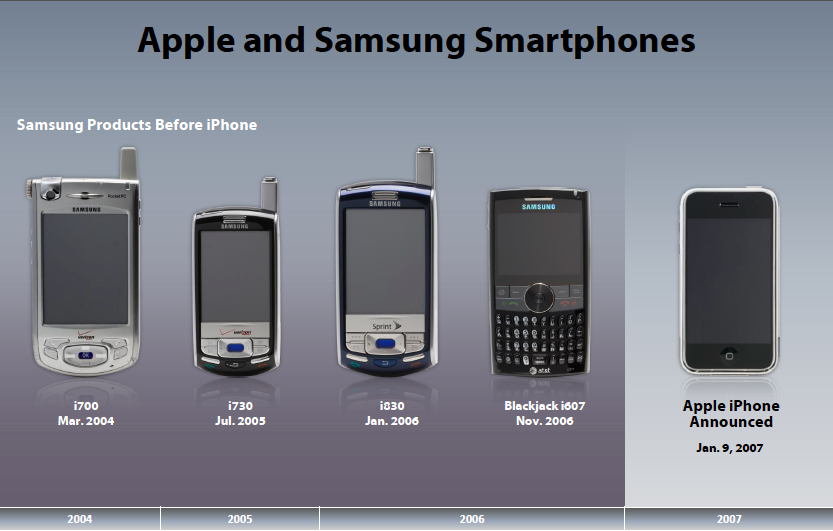
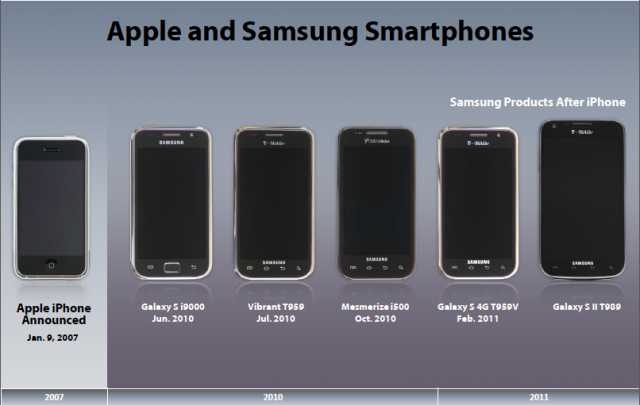
Not really.. all the before photos are for keypad phones. All the after photos are for touchscreen phones. I would argue that if you are going to design a pure touchscreen phone, you are likely to end up with an 'iPhone-like' design. Case in point is the LG Prada which was unveiled before the iPhone.
While what you're saying holds a bit longer term, those images seem cherry-picked, maybe there's another one missing?
I'm saying that because if you look at the years, the first one goes:
2004 - 2005 - 2006 - iPhone (2007)
And the second one goes:
iPhone (2007) - 2010 - 2011
If they want to prove the point they should not be disingenuous and show some Samsung phones from 2008 and 2009. I doubt that Samsung transitioned from the old design to the new one instantly in 2007, via their magic iPhone cloning machine.
Also, the iPhone was more of a forcing function than anything. If you look at a longer term evolution, screens were getting bigger and bigger and the keyboard smaller and smaller. The iPhone shaved 5-10 years from that evolution by shaming complacent phone producers into moving forward at a decent pace.
Parent is referring to the fact that the phone was a full screen and had a grid of icons (reminiscent of Palm) on it like the iPhone did: https://i.imgur.com/Fdk0566.jpg
Parent post didn't say the phones looked the same. The iPhone refined a lot of existing functionality.
People making this argument seem to be under the incorrect belief that Apple patented a grid of icons. They did not. They patented a specific aesthetic and functional design that incorporates a grid of icons, but is much more specific than only that.