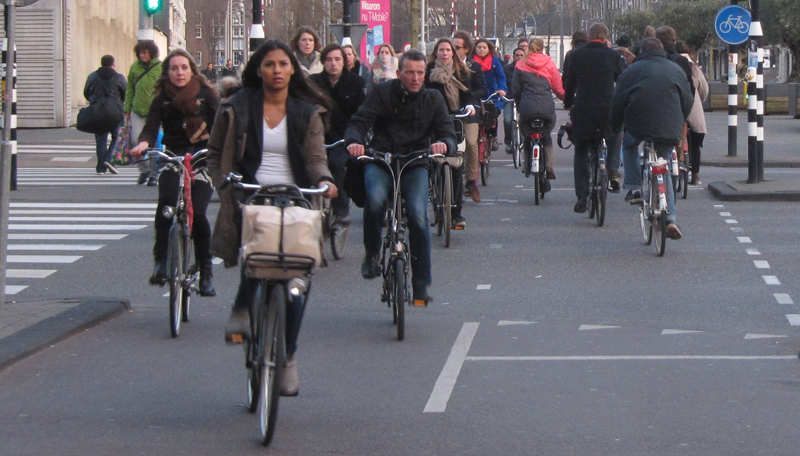
It seems like a bit of class warfare on the part of the Koch's. Without public transportation people in lower income areas can't get to better jobs, healthcare or schools. People in these areas also don't have access healthy food because grocery stores won't open in areas where the majority of customers use food stamps and government aid. Yes current modes of transportation are becoming out dated the newer modes like self driving cars are not ready for the mass public. What the Koch's fail to grasp is that the more people making a living wage we have means we have less people living off entitlements like food stamps. If we have more people paying taxes instead of living off the taxes of other we will see improvements for all and possibly lower taxes due to a surplus not a deficit. Sorry for the soapbox.
It's getting pretty intense, too. Michigan and Ohio are both passing rules to limit Medicaid eligibility in counties with low unemployment rates.
In both states, those high employment counties are counties with big suburban job clusters and big cities with high unemployment. Now, those city residents will be denied Medicaid because they live "near" lots of jobs which they cannot reach without public transit, which Michigan and Ohio are strangling.
> It seems like a bit of class warfare on the part of the Koch's.
You can get richer by increasing your wealth or by decreasing everybody else's wealth. People that think that life is a zero-sum game think that both are the same thing.
People with a growth mindset care more about wellbeing over relative richness. Sometimes the best way for me to have more is for everybody else to also have more. And others happiness and wellbeing is part of my own.
This is a real quote but, without context, gives an unfair impression about Buffet: he said that while supporting bigger taxation.
He also said something in the lines that "he was paying a lower tax rate than his secretary". That sounds crazy to me, but I'm not going to discuss about finances with Warren Buffet.
Probably because it's not true. Of course, it all depends also on definition of "tax rate" - are you talking about federal income tax? All taxes combined? Marginal tax rate? Effective tax rate? Single-year or averaged over a period of time? Do you include corporate taxes (which are paid by corporation, but effectively reduce the wealth of corporate owner or shareholder)? Until you define all those, this slogan is meaningless.
> I'm not going to discuss about finances with Warren Buffet.
He wasn't discussing finance, he was propagandizing. These are completely different games with completely different rules. In finance, numbers and facts matter - if you lie in a financial report, you risk heavy fines or jail, and probably will lose confidence of your business partners. If you lie in propaganda, as long as the lie is believable, well packaged and matches the prejudices of your target audience, you win.
Please help me understand how the context of him arguing for a tax increase changes the meaning of the quote. How does the quote (independent of context) give an unfair impression of Buffett?
Not surprising is it. Nevermind their political or philosophical viewpoint, when was the last time a Koch brother or family member took or relied on public transportation?
Some commenters questioning the benefit of public transit infrastructure in an age of self-driving electric vehicles have perhaps never lived in a city with good public transit. Road traffic in Victorian London was on average faster than it is now, but investing in underground tunnels for trains was still deemed necessary (even profitable). Likewise, buses massively reduce the road footprint per passenger, not to mention the increased energy efficiency, regardless of whether it renewable or not.
And finally, end-to-end transport offered by personal vehicles or taxis has been disastrous for public health. The difference between walking to your driveway or curbside versus a five minute walk to a bus stop or ten minute walk to a train station everyday would be enormous aggregated across an entire population. It would be a great missed opportunity if the idea of being able to summon a driverless electric car (we still have no idea how this technology will really pan out, whereas buses and trains have been around for over a century) kills public transit as an alternative to single-occupancy vehicles before it's even off the ground.
> commenters questioning the benefit of public transit infrastructure in an age of self-driving electric vehicles
Such commenters would also not be living in reality. A few self-driving vehicles deployed as research projects in select areas hardly defines an “age”. We’re just at the start of the path, and until there are millions of these things roaming the streets, they will have no impact on society. People need to get to work today, not in some near future that is still defined in years.
I think there's an interesting take on this - we are on the verge of a huge technological shift with the advent of self-driving cars. Should we hold off on massive transit projects where they don't already exist that is the community doesn't already have a subway and wait to see how self-driving cars pan out?
It's like investing in traditional cargo ships right as containerization started happening. Or investing in horse related infrastructure when the automotive was first being released.
This seems relatively sensible to me. Address near term issues - small fixes. And not fund huge projects that may become obsolete before they're finished.
I guess the question is -- how quickly will self driving cars be deployed, and how will they effect the areas. Will self driving cars completely replace buses?
No they won't, for the same reason that cities without public transport or minimal public transport have horrible traffic: the sheer density of people a bus, tram or light rail line can move far exceeds private vehicles with one or two people in them.
Higher speed actually translates into less throughput. Cars take up more than just their physical space; there is also a gap that is needed to stop safely in time--and this gap grows according to the square of velocity.
(You can argue that people don't usually leave sufficient space to stop, but I will point out that self-driving cars, which prompted this discussion, are going to be following those basic safety rules)
If autonomous vehicles arrive in the form that most people imagine, there will be a surge of traffic like you've never seen. Make something cheaper/easier and you get more of it. Furthermore, unless cities actually ban cars driving around without a passenger (which seems entirely possible), you'll have vast numbers of cars circling the block or heading out to the suburbs to park which their owners do their thing.
No one is yet sure whether traffic will increase or decrease.
As you describe, people may buy self driving cars and use the self-driving feature to drive them more often. Wealthy folks and people in rural areas are almost certain to take this route.
Others predict that people won't buy cars at all and will instead rent them from ride services, who in turn may promote ride sharing on an unprecedented scale. Poor folks, for whom a car is a major expense, are almost certain to take this route, as well as city dwellers.
Personally, I think we may see traffic increase in some areas and substantially decrease in others. I suspect the largest source of traffic -- the commute -- will shrink considerably as networks of reasonably dense self-driving vanpools and small busses pop up.
You have five or six revolutions happening all at once. Self-driving isnt going to revolutionize car ownership. People own cars for irrational reasons (fashion etc). Nor will self-drive suddenly make carpooling cool.
>> reasonably dense self-driving vanpools and small busses pop up.
Alternatives probably will decrease ownership at the margins. For example, I know a couple in SF who don't own a car and that wouldn't have been nearly as practical before Zipcar and Uber.
However, it's not like paying a driver $100/day to drive a minibus around to pick people up and drop them off is likely the reason that isn't a widespread service today. So someone would need to explain to me why self-driving changes that equation.
And to carry a car seat for the toddler, and a bike rack, and a change of clothes for the gym, and a bumper sticker saying "26.2" to say you've done a marathon, and some tools because after the gym you're going to fix your parents' sink, and a bag of sand because the roads have iced up where they live.
Quite rational reasons for why a driverless taxi won't work.
And some of us have very practical reasons not to ever rely on others for transport. I'm in the military. I'm expected to be able to get to work no matter what. We are in a tsunami area. Should that happen and my unit be stood up to respond, I need a vehicle that will get me to work even when the power/cell towers are all out. My CO doesn't want to hear that I cannot get in because the Uber app on my phone is down. Without private vehicle ownership we would all have to live on our bases.
Those are funny things to get upset over. Most of those don't sound irrational if you have the need, but I don't have any of those. I never knew what that "26.2" bumper sticker meant. I do have a CUV for the winter snow and ice though. Also, I don't think taxis, let along driverless ones, service my area which is out in the country (rural) even though it's only 30 minutes from downtown.
"upset"? I don't understand how that's relevant to this thread.
sandworm101 mentioned "People own cars for irrational reasons". I wanted to add some rational reasons for owning a car, beyond what RightMillennial wrote.
Many people don't have a car and don't need a car. The point is that there are reasons for owning a car beyond 'irrational' things like fashion and coolness.
Maybe. I'd have to ask why we don't see more of this today. If you're looking at services transporting multiple passengers in a car or even minibus, self-driving isn't as important because the driver cost is amortized across multiple passengers.
That said, I agree that habits can change. Car-pooling was probably more common at one point than it is now. On the other hand, a lot of people seem to favor Uber because they don't want to deal with public transit even when it's available.
I think we do see a lot of this today: Uber and Lyft already have incorporated ride sharing and I use that option every time -- when I'm in a city I frequently have another rider or two. I'm curious to see how this will increase as ride sharing density grows.
I think people avoid public transit because it is necessarily slow due to the multiple stops. They may also avoid it because it is too accessible. Sharing a vehicle with other commuting professionals is a vastly different experience than what you'll find on most public transit.
Because right now, this class of service is broken up in ad-hoc service companies, none of which have been incentivized to become a regional rental pool.
Consolidate taxi/minibus/event bus/medical&elderly ride/mass transit into a pool of vehicles available 24/7 with resources for surge times/maintenance/cleaning etc, and this will become the norm easily enough.
Then it's just a question of who operates and at what cost?
A couple of things to take into consideration with the autotaxis. We have the potential for a hybridization of taxi-bus.
Dynamic routes based on individual demand, grouping together a small number of people into a quick access people carrier. E.g I want to go right across town, you have a shorter journey that roughly overlaps my route, the vehicle will deviate slightly to pick you up.
The second thing to consider is the opportunity for mass-transit level control of autotaxi fleets (or all cars in a glorious future where everything is awesome(tm)). Optimsing the merging and cross traffic flows beyond what traffic lights do today.
They're far enough away that it doesn't make sense to put off purchasing normal buses (which could probably be retrofitted with self-driving tech anyway). And certainly that doesn't obviate the value of things like planning and beginning to carry people on routes; setting up stops (signs or shelters); and setting up bus lanes.
And rail transit is a whole other beast. Do you know how much higher a volume of people can be carried by a subway than by even the most efficient bus route running buses bumper-to-bumper (let alone private vehicles)? (The unwillingness of politicians to acknowledge this is one of the reasons the L train shutdown in Brooklyn next year is going to be such a shit show.)
Cost and flexibility. Buses are cheaper and more responsive to changing traffic patterns than trains. They are not as nice though.
If for instance people in a given community want to start traveling to a different part of a city they either have to create new rail routes or people have to take long inconvenient trips.
Ha! Apparently you haven't used Northern in the UK. Nice! (chuckle)
I don't think it's really about nicety, but about capacity.
A subway train can carry up to 1'000 passengers, depending on length and construction. You can have frequencies of a train every 90 seconds (example: line C in Prague, during rush hour). So you can transport up to 40'000 people per hour in each direction.
Buses, while certainly much better than private vehicles, can never match that capacity. Alas, they're much cheaper and certainly more flexible.
> Buses are cheaper and more responsive to changing traffic patterns than trains
True, but not very useful. The #1 Bus line in Boston takes a route that a trolley once took. And before that it was a horse drawn railcar. And before that it was a 10 seat omnibus carriage route. Same route for a mighty long time.
The flip side is that they’re on the same roads as cars, which means exposed to the same congestion. And to the degree they get some people out of cars, they get other people into them.
For better or worse, trains have fixed routes and aren't very dynamic. I actually find it a bit surprising we don't see more of a formalized mini-bus system in the US given that it was pretty popular in some other countries even before GPS and apps. I guess UberPool serves a somewhat similar purpose.
Perhaps there's not a lot of overlap between people who take Uber a lot and people who willingly step into a bus of any kind.
An army of self driving cars doesn’t get you the density of a train when space is already at a premium, which is the case in many urban centers. Even the source acknowledges this; they just downplay how many centers it’s true for.
It’s an interesting case of doublethink to suggest that the programs are unwelcome but also lead to gentrification. Apparently a lot of people do like transit :)
Even with self driving cars, they cannot move any where near the quantity of people in a given space that a train can. It's not going to be a solution for dense cities.
Besides, if we are just on the cusp of having self-driving cars we should be able to deploy self-driving trains right now and reap all the benefits of autonomous transport immediately.
> Besides, if we are just on the cusp of having self-driving cars we should be able to deploy self-driving trains right now and reap all the benefits of autonomous transport immediately.
We are. In London the DLR is the most obvious driverless network, but various parts of the Tube have been essentially driverless since the 1980s (initially on the Victoria Line, then on the Central after its resignalling, and on the Jubilee extension).
As excited as I am for robotaxis, nothing beats the raw people moving capacity of trains. The places where robotaxis offer the greatest benefit is in providing first and last mile services getting people to the train station and back in sprawling suburban areas where adequate transit service isn't feasible.
You'd need to have some very smart, and tough public policy in place, though, to constrain robotaxis to instances where they provide maximal societal benefit. It will more likely be a free for all that makes traffic worse, not better, because that's just the way these things tend to go.
As much as I want self driving technology to help ease the pains of public transit in major cities, I have a feeling were quite a bit further from that than we are being told.
Public transit also helps out those who cannot afford alternative forms on transit. I don't see self-driving tech replacing transportation for low-income people, unless we move away from personal vehicle ownership.
Why should they replace buses? What about self driving buses?
What about an automated subway? It's just a box on a track, with the state of all the trains in the track known, self driving would almost be overkill for subways/trams/trains.
It's still public transport. There's no need to hold off the development on both ends.
Aside from the density issue which others mention, self driving cars are un-proven technology. I get that a lot of smart people are working on them, but it's one thing to test a fleet of even a few hundred cars, but another entirely to have cities with thousands or hundreds of thousands of self driving cars. This is going to take longer to roll out and have the kinks sorted than you think.
A self driving car takes up as much space as a normal car. People tend to know how much the new lightrail is going to cost but don't know how much it costs to turn a two lane road into a three lane road, or the general costs of the automobile infrastructure. When I went digging around I found each traffic light pole unit cost $150k, so a normal intersection is $600k
Economically, not everyone can afford self-driving cars. In the near future, they appear to be luxury items.
Trains move more people more efficiently and cheaply. That should remain the case even as driverless cars become popular, at least for another generation - maybe two.
Didn't the head of Waymo say we are still 30 years away from generally available autonomous cars.
I think it would be a shame to put off important projects on the basis of something that may never happen. I'm sure it would keep the Koch brothers happy though.
"Vaporware is often announced months or years before its purported release, with few details about its development being released. Developers have been accused of intentionally promoting vaporware to keep customers from switching to competing products that offer more features."
I think your analogy how but you have what's the container so and what's the cargo shop mixed. Self driving cars will allow us to increase car densities and certainly lot road deaths but they will never be as efficient in transporting large numbers of people. It's just a matter of space. You can fit just so many more people in the space. This tweet's gif shows this pretty well https://twitter.com/adamjcs/status/529431691534667777?s=21. It's a bandwidth problem.
I'd argue that efficiency in a transport network has to be measured in how many other people and facilities it puts into people's realistic reach. It's a bandwidth problem only up to a point. Streets aren't all constantly clogged.
If you got rid of all powered transport there would be plenty of unused capacity. But many trips would no longer be feasible. Adding public transport helps enormously, but only along popular routes. Self driving cars may not have the density (though, if used exclusively, they could well be an order of magnitude more dense than ordinary cars) but they have the ability to take the most efficient route, and take you there comfortably with significant luggage. That makes trips possible that public transport can't serve.
I'd wager you will continue to see a mix of transportation modes at first, then a proliferation of non-vehicular transport for shorter/medium range trips, with greatest acceleration of change occurring in the highest person-density areas like NYC, LA, Chicago, and other big cities with their eyes on ending the scourges of public parking, local emissions, traffic accidents, and just generally the unsightliness of a car-centric world.
While the ride-hailing self-driving cars will be a great boon to those not wanting to drive, saving parking and potentially preventing accidents, I do believe SDC's will come in waves starting from the SW USA and California before spreading to the rest of the country/world. In these areas, public transit will likely be less useful, since for instance in Tucson, AZ, the city is massively spread out and busses would simply incur a much greater time-cost due to their non-personalized route.
Moving forward, as SDC's become more % of the fleet in urban/suburban areas (still won't be in rural areas for another 5-10 years or more), you will probably see more variety of SDC's. Instead of having a 50 person bus, you can have a 5-7 person SD shuttle/minivan (think Waymo Chrsyler Pacifica) that will take 5 people with similar routes to the same place.
Once SDC is highly penetrant in terms of %, I'd expect a great prolfieration of electric scooters, electric pedal-assist bikes, regular bikes, pedestrians, and all sorts of non-vehicular transport. I myself would ride a bike to work if not for the very low-skill drivers I encounter daily in my commute. This happens to be in an urban area with very poor bike infrastructure and very large hills. SDCs + electric bikes would solve these two issues, IMO, and they are probably ~10-15 years out in my location.
I actually think self driving technology will be most cost effective in rural areas - you can't run bus routes because there is no common traffic patterns and the there isn't enough demand. However, self driving on demand transit will be able to pick people up and take them where they need to go. You may have to wail till a vehicle is free, but that's better than super infrequent bus routes and messy connections.
Driverless has some benefits, but mind that the driver has a secondary purpose besides steering the vehicle: He is a security contact and brings saftey in different situations. Safety for women travelling at night, safety in case of an accident to handle evacuation etc., safety in case of obstacles on the road, ... automated systems can assist quite a lot, but won't handle all.
Self-driving cars may help with traffic, but not with pollution or environmental issues. New mass transit projects should try to take advantage of newer tech, but self driving vehicles and mass transit solve different problems, so I see no reason not to pursue both.
Indeed. It's a way to funnel money around. Companies doing self driving cars will get it 90% there, then struggle with the last 10% and eventually funding will dry up as investors lose interest and move on to something with faster returns.
That’s especially true when rich ideologues attempt to defund or block every project that comes along. In Seattle’s case for ST1, at least half of the problem was that every plan was litigated to near-death by opponents whose only goal was to cynically create delay.
Couple this with idiotic fantasy projects (like monorails that go nowhere - the self-driving car of the mid-aughts!), and you have a self-fulfilling prophecy.
European here, living happily without a driver's license.
Could someone please explain the gentrification argument? How is public transport supposed to make it worse?
Assuming gentrification occurs when one area is much more desirable to be in than others, then with good public transport it can be reached more easily. People can live outside the center (or the nice district) and still get a good experience, work or spend time there. The desirable area expands. It seems to me that if anything, this should work against gentrification.
Also, living in cities means giving up some freedom. We share it, we have to make some kinds of compromise: keep the noise down, take up less space for our private use and use the public more (like parks instead of own gardens). In my opinion this also means limiting the use of cars, so that city centers don't have to accommodate wide roads and parking space and could become more walkable and generally pleasant. I appreciate that most major European cities seem to develop in that direction.
Want freedom - go live away from people, no one will restrict you then.
"The nice area expands" - basically what gentrification is.
If public transit opens up travel options for poorer (usually minority) areas, young white people who can't afford to live in the city will start moving there, bringing their yoga studios and brunch cafes and actual grocery-stores-that-arent-just-an-isle-of-canned-food-in-liquor-stores.
What’s the story here? Seems like Koch Bros are against raising taxes. They aren’t “killing” anything.
Let’s assume the tax raise will only go to public transport. Let’s assume for now it’s a good plan and actually wanted by the public. The issue isn’t the previous assumptions but the fact that taxes will not be lowered afterwards.
So even after completion of the project, the tax that was put in place to raise revenues to fund the project will still remain in the books. That’s the insidious nature of government. Once it has it it will not let go.
> One of the mainstay companies of Koch Industries, the Kochs’ conglomerate, is a major producer of gasoline and asphalt, and also makes seatbelts, tires and other automotive parts. Even as Americans for Prosperity opposes public investment in transit, it supports spending tax money on highways and roads.
Also: stuff requires upkeep, consider the current state of the woefully unfunded NYC subway. You can’t just build it and expect it to stay in perfect condition forever.
> consider the current state of the woefully unfunded NYC subway
Everything I've read about the NYC Subway system indicates that it's funded more than adequately, but due to mismanagement, corruption, and cronyism, the funds walk out the door in the pockets of ghost workers.
Assuming the system wasn't awash with grift, is there evidence to suggest that NYC doesn't actually fund it adequately? NYC residents pay well above the national rate in taxes, and presumably those taxes are intended to fund transit. If the money taxed isn't being used to actually maintain the infrastructure, I think it supports OP's argument that the taxes haven't abated but the services being offered for them have.
Without getting into the ideological debate of whether publicly funded projects are good or bad, I think it's fair to assume that most people expect that when taxes are raised to fund transit, that the taxes raised will be used for transit, not to line the pockets of the friends and cohorts of who raised the taxes.
I don't think I've read the same things as you. Do you have sources for the cronyism and ghost workers?
Also, the tax levels in NYC don't necessarily relate to the levels of subway support (e.g., NY state contributes to the NYC subway).
> I think it's fair to assume that most people expect that when taxes are raised to fund transit, that the taxes raised will be used for transit, not to line the pockets of the friends and cohorts of who raised the taxes.
This is a straw man argument - the implication here is that the NYC subway's sole financial problem is corruption. Is that actually true?
> the implication here is that the NYC subway's sole financial problem is corruption. Is that actually true?
So, that isn't the assertion. The argument that taxes are raised for a project, then being diverted to general funds is a separate issue from the one of corruption, and speak more directly to OP's argument that "taxes don't go down", to which the rebuttal from GP was "Well, taxes shouldn't go down, because maintenance is a thing". If the taxes don't go down, and also aren't being used for the purpose they were raised, you have sort of a shell game.
That said, on the matter of corruption, here are a few quotes from the first source I linked:
    > The estimated cost of the Long Island Rail Road project, known as
    > “East Side Access,” has ballooned to $12 billion, or nearly $3.5
    > billion for each new mile of track — seven times the average elsewhere
    > in the world. The recently completed Second Avenue subway on
    > Manhattan’s Upper East Side and the 2015 extension of the No. 7 line
    > to Hudson Yards also cost far above average, at $2.5 billion and $1.5
    > billion per mile, respectively.

    > The spending has taken place even as the M.T.A. has cut back on core
    > subway maintenance because, as The New York Times has documented,
    > generations of politicians have diverted money from the transit
    > authority and saddled it with debt.
I remember glancing at that NYT article. It's hard to prove these things, but they only peripherally imply the idea of 'ghost workers'.
I agree that it sounds like social connections are leading to small numbers of contractors, but the takeaway I saw is the lack of political will to manage contracting - these so-called 'soft' costs were on the order of 1/3 of the overall costs.
I didn't pick up on the duration of taxes argument - I see your point there.
That doesn't prove all of the allegations from the earlier articles, for sure, but does confirm that the story wasn't made up from whole cloth.
> “Lokhandwala concealed his receipt of the bribe payments by having the contractors issue checks to shell bank accounts he controlled,” the DOJ said. “In exchange for the bribes, Lokhandwala promised to steer future work to the contractors and to expedite bureaucratic paperwork for their benefit. Lokhandwala threatened to bar the contractors from future projects if they did not continue to pay him.”
In addition, a large chunk of NYC's taxes (blue districts) wind up going to Albany and then redistributed upstate where tax revenue is lower (red districts) for things like highways and services.
You could use that argument to defund any infrastructure you wanted, existing or proposed.
In the long run, not funding infrastructure has the same effect as killing it.
Once a sizeable populist group decides that taxes are theft, it will frame every policy decision we make, until we destroy our once-great institutions.
There was a time when the USA dreamed big, believed in itself and invested in itself. We had a growth mindset.
We have all been told to "look out for number one." They say that our government is corrupt and incompetent. They say we should drown it in a bathtub like an unwanted kitten.
Some A+ fear mongering out there in the austerity universe.
They're not against raising taxes. They're for using taxpayer money to support their industries (see: roads, highways, cars, trucks, etc) but against using taxpayer money for things that might cause their industries to make less money (see: public transit).
They massively fund political campaigns with the intent of pushing the policies they want. They're fairly successful at it. It's perfectly reasonable to say that they're "killing" things they're pushing against.
Fake tax reductions. It reduced taxes temporarily for some low and middle income folks. Increased them permanently for many middle income folks due to double taxation (state income taxes paid are purposely no longer tax deductible on federal income taxes specifically to hurt blue states). And permanently lowered them for very high income folks.
That project would have kicked their sales tax to 10.25%, highest in the country, and like every major public project they’d go far over their 5.4b budget.
The link to Koch brothers is a bit tenuous, it was the voters who killed this project, once they knew the costs.
The article paints their motivation as naked self-serving hypocrisy:
> One of the mainstay companies of Koch Industries, the Kochs’ conglomerate, is a major producer of gasoline and asphalt, and also makes seatbelts, tires and other automotive parts. Even as Americans for Prosperity opposes public investment in transit, it supports spending tax money on highways and roads.
> Americans for Prosperity counters that public transit plans waste taxpayer money on unpopular, outdated technology like trains and buses just as the world is moving toward cleaner, driverless vehicles.
> Most American cities do not have the population density to support mass transit, the group says. It also asserts that transit brings unwanted gentrification to some areas, while failing to reach others altogether.
> Public transit, Americans for Prosperity says, goes against the liberties that Americans hold dear. “If someone has the freedom to go where they want, do what they want,” Ms. Venable said, “they’re not going to choose public transit.”
Public transport is against freedom? I got to say, that is creative.
Gentrification as an effect happens when an area becomes more desirable to live in. That means here that people place a positive value on public transport.
To deny an area the benefit of public transport based on some weird altruistic and paternalistic motive doesn't really seem credible.
It's really tail wagging the dog too. To say we should just keep areas shitty or undesirable to avoid gentrification seems totally backwards.
Welcome to the world of political rhetoric. If something is likely to trigger the desired emotional answer by matching a number of keywords, it's an acceptable device; the literal meaning is secondary at best, and ignored in many cases.
It works the other way too - people see right wingers attack public transport and assume it's evil without looking into whether it might just be an poor use of tax money.
No, freedom is against public transport, not the other way around. It may be a silly argument (personally, I like BART and Metro in D.C.), but you don’t get to erect a straw man.
I'm not american, so this is cheap talk. I'll start with that.
I don't have an outright objection to these positions. They're not crazy or nonsensical. They're matters of judgement, taste & perspective. Cars/roads have been very successful, as a transport technolgy. It's not wrong to be pro cars.
What I do have a problem with is the Das Capital-esque, think-talk-esque, manifesto-esque statements. The position isn't presented as "I like cars better," it is presented as:
"Cars are better. This is an absolute truth. I proved it.^" I can prove it using complicated philosophy with roots in America's founding or Bastiat. I can prove it with Adman Smith & Ricardo derived philosophy. Here is my horrendously complex econometric analysis, that only ever seem to convince their own authors.^
This type of argument is ironically bolshevic, and has all the characteristics that oponents of marxism took issue with, from fredriech hayek to Karl Popper. More importantly, it is fanatical and this makes it hard to engage others of different opinions/tastes. This is particularly frustrating here in this case, where the arguments so clearly involve matters of taste and subjective preference.
Cars need public infrastrucure too, all the asphalt you see everywhere. The infrastructure is costlier in land use. Consumer choice.. I'd say you could make the consumer choice argument both ways. People certainly like (judging by house prices) to live in (and visit) less car-centric cities.
This way of presenting politcal cases is not unique to the american right, it permeates all places & all parties.
^Al la: You are an ass. I can prove that mathematically.
That is a common meme among right-wing politicians who try to profit from private cars factories; but here in Europe it doesn't fly with the general public, who know better.
Public transport is demonstrably the most cost-efficient method for the daily commute of hundred of thousands people in a city, provided the city itself and transport routes are designed accordingly (which arguably is the main problem in the US). For those sporadic free range transportation needs such as vacations and weekend escapades, car rental and taxi services should typically be enough for for all those who normally have enough travelling by public transport.
Even though I am strongly in favour of public transport it's hard to compare Europe to the US. For one thing our populations are much more dense than the US, more than ten times as high in the case of the Netherlands.
That argument is almost certainly wrong. In areas with good public transit options, there are any number of examples of people choosing it over other options they very clearly have.
Show me the person with the freedom to go where they want, do what they want, would choose to wait for the crowded bus rather than some eco-friendly quiet car with air-conditioning and your own driver.
I'm married to one, and I see crowds of others every day.
In a big city, public transport can be much more convenient than driving. You don't have to fight traffic, you don't have to find parking, you can read or watch videos while you travel....
Its really the density argument. Do you go for public transport and hope the density then follows to make it more worthwhile? The alternate of getting a dense place and then trying to add good transit options seems just as likely to fail. I'm sure theres some middle ground I'm missing. But busses using the same clogged roads, or trying to find space for more rail/bus/bike lanes in already overcrowded areas seems like an expensive problem to fix. I obviously don't know the answer either way. I gotta think that we can't just do sprawl forever though.
A public bus has to fight the same traffic a private car would (my example)
> you don't have to find parking
Neither would a car with driver (my example)
> you can read or watch videos while you travel....
Same applies to a car with driver (my example).
Look, I'm not defending the original argument -- I clearly stated in my original post how wrong it is. I'm just pointing out why this rhetorical bullshit works as intended.
Sorry, I guess I misread with the assumption that the hypothetical was in some way connected to reality.
I mean, if we're removing limits, show me someone who would ever take a car anywhere, as opposed to sitting on the beach of their own private island sipping cocktails made by their butler.
Isn't freedom about letting people make their choices? Not going for public transit because people are "probably not going to choose it" sounds specious.
As is commonly the case, raising taxes would hurt those who can buy and maintain a good car properly, but benefit those who depend on quality public transport.
Car owners in any place which has bad traffic should be in favor of improved public transport. The more cars you take off the roads, the nicer the driving experience will be for people who want to keep driving!
The problem is that in many American cities it doesn’t work like that - e.g. a lane of traffic is removed for a dedicated bus lane, increasing general traffic congestion, but bus utilization does not fully replace that same number of drivers that would have used that bus lane
Agreed - I suppose the point I was getting at was that public transport's record in the US is very mixed, and as such, it is not unreasonable to be skeptical of proposed plans...
>Public transport is against freedom? I got to say, that is creative
If you manage to filter out actual information from the crass left-leaning garbage that makes up 90% of this completely biased article, you'll see that the core of the story is a actually a fight again raising taxes.
You may or may not agree with the proposition to raise taxes to finance public transportation (which is pretty much impossible to pass judgment on without more local context on how public finances are managed in Nashville), but please, please try to see through the rank propaganda.
There is a point here. Public transportation is great, but under the incredibly inefficient management of the government it will almost always cost anywhere from 2x to 10x what it really should. That means it not only costs more, but takes longer to complete and is possibly irrelevant by the time it is actually usable. This wasn't the case in the past as much it is today and it's only getting worse.
This almost reads like a mad lib of every surface level, trope-like critique of publicly funded initiatives without actually saying anything at all of substance.
Government may be inefficient at times but so far they've been the most consistent purveyor of public mass transportation. It may not be great but I think in the larger picture the general public is probably well satisfied with transit that is consistent if you polled riders.
No mass transit system makes a profit, at least the last time I talked to someone who was heavily involved in the numbers. They require a subsidy of, what was it, 70%? That doesn’t make it wrong, but it has to be considered.
That is wrong. The Munich public transport system has been turning a profit for at least 15 years out of the last 17. For the two missing years, I did not find numbers or sources, but it's probably the same.
Pretty sure there are others that run successfully.
BTW only road systems where you pay for every mile you drive (see e.g. motorways in France, Spain, Italy) turn a profit. All others are, basically, just a waste of taxpayers money ;-)
It's usually failed policies and nincompompous administration that make public transport systems fail.
MTR in Hong Kong was making $2B per year in profit. The model they use is largely the same one being tried in Florida where real estate projects are integrated with the rail system.
The cost of a blue line ticket in Chicago — a line running from downtown out to O’Hare and out west past city limits - is $2.50. If you take it every day, a monthly pass is... $120 or so? That’ll take you anywhere: buses & trains.
Do you have an example of where this a) exists b) isn’t government-run, c) cheaper?
I disagree that public transportation is great, it's shit, it's crowded and uncomfortable. I avoid it outside of Amtrak. I don't agree with the article but if the choice is CTA or Uber pool im taking Uber for roughly the same cost.
Didn't even use a throwaway account to make your slightly dissenting opinion, brave.
I see the same things in my area with the light rail that was years late, millions overbudget and still is largely underutilized. I am a proponent of mass transit but not every plan is worth endorsing.
"The group’s Nashville victory followed a roller-coaster political campaign, including a sex-and-spending scandal that led to the mayor’s resignation."
Oct 2017 - Unveils $5.2bil plan
Mar 2018 - Pleads guilty to felony and resigns; interim mayor (vice mayor appointed)
May 01 2018 - Vote on plan
May 24 2018 - Vote for new mayor (vice mayor wins with 55% of vote)
Such public transit tax boondoggles always include buses and commuter rail in one measure. But the OVERWHELMING majority of such spending (ignoring the other trendy items such as hiking trails, beautification and congestive bike lanes) is for rail — NOT buses.
Buses are FAR cheaper and relatively much more efficient than rail. But central planners LOVE choo-choos.
Rail is NOT desired by most commuters. From 1985 to 2015 the Los Angeles region spent $9 billion on transit improvements — almost all on rail. At the end of these 30 years and with a bigger population, public transit in the region has fewer riders in 2015 than they had in 1985. Not just a lower PERCENTAGE of rail travelers — fewer ACTUAL riders.
http://riderrants.blogspot.com/2016/02/billions-spent-but-fe...
There are very few cities in America where public transport is the most efficient option for MOST trips - e.g. think about cities where a family of four could honestly say that they wouldn’t need a car.
If a large capital project is not going to change that equation, it seems unlikely that that is an efficient use of money.
It’s sad to say that in all but the largest and densest American cities mass transit is used for the most part by people that can’t drive.
Still, one gets the sense that these campaigns succeeded mostly because there was no response to them. This "team" the reporter followed talked to 66 people in one day? The campaign in total raised $1.1M? These are not overwhelming numbers, if the entire Nashville business community and political apparatus had really been united as described in TFA. It seems possible that support was a mile wide and an inch deep. It's easy to give lip service to a popular politician. This charismatic mayor was not around for the long haul, even if her bodyguard had not been the type of cad to kiss and tell. If her scandal had been delayed a year, the measure had passed, the money raised, etc.: then what? What strong constituency existed to keep pushing this project in the right directions over the decade it would take? If those people exist, they should have gone door-to-door a week after these AfP yokels to complain about rich Kansans interfering in our politics to sell us asphalt.
Public transit is the way of the future in higher density urban areas. Not only is it more energy efficient per rider and of assistance to those that are financially less well off. It has a much lower impact on air quality. Check out the article on electric vehicles from
The Guardian Aug 4, 2017. Always concerned when rich people with a vested interest discourage a service that helps the working poor.
Early polling here had suggested that the $5.4 billion transit plan would easily pass. It was backed by the city’s popular mayor and a coalition of businesses. Its supporters had outspent the opposition
So the evil Koch's money was actually less than the benevolent whoever-that-was-NYT-is-not-going-to-tell-us's money. So how did it happen?
“This is why grass roots works,” said Tori Venable, Tennessee state director for Americans for Prosperity, which made almost 42,000 phone calls and knocked on more than 6,000 doors.
So it's not nefarious Koch Brothers and their dark magic. It's people on the ground making phone calls and knocking doors and convincing people that they are right. This is how democracy is supposed to work. But of course for NYT it is anathema since their side lost this time, so they would present it as some kind of dark magic of evil Satan brothers. I would want to say I expect better from NYT, but the times when I did has long passed.
When Americans pronounce their name as "Coke", is that a mean-spirited jab at the troublesome byproduct of Fred C. Koch's petroleum cracking process, or is that how the family pronounces it themselves?
I live in nyc now, but grew up in a small conservative-learning town.
So many of my friends & colleagues who have spent their lives in liberal areas refuse to see the issue from the perspective of middle-class conservatives --> instead calling them 'deplorables' or 'morons'.
If you went around at my town's local supermarket handing out $50 gift cards - telling people that this was how much their taxes were going up - that proposition was getting voted down.
I understand 50$ goes far in small towns than in NYC. That said, shouldn't voters consider a proposal based on its merits than solely from a tax increase viewpoint? Sure I'm paying $50 more in taxes, but if it means not having to use my car as much, then it is a win, isn't it?
Handing out gift cards is a shitty move even if all their reasons against the project made sense (which it doesn't). These should be settled with educated, sensible debates rather than who has more money to spend.
You're right. Completely right. Citizens should understand and think about tax increases in terms of their longer terms use. Whether that's increased security, infrastructure, education, etc.
Driverless cars are tested in Arizona. I am not impressed.
The US is FINALLY being weened off their urban sprawl fetish, every city on the planet is heavily investing in public transport.
When Trump was talking about how North Korea could one,day look like Singapore I smiled. Why does LA or New York not look like Singapore?
They are massive specific donors for causes that match their Libertarian beliefs. They are Libertarians and fund quite a few causes that would tick off the average GOP voter.
Where is the need to spend 5.2 billion on public transit ? A few electric buses with point to point connections will do. Start small and expand as needed. Just one high density suburb <-> Downtown connection is sufficient to start with. Electric buses are so good, they have instant torque - so there is none of the lag that plague traditional diesel buses, they are fast, quiet and since it's point to point, your range anxiety is practically eliminated. A dedicated bus lane or the HOV lane and a stop every 1/2 ecits should cut it.
Sure it's not as fast as a dedicated subway or the Shinkansen but at a fraction of the cost, you are bringing in people to start using public transit.
The issue with starting small is that there is no network effect - somehow people have to get to the starting or end point.
This can work if you have a city structure with a clear resedential area and some central leisure or work place and there's lot's of commute between, but for many areas the benefit only comes if many people can use a network effect of reaching many areas.
Big cities never seem content to let public transit compete with cars on a level playing field. Instead, they adopt anti-car policies to force people to behave like they want them to. See the highly inefficient HOV lanes, the purposeful underdevelopment of roads, exorbitant parking prices, punitive fuel and car taxes, closure of lanes, and so forth.
If the people really want public transportation, why do you have to punish them for using cars? Could it be that people value the freedom and privacy of having a car and living in the suburbs? Of living in quiet suburbs free of street crime and roving gangs of ne’er-do-wells? Of being free from the inherent restrictions to freedom that come with being in closer proximity to others?
> Big cities never seem content to let public transit compete with cars on a level playing field.
You're right. We need to insist that drivers pay as much for their privilege to use public roads as we insist that public transit users pay to use public transit.
> See the highly inefficient HOV lanes, the purposeful underdevelopment of roads, exorbitant parking prices, punitive fuel and car taxes, closure of lanes, and so forth.
Oh. You want the government to subsidize your car-centric lifestyle even more than it does so. SOV cars have very large demands on space, and in urban settings, space is at a premium. Free parking, or even mandatory parking minimums, are essentially taxing everyone for the benefit of drivers.
The normal "user fees" for roads--gas taxes and car taxes--simply do not cover the actual costs even of maintenance for roads, let alone the capital costs of expanding them. This means that those funds come from general revenue, again causing everyone to subsidize drivers, whether or not they actually use them.
I see your point, and it’s a very valid observation. But I think it’s different when the overwhelming majority of people want cars and want to live in the suburbs. Organizing public goods to serve the collective desires of the vast majority is different than socially engineering society by forcing them to abandon their preferred way of life because a powerful minority thinks it’s backwards and unenlightened.
Maybe you are right, but I would challenge the assumption that the overwhelming majority of people want cars and want to live in the suburbs. Many lament having to live there, but have little choice due to factors such as cost, schools, crime, etc. It is interesting to see how many American's choose for vacation, a high density hotel, condos, cruises, etc. Maybe Americans prefer living in villages and higher density communities more than people realize.
> Big cities never seem content to let public transit compete with cars on a level playing field
The idea that they should do so badly misses the entire justification for a public service.
> If the people really want public transportation, why do you have to punish them for using cars?
The main reason to have a public service rather than a private one provided by the free market is to address an externality (either of benefit with the public service or of harm with the private service it displaces.)
Competing with the private service on a level playing field is, in that case, contrary to the purpose of having a public service.
In the US we have the opposite. The pro-car policies have "forced people to behave like they want them to." Most Americans live in sprawling areas where people are forced to have to buy cars to do normal activities like getting to work, but groceries, or get their children to school. People are no longer free to walk and bike where they choose due to speeding traffic and highways everywhere.