A problem with such tiny cars is that they cannot absorb enough kinetic energy in a crash. Although they cannot go very fast compared to traditional cars, a frontal collision between two tiny cars going at full speed will likely have severe outcomes for the drivers and passengers. Of course, it might get worse when they get hit by a faster driving traditional car.
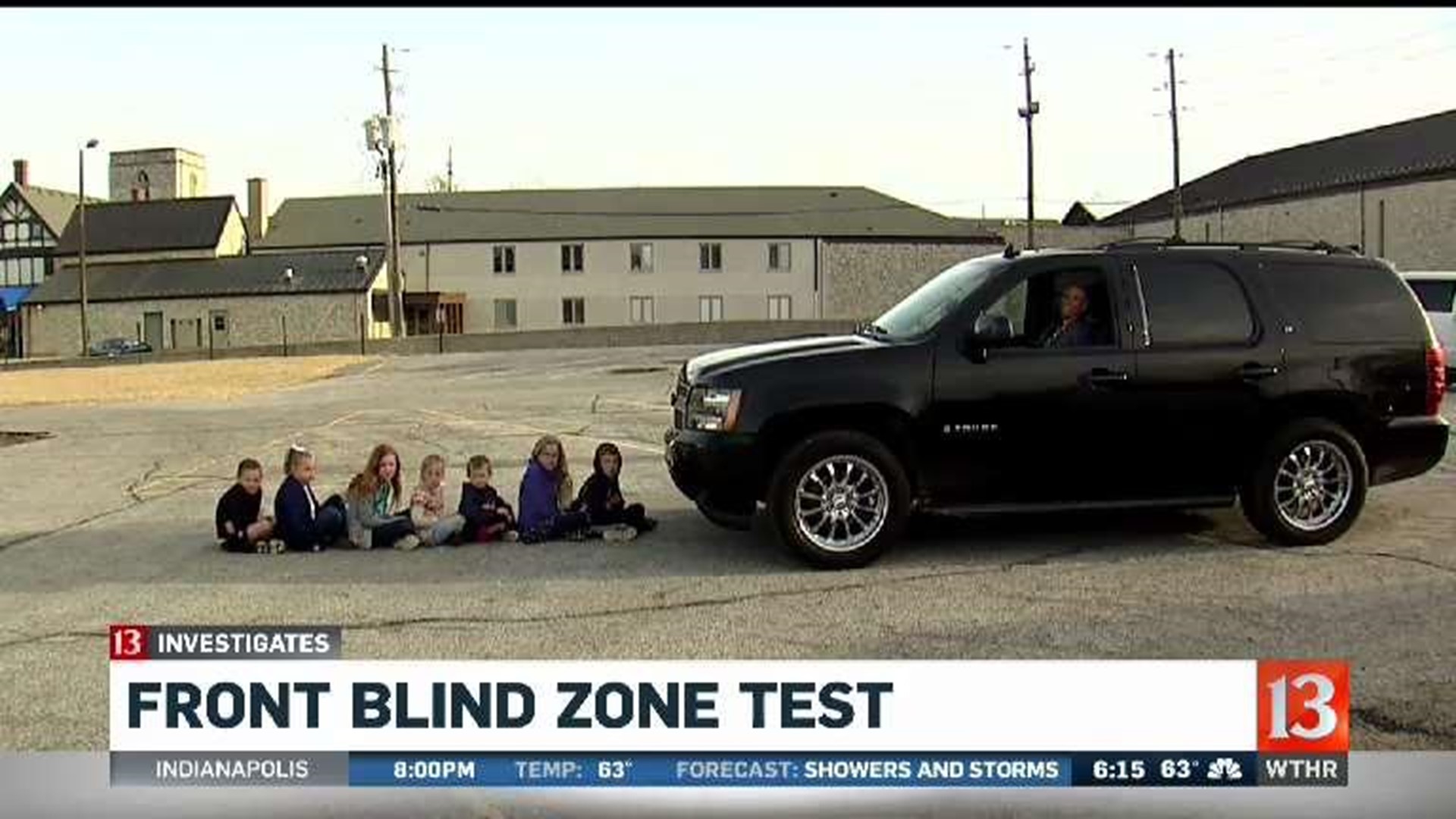
As you sort of suggest, the real problem is the gigantic cars filling the roads these days. Why do we allow this? You can't even see out of them properly:
People used to transport lots of kids in smaller cars. These new larger SUVs are also more likely to get into accidents so it's probably a bad idea to use one if you want to bring your kids around.
That's such a red herring. Bigger cars are safer for the people in the bigger car, but way more dangerous for everyone else. Faster cars are more dangerous for everyone. The solution is smaller and slower cars. Not an arms race of whose tank has the best armour.
Geez, what nonsense. Obviously, smaller cars serve only a specific market segment. There will always be a need for bigger vehicles for various reasons - big families, deliveries, etc. I'd say the red herring is your post.
I grew up in a family of 6 and we never had cars as large as the ones on the market today and we were just fine. These larger cars actually have higher rates of getting into accidents so they're less safe for the people inside the car as well as for the people outside them. And just because there will be a need for bigger vehicles for a small set of use cases doesn't mean the majority of people should be driving in them day-to-day. (SUVs now make up about 50% of market share apparently)
Proof by example. Just because it worked well for your family growing up, that does not mean it does for everyone else. For instance, when I was a kid, there were all kinds of stores in walking distance from our house. All of them are now gone and replaced by much bigger stores on the outskirts of the same town. Also, my grandparents lived close-by, so my parents could drop us off quite easily if necessary.
A lot of the things that could be done on foot now require some form of transportation in that area, and PT is too sparse to be a real alternative, especially when you have four children.
If SUVs make up 50% of the market, it is not surprising that they get into accidents more, but of course it's unclear what exactly you mean by "higher rates". But in any event, just because they are involved in more accident does not mean that they're less safe for people inside the car - I would think that the safety features of elaborate cars are an order of magnitude more developed than those of these tiny three-wheelers.
And those 50% of SUVs will not go away over night to be replaced by tiny cars. So that's why the reply to my original post makes little sense: as long as our streets are filled with huge cars, it's without a doubt more dangerous to drive along in a tiny one.
Usually rates like this are calculated "per mile traveled" or using some other normalising factor to make them comparable. And yeah, I don't need to go get your citations for you but you are now using "I would think" rather than looking at numbers and I'm telling you that the numbers say they are less safe.
They could go away pretty quickly if there was the political will. We have made large overhauls of societal infrastructure quickly in the past and we could do it again but people are too comfortable to take these matters seriously.
> A problem with such tiny cars is that they cannot absorb enough kinetic energy in a crash.
It's not about absorbing kinetic energy. It's about spreading out the deceleration to the human over a longer period of time. The total energy imparted to the human will be the same (the integral of force over time), and even the same as if you used the brake to stop the car.
> a frontal collision between two tiny cars going at full speed will likely have severe outcomes for the drivers and passengers
Wouldn't the lower mass of the vehicles mean less forceful impact of the crash? Momentum, kinetic energy, impact - everything scales linearly with mass. If that cars weigh half as much they only need to handle half as much impact.
> Of course, it might get worse when they get hit by a faster driving traditional car.
The real problem, as you mentioned, is when they get hit by a bigger car. The same problem we have where regular cars get hit by trucks, or trucks get hit by semis. It's pretty obvious size matters.
In a potentially deadly collision, what matters is the humans inside, not the car. Initial and final velocity are generally fixed, and the process of decelerating the human is what needs to be done safely. This is why cars have "crumple zones", decelerate the car overall more smoothly, and why airbags are used, to decelerate the human more smoothly. (We're talking "my neck didn't break" smooth.)
You can easily imagine a large truck formed as a rigid body that actually crashes worse than a tiny EV with a few feet of crumple in front of the driver. But all else equal, it's generally easier to design a survivable crash when there's more car to work with. Though EVs make it easier, by being able to use the "frunk" as almost purely crash mitigation, instead of also needing rigidity for the engine.
Though the biggest factor by far is relative speed. It's 10x safer for everyone to be going 25 mph instead of 40 mph.