No book influenced my attitude toward philosophy more than Wittgenstein's Blue Book. Here are a couple gems:
> The questions, "What is length?", "What is meaning?", "What is the number one?" etc., produce in us a mental cramp. We feel that we can't point to anything in reply to them and yet ought to point to something. (We are up against one of the great sources of philosophical bewilderment: we try to find a substance for a substantive.)
> The idea that in order to get clear about the meaning of a general term one had to find the common element in all its applications, has shackled philosophical investigation; for it has not only led to no result, but also made the philosopher dismiss as irrelevant the concrete cases, which alone could have helped him to understand the usage of the general term. When Socrates asks the question, “what is knowledge?” he does not even regard it as a preliminary answer to enumerate cases of knowledge. If I wished to find out what sort of thing arithmetic is, I should be very content indeed to have investigated the case of a finite cardinal arithmetic. For:
(a) this would lead me on to all the more complicated cases,
(b) a finite cardinal arithmetic is not incomplete, it has no gaps which are then filled in by the rest of arithmetic.
> Now I don't say that this is not possible. Only, putting it in this way immediately shows you that it need not happen. This, by the way, illustrates the method of philosophy.
I love his attitude that people talk in the same kind of compulsive way that a squirrel stores nuts for the winter. Not to say it is mindless but that it isn’t rooted in philosophical consistency. Asking again and again “why” like Socrates doesn’t get to the truth it just gets us caught in circles.
Another unrelated Wittgenstein-ian point that I found enlightening in college is that in PL design you can’t design a language that stops people from writing incorrect programs. Statements can’t be correct as an inherent quality of their structure, they can only be correct in context of a goal.
That was Socrates' point. He was asking questions to expose how brittle the claims of knowledge and certainty were. I do find it strange that Wittgenstein—a man who considered Kierkegaard (who wrote an entire book on irony and Socrates) as one of his favorite thinkers—seems not to have realized that Socrates' quest for a certain, clear meaning of a team was ironically intended to always finish unresolved. It makes me a bit curious what he took from Kierkegaard, who was every bit as much of an ironist, if Plato's rather blunt representations of Socratic irony alluded him.
Of course the irony is that Wittgenstein asks "why?" again and again like Socrates and for very much the same purpose (to show that it gets us caught in circles), thus representing even more ironic loops than the previous circles. Wittgenstein turns to philosophy to repudiate it and show as much to his students (show the fly out of the bottle), but in so doing he affirms a central Socratic lesson, but with far less irony. And I would say irony wins out: rather than quiet philosophy into therapy, Wittgenstein became the most influential 20th century philosopher who attracts by far the most published academic and popular commentary.
As tends to be true of much of philosophy, the core insight of Wittgenstein is not too big, I think. His argument, at least in his later work with language games, revolves around "why is it that we look for truth with such unclear language? Is it even possible to clarify our language?" And that's both Socratic and also more specific than Socrates. It's done in a very down-to-business and direct tone, which gives it that ironic sensibility, since it projects confidence in an investigation that we can easily see is going to start reducing itself to the tiniest scraps of truth by assuming so little a priori.
Within the context of his mathematical investigations this question makes a lot of sense, though: the younger Wittgenstein was studying logic under Bertrand Russell and therefore had a lot of exposure to the idea of a formalized logical totality as represented by Principa Mathematica - this was the world he lived in. And he did not seem to feel that the incompleteness theorems settled the limitations of logical formalism either.
Ah, but perhaps Wittgenstein was being ironic in pretending not to understand Socratic irony; Wittegensteinian irony. And perhaps zwkrt was being ironic in pretending not to realize Witgensteinian irony; zwkrtatic irony. And perhaps you are being ironic in pretending to misinterpret zwkrtatic irony; bangkoksbestic irony. I assure you, however, that this comment is not ironic, nor is the one after this.
Not so sure that's quite it. Having reflected on this a great deal over the years, I would say that many of Wittenstein's insights about language and life are more closely expressed as Tathata. [https://en.wikipedia.org/wiki/Tath%C4%81t%C4%81]
This is just like non-euclidean geometry. There are some fundamental postulates that you choose, in any kind of descriptive language, which is just convenient and doesn't really come from an empirical observation or is subject to constant improvement or change. They just are.
I really love how this subject is approached in the Zen and the Art of Motorcycle Maintenance.
Not quite all public domain. (in English) [0] (maybe? gray area)
I'd highly recommend checking out his work on (and coining of the term) "language games" [1] I'm not sure I agree with all of the thinking behind them, but it's a fascinating concept that has useful nuggets whether or not you agree with everything Wittgenstein says about them. They are explored pretty fully in his work "Philosophical Investigations" [2] This work pretty much set aside a fair amount of his thinking in Tractatus Logico-Philosophicus, which is still an interesting work in its own right. I think that even a cursory ELI5 treatment of this material in a standard college course would be very useful in arming students with tools needed to dissect language. I've used it (in brief) when teaching a course on Informal Logic in relation to propaganda.
[0] It seems copyright on the English translation might still be in effect, or at least a gray area of determination. Since it's a common text use in college courses I'm guessing the copyright owners may fight public domain release. The issue will be whether or not the translation was a work for hire or if it can be considered sufficiently different to constitute an original work. The English translation by Anscombe, Hacker, and Schulte occured posthumously, and so might not be considered work for hire. Hopefully it will resolve in favor of public domain. For a shorter consideration of "language games" check out Blue Book.
Wittgenstein’s father was one of the richest men in the world. He inherited an enormous fortune and renounced it. That would suggest he felt property was an inhibition to his thinking and writing rather than an encouragement.
He said that someday philosophers would forget him and he would be discovered by others who would finally figure out what he was truly trying to say. May this be the start of that era.
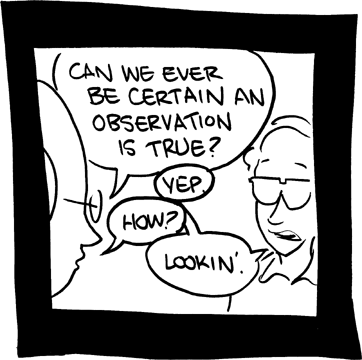
Descartes (and others): We can't know for certain that the external world exists.
GE Moore: "Here is one hand, and here is another. There are at least two external objects in the world."
Wittgenstein was pointing out that this doesn't address any of the actual claims. (I think "agree" is a confusing word to use in the translation. "Know" would work better.)
The Cartesian begins with a hidden assumption - let's call it the internalist assumption - that in order for me to know that "here is one hand," there needs to be no possibility that we are in a simulated world (for if it's possible I'm in a simulated world, then I don't really know that here is one hand).
Moore's point is: why is the internalist assumption any better than the assumption that here is one hand?
The point isn't about the external world. It's about deduction vs induction, the point is about axioms. Axioms are arbitrary, thus deductive reasoning is ultimately arbitrary.
If there is a hand then everything else falls out deductively. Using induction, it's trivially true that there is a hand.
Using deductive reasoning to prove an inductive proposition is ultimately a waste of time, using inductive reasoning to create a correct framework for deductive reasoning is ultimately unknowable. Both of these together is how we live our lives and create our standard model, which is ultimately imprecise at best, and wrong at second best.
This is Moore's point, that we are wasting our time trying to deductively prove the existence of an external world when it's trivially provable. We may not get accurate axiomatic framework, but we can never get that anyway.
Much of the point of philosophy is properly delineating between these two methods of reasoning. Much of analytic philosophy is finding areas where language blurs the two.
You are basically asking if it's possible to know whether we live in a simulated world or not.
That is a good question. One possible answer would be "It depends on the quality of the simulation". If we are living in a simulated world there could be a simulated drug the so-called red pill which allows you to see the execution of the simulation.
If we started seeing Fortran source-code in the sky and the code would seem to be about running a world-simulation, and we would also see data-expressions in the sky that curiously described the world we experience outside of us then I think we would be pre-disposed to think it looks like we are simulated beings in a simulated world.
There is no difference. It would only matter if you could wake up from the simulated one. Everything in this world seems real, and since I have not waken up to confirm that this is not even real, I might as well just consider it real and go on with my life.
Wittgenstein in a lecture once asked his audience to imagine coming across a man who is saying “...5, 1, 4, 1, 3 — finished!”, and, when asked what he has been doing, replies that he has just finished reciting the complete decimal expansion of π backwards.
My main take from reading Wittgenstein was that no one agrees on the meaning of words so there's barely any point arguing about things. I suppose that's sort of positive.
My main take from arguing about things is that it being founded on a mutually disagreed word meaning doesn't end the argument!
A somewhat related experience I had recently and found very strange was having two parties who each knew me meet, and relate stories about me or things that I'd supposedly said, in a way which made clear that at best my meaning was misunderstood even if the words were correct. What of all the other dialogue that didn't happen to come up? What percentage of what we say is understood as we intend, even if it seems so at the time?
Nope. You probably just had JavaScript disabled (which would be the sensible thing to do). Or maybe they haven't got round to it yet and in a few weeks all of what you mention will be implemented along with 48 tracking cookies, 4MB of JavaScript downloads (of which only 16KB is ever used) and an incomprehensible cookie banner referencing 641 privacy policies which no one will ever read!
The things we do, eh? I wonder what Wittgenstein would have made of it all.
I really appreciate Wittgenstein's idea of family resemblance concepts, that things we group together may not be in fact grouped by a shared trait, but instead my consist of a bunch of different sets of overlapping traits, such that no one trait is common to all.
"If we think of the world's future, we always mean the place it will get to if it keeps going as we see it going now and it doesn't occur to us that it is not going in a straight line but in a curve & that its direction is constantly changing." (Wittgenstein, from Culture and Value)


> The questions, "What is length?", "What is meaning?", "What is the number one?" etc., produce in us a mental cramp. We feel that we can't point to anything in reply to them and yet ought to point to something. (We are up against one of the great sources of philosophical bewilderment: we try to find a substance for a substantive.)
> The idea that in order to get clear about the meaning of a general term one had to find the common element in all its applications, has shackled philosophical investigation; for it has not only led to no result, but also made the philosopher dismiss as irrelevant the concrete cases, which alone could have helped him to understand the usage of the general term. When Socrates asks the question, “what is knowledge?” he does not even regard it as a preliminary answer to enumerate cases of knowledge. If I wished to find out what sort of thing arithmetic is, I should be very content indeed to have investigated the case of a finite cardinal arithmetic. For: (a) this would lead me on to all the more complicated cases, (b) a finite cardinal arithmetic is not incomplete, it has no gaps which are then filled in by the rest of arithmetic.
> Now I don't say that this is not possible. Only, putting it in this way immediately shows you that it need not happen. This, by the way, illustrates the method of philosophy.