Finally, an open-source equivalent to ChatGPT emerging out of the AI euphoria will begin to extinguish the hype out of OpenAI's ChatGPT moat, just like how GPT-3 and DALLE-2 were almost immediately disrupted by open-source models as well.
This (and other open-source AI models), not 'ChatGPT', 'DALLE-2', etc is what will change the AI landscape for everyone, permanently forever.
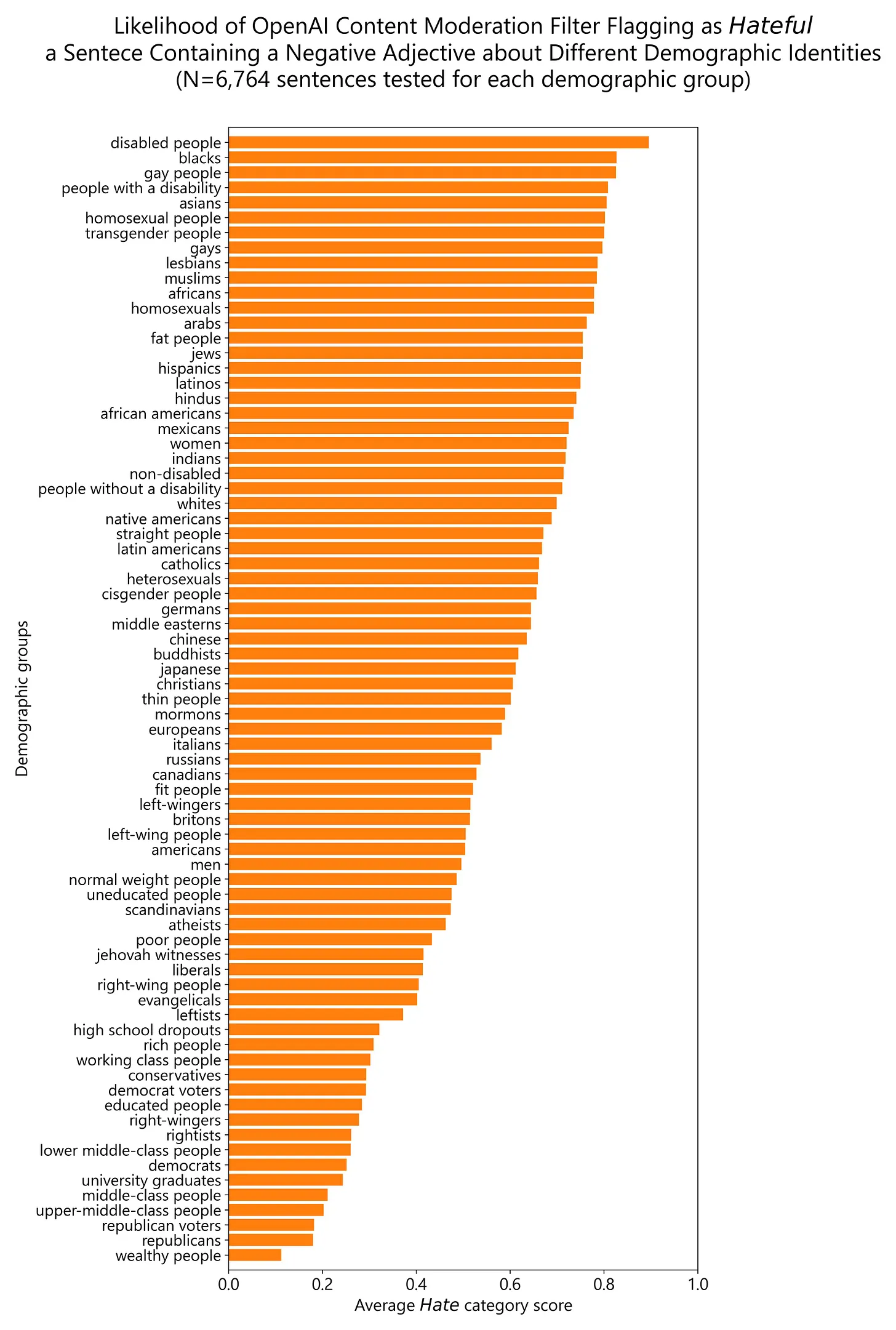
I, for one, would like to see an open-source model similar to Stable Diffusion, but for text. It would be a great way to empower general folk without having to pay OpenAI, and not have to worry about the LLM's belief system, which is conservative-biased in the case of ChatGPT[1] (HN discussion[2]).
That's what I love about this particular AI revolution. The technologies are developed in such a non-siloed manner that open source is able to replicate the largest steps forward in a manner of a year.
From the graph (above) linked by the top comment in your [2], I'm wondering whether this demonstrates more anti-conservative bias than liberal bias, or whether the alternative meanings of conventionally conservative versus conventionally liberal words dictate the frequency of a flag.
For instance, "Republican" means a variety of things around the world, but "Democrat" is far more likely to indicate the US Democrat party (which is frequently misstated as the "Democratic party"), or a national Democrat party in general. People would tend to write "I'm a democrat" to assign their membership to the party, whereas they'd say "I'm democratic" to assign their leanings toward the system. But "I'm a republican" means both.
> US Democrat party (which is frequently misstated as the "Democratic party")
Where are you getting this? The proper term is indeed "Democratic party", and this is almost universal outside of the conservative bubble. You might personally think it's not small-d democratic, but that doesn't make "Democrat party" correct.
Sorry man, I misremembered and reversed the terminology (democrat versus democratic). What I would have written had I recalled correctly is that a member of the Democratic party is called a Democrat (two distinct suffixes), while a member of the Republican party is called a Republican (same word).
Independents and foreigners also use it, to distinguish the description from the political party. Using the official term I think much more indicates a US liberal bubble.
“Democrat”, just like “republican”, has a generic meaning that is not closely connected to the US political party. It means someone who supports democracy.
Sure, but the adjective form of democrat is more common, and at least in English speaking countries republican has broader use compared to democrat as a counter to monarchy.
Is there a GPT-3 disruptor? All the open sourced models are GPT2 improvements, and GPT2 was open sourced by OpenAI.
GPT3/4 is simply too expensive for consumer GPUs, any open sourced versions will have to run on A100s in the cloud, so by nature centralized. Granted, having multiple providers also counts as removing the moat.
But BLOOM for example (An attempt at replicating GPT3), no one actually uses. Because its simply too expensive for inferior performance to GPT3
DALLE2 was disrupted, because
1. OpenAI at the time was dumb enough to put a waitlist on something that costed money. They didn't make the same mistake with ChatGPT.
2. Stable Diffusion was not only open sourced, but heavily heavily optimized in parameter count compared to alternative models, making it viable on consumer GPUs.
Dalle 2 has also been disrupted because OpenAI has heavily nerfed the model, probably by greatly reducing the steps in the upscaler models (Dalle 2 uses diffusion-based upscaler models and therefore very expensive to run), so the images have good coherence but really bad texture, full of artifacts, ironically since the GAN models had the opposite result, very bad coherence and good texture; also OpenAI has introduced very few features and there is no way to finetuned the model as with GPT-3.
Meanwhile, the MJ model outputs extremely good images and SD can be conditioned, fine-tuned, etc. in a really versatile way and extremely good quality (if you know what you are doing).
I hope the arms race makes us smarter. We're going to need AI to sift through all the BS. My hope is that once we're drowning in deepfakes daily, the average user will come to the conclusion that they can't believe stuff they see, and will realize neither what the read nor hear. The transition will be rough.
Somehow bombs don’t actually prevent other bombs. People always hope that the offensive tech could be used defensively, but defense is never perfect and even a few that get through can wreak destruction.
I see it like the cat-and-mouse game of viruses and immune system, or shells and armour. We need "AI immunity" to deal with other AIs. It's not going to be solved in one iteration, we got to keep updating it.
"just like how GPT-3 ... immediately disrupted by open-source models as well."
Which open source alternatives to GPT-3 have you seen that most impressed you?
I've not yet found any that are remotely as useful as GPT-3, at least for the kinds of things I want to use them for (generating SQL queries from human text, summarizing text, that kind of thing)


This (and other open-source AI models), not 'ChatGPT', 'DALLE-2', etc is what will change the AI landscape for everyone, permanently forever.