Bill Gates has been buying up water reserves, has investments in polluting industries, and he's got an interest in keeping the public thinking it's "not so bad". It is. Bill Gates is also behind the "our world in data" series on youtube, that consistently misrepresents climate science to make it seem like we can solve it with enough "green industry", when the only real solution is degrowth, we can't afford to keep siphoning the carbon out of the earth. GDP growth is correlated with --- and the main driver of --- the warming.
This message doesn't serve the interests of billionaires, and Gates is no exception.
Economists tell us that the COVID-19 pandemic triggered the sharpest downturn in the world economy since the Great Depression. Result? Well, looking at the Mauna Loa atmospheric CO2 for the last five years, it's difficult to detect any shift in its monotonic increase.
This is an emotional response and not a scientific one. The Haber–Bosch process was the biological equivalent of a deferred-interest loan. It gave us enough food to scale from 2 billion to 8, but now the planet is coming to collect its dues. We never had the natural resources to support humanity's current numbers, and by inflating our Nitrogen supply and stripping the Earth of everything else we need, we've utterly fucked it all up. Degrowth would be the worst tragedy in human history, but it would at least give future generations a chance. Geo-engineering is like paying off one credit card with another. It's a recipe for further disaster and doesn't solve the underlying issue. Humanity has to default.
Yes, but more specifically, all technological progress since the industrialized revolution. Prior to that, we at least had a reasonable credit limit in the form of a fixed Nitrogen cycle. Advancements in pre-industrial technology primarily made life easier, not more abundant.
That's an interesting question, and one I've looked at answering in part by looking at technology in terms of its mechanisms.
As I see it, it's possible to frame all technologies as being fundamentally based on one of the following mechanisms, interactions, or focus points:
- Materials: stuff, its properties, abundance, and sourcing and disposal issues. Wood, stone, ceramics, metals, fluids, chemicals, nuclear materials.
- Fuels: energy potential stored in material arrangements. Biomass, fossil fuels, nuclear fuels. This excludes energy flows such as solar, wind, tidal, and geothermal. Subject to limits in stores and creation rates. Result in waste products and phenomena.
- Power transmission and transformation: from simple machines to complex mechanisms and grid distribution. Levers, screws, pulleys, electromagnetism, beamed energy. This would include energy flows described above.
- Process knowledge: "technology" writ large. As J.S. Mill put it, the study of means, how to achieve some goal through some process or technique.
- Causal knowledge: "science" writ large. As J.S. Mill put it, the study of causes, or why the world is and acts as it does, based on empirical study.
- Networks: nodes and links. These may be physical or logical. Transportation, distribution, social, economic, commercial, political, and conceptual collections of loci and the connections and interactions between them. Famously give rise to network effects, also subject to hygiene factors (below).
- Systems: management of process with feedback and models. From basic polity to vast technological, economic, and ecological systems. "The Art of ship handling involves the effective use of forces under control to overcome the effect of forces not under control" -- Charles H. Cotter.
- Information: input, processing, storage, and output. From basic anatomical senses (sight, sound, smell, taste, touch) to language, maths, logic, abstract representation, manipulation, detection, transmission, reception, and retention. Capable of immense scaling itself, but often with profound limits on direct application.
- Hygiene: management of unintended and/or unanticipated consequences. All technologies achieve both desired and undesired effects, those may be manifest or latent, and may occur immediately or lagged. We tend to best cope with immediate and manifest effects, it is the lagged and latent ones that tend to cause the greatest trouble.
The technologies which seem to best fit your "credit card" model are those involving fossil fuels especially, materials resources formed very slowly or at singular points in time in Earth's history, and of hygiene impacts whose immediate and long-term consequences diverge strongly. Steve Keen (amongst others) shows that economic productivity scales near-linearly with energy consumption, yet we are using fossil fuels at rates millions of times greater than they accumulated. Virtually any mining activity represents extraction at rates greater than accumulation (the reverse is "farming", though even that can be problematic). Current industry has a strong reliance on a large number of elements and minerals, many of which are scarce or sparse. An example of the latter being "rare earths", which are not actually rare so much as they do not form ore bodies, and must be separated with high energy and waste-material costs from exceedingly low concentrations in the Earth's crust. Similarly, various emissions are often presumed or advertised as being low-consequence ... until they are not. Heavy metals, inert compounds (most notably hydrofluourocarbons), synthetic materials (e.g., plastics with bioactive and endocrinologic effects), and carbon dioxide resulting from combustion are all now major environmental concerns, initially dismissed, overlooked, or actively obscured by those with a short-term benefit from their use.
It seems that there are possibilities within process and causal knowledge, power transmission and transformation, networks, systems, and hygiene mechanisms for technologies which are far less prone to risk or debt-shifting. Though critics such as Tainter would suggest that complexity is its own inherent risk, with substantial justificiation.
Not disagreeing with your post here but curious about this point:
> Steve Keen (amongst others) shows that economic productivity scales near-linearly with energy consumption, yet we are using fossil fuels at rates millions of times greater than they accumulated.
The only way I can see (without spending more than just a few minutes thinking about this comment) this being true is with 100% efficiency and I wonder if that's the underlying assumption here. I'd hazard a guess that we're using fossil fuels at low single digit percentage efficiency if that and perhaps even putting more in than we're getting out. To your point though, since we're using fossil fuels way faster than they accumulated there's just no way to escape "running out" [1]. Just a matter of when.
[1] I don't think we'll ever run out of course, it'll just be more and more expensive. When I think about running out I think about not having society able to adapt to the cost because of how we've built and designed our infrastructure. The US is particularly screwed here since we rely on them so much.
Steve Keen, Robert U. Ayres, Russell Standish, "A Note on the Role of Energy in Production" (March 2019):
Energy plays no role in the standard Cobb-Douglas Production Function (CDPF), and a trivial role in a three-factor CDPF where it is treated as a third input, independent of labour and capital. Starting from an epistemological perspective, we treat energy as an input to both labour and capital, without which production is impossible. We then derive an energy-based CPDF (EBCDPF) in which energy plays a critical role. We argue for the redefinition and measurement of real GDP in terms of exergy. We conclude that the “Solow Residual” measures the contribution of exergy to growth, and that the exponents in the EBCDPF should be based on cross-country comparative data as suggested by Mankiw (1995) rather than the “cost-share theorem”.
For an excellent discussion of efficiency of energy use over time, see Vaclav Smil's Energy and Civilization (2017), which shows the actual attained efficiencies of various fuels usage.
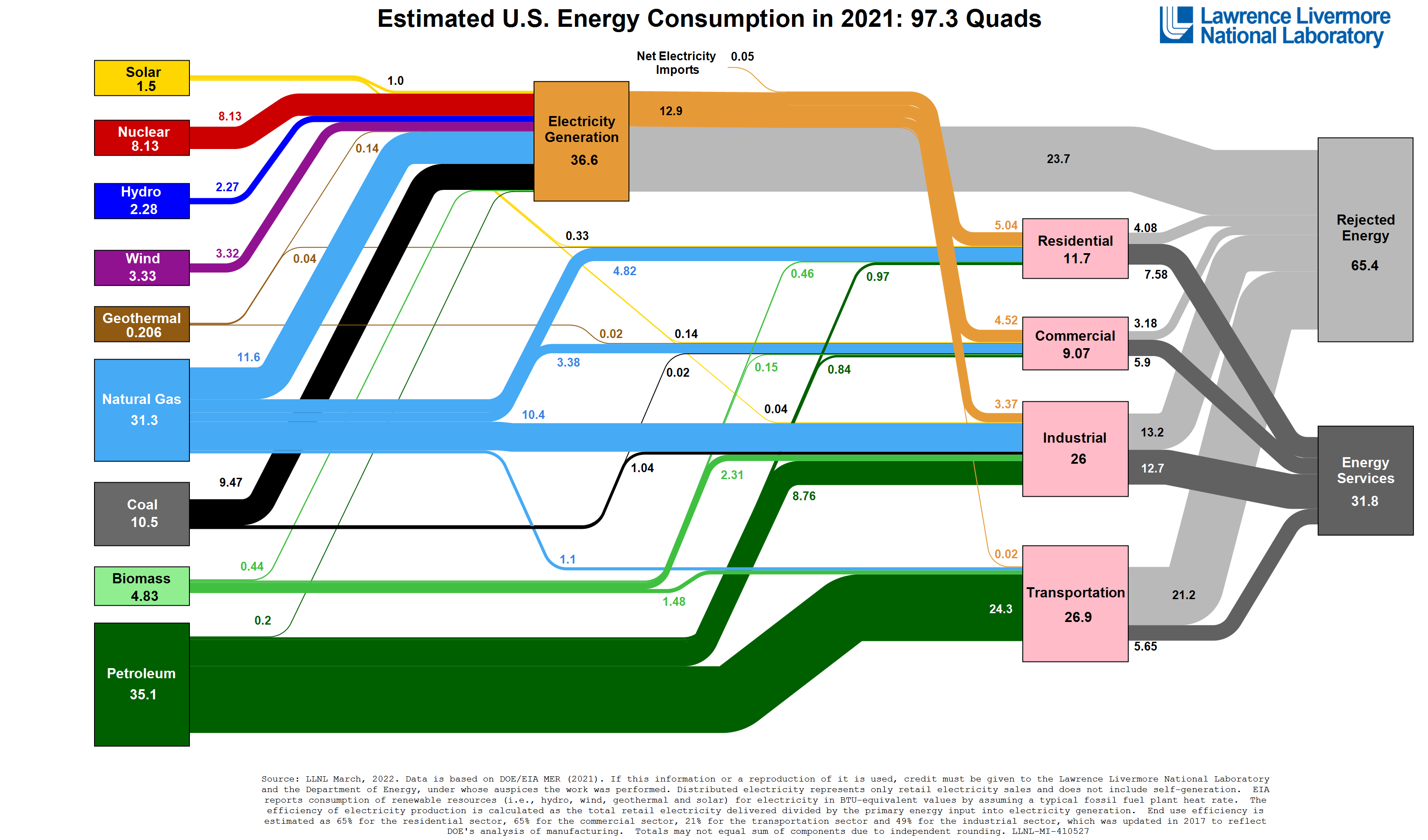
Note that due to conversion efficiency limits, most generally those of Carnot engines, achieved efficiency in converting thermal to mechanical energy trends around 30%. That can go higher in some applications (e.g., dual-cycle steam turbines combined with usage of residual thermal heat in cogeneration plants). But for the most part large-scale modeling relies on the 30% figure. See for example the Lawrence Livermore Labs energy-flow Sankey charts, in which ~30% efficiency simply assumed for the model, rather than explicitly measured, based on modeling:
End-use efficiency is estimated at 65% for the residential sector, 65% for the commercial sector, 21% for the transportation sector, and 49% for the industrial sector, which was updated in 2017 to reflect DOE's analysis of manufacturing.
It is the only practical solution. The only way to get humanity's energy equation to balance is to dramatically reduce the population or dramatically reduce energy use per capita or invent and deploy a mythical free energy source within the next 30 years. And this just covers replacing black energy with green energy -- even more energy will be needed to address the climate problem.
You underestimate the threat of eco-fascism. By that I don't mean green party politicians, no, I mean literal facists who blame climate change on overpopulation and who believe that the population has to be cut drastically. In the most basic form this would mean closing our borders and making sure nobody can cross illegally by using lethal force, if necessary.
Climate change is a result of overpopulation and overconsumption, though. It's right there in the name. The climate is changing as a result of anthropogenic activity. I fail to see how eco-fascism affects the outcome here, if we do not cut our population and consumption the planet will do it for us.
I'm not certain I do. I feel like we may be arguing the same side here? What I'm hinting at is that unless concrete results don't begin to materialize and that right soon the resulting climate driven geopolitical upheaval, and knock-on effects to global logistics, is quite likely to result in a significant downsizing of both global GDP and the world population. Perversely both of these obviously bad outcomes will very likely improve global carbon emissions. Here's a really shitty joke for you: How do you reduce your carbon footprint by 100% overnight? Shoot yourself in the head. How do you reduce your carbon footprint by 900% overnight? Go shoot your neighbors in the head. :/
pedantic "secrete" means to emit fluids or odor.. if you say so! ; "clandestine" means secret or secretive "especially if illegal" .. not illegal per se..
"so what" is up to you.. maybe it means nothing to you, "so what"


This message doesn't serve the interests of billionaires, and Gates is no exception.