Always seemed pretty strange to me that you can build and oversee an organization widely perceived (whether fairly or not) as evil, host what those evil-perceivers will view as Bad Rich Guy Conference in public, in a country where anyone can get as many guns as they want, and there isn't more violence like this. Seems like an unstable operating point for a society.
This is the comment that has been in my head since the news broke, and I feel like we are only at the beginning, like the pause before the first drop of a rollercoaster with the forward looking macro (political and economic tension, broadly speaking). Laws and rules only matter so long as we're all willing to believe they do.
Same here. With as many guns and victims of corporate greed that we have, I'm actually pretty shocked that we don't see this happening as routinely as, say, school shootings.
I wonder if we'd see slightly more ethical behavior from corporations if their C-level staff and board members had to routinely practice lock-down drills because they were getting offed once a week.
Doubt it. They will just never leave their island compounds and other fortresses. There have been many news stories lately of these guys building up compounds and bunkers. Many of them off-shore and entirely unreachable by the general public.
Many of these CEO types never interact with the general public without many armed men around them. I would not expect them to act any more ethical than they currently are.
We've all been watching how effective drones have been in the Ukraine war and there's nothing stopping a motivated individual with nothing to lose from droning a corrupt elected official, a cop who brutalizes innocents or an oligarch.
The rich will isolate themselves further behind even more surveillance technology, more physical barriers, and, because that is never enough, inordinate amounts of paid thugs.
I don't know how to write this comment in a way that won't land me in a CIA black site so I'll just start with a disclaimer that this post in no way celebrates or condones any violence, but I wouldn't be surprised if political assassination attempts go up 10-fold in the next 10 years. We already saw two different assassination attempts against Trump during the lead up to the election. You can read my older comments to know my political leanings, I don't like Trump. But wow, I'm genuinely more worried about the stability of our society because of increases in violent acts like this and the inevitable retaliation by the government against all people in the name of "security", than anything Trump could enact.
I wouldn't be surprised if New York passes new gun control laws because of this shooting; I wouldn't be surprised if there's a congresscritter or White House Staffer or judge who's assassinated in the next several years causing some kind of martial law situation. It's scary times we live in right now.
I know you are half-joking, but it shows how worrying things are related to public discourse where you need such a disclaimer at the start of your argument.
The scenario you describe is rather frightening. Let's hope the "CEO class" (for lack of a better term) and the general public will allow reason and ethics to win out.
One thing that is for certain, there should be better legal limits to what companies can get away with. We need our justice system to get involved well before vigilante's start running amok. The US government should have stepped in a full decade ago to reign-in United Healthcare's misconduct and fraud.
New York State and City (separate firearms laws) already has some of the strictest gun control laws in the country, requiring permits for purchasing pistols within NYC, concealed carry licenses throughout the state, magazine size limits, etc.
>I wouldn't be surprised if New York passes new gun control laws because of this shooting; I wouldn't be surprised if there's a congresscritter or White House Staffer or judge who's assassinated in the next several years causing some kind of martial law situation. It's scary times we live in right now.
This is most likely going to happen with an incoming authoritarian gov't anyway.
Do recall that one Congress critter, that is very pro-gun was shot at a baseball game, survived, and still stood against gun legislation. We'll see if things change if the wind shifts and more rich people (the Congresscritters' owners) are targeted.
Trump is an exceptional case who genuinely is feared to democracy itself as risk. The logic doesn't carry over to most other national politicians, although it absolutely can at various local levels.
Besides politicians, corrupt private leaders are at risk.
I am also not convinced that assassinations will make society less stable. At least in the targeting assassin's mind, it's intended to make society more stable by eliminating corruption.
>Laws and rules only matter so long as we're all willing to believe they do.
And everyone has seen it thrown in our faces for a year or so now what the blatant two-tiered system looks like. On a longer time scale if you want to count the lack of consequences for those behind an attempted coup in 2021 and a recession that harmed millions of lives in 2008.
If the government won't hold people accountable, and people are pushed to their ends, then things like this can happen. As OP stated, thankfully, it doesn't happen as often as one would think given our society. It does take a lot to murder someone else.
I think people skip over this a LOT, but it's the basis for society and was long before we had the means to track down most killers and bring them to any sort of justice. Most people, even when given freedom from consequences and ample opportunities, are not murderers.
Not murderers of others they consider to be “in” their own “group”. But murderers of out group folks seems like it just depends on enough rage and desperation to build up.
>Most people, even when given freedom from consequences and ample opportunities, are not murderers.
I don't necessarily disagree with this completely, but it's also worth noting how easily people seem to go with the status quo, eg criminal gangs, nazism, support of genocides, etc.
I think most people have a bit of killer in them, given the right circumstances.
People do value their lives and liberty and (for all the memes to the contrary) the police are very good at hunting down murderers of high-value targets because most challenges the police face are challenges of focus and resource-allocation and cities tend to authorize a spare-no-expense approach to something perceived as a direct attack on the fundamentals of the status quo. Consider the full-scale house-to-house manhunt after the Boston Marathon bombing as an example case.
So I think most people know that if you come at the king, you are definitely throwing your future away (and Americans, for all the complaining, tend to be comfortable / hopeful enough that they don't want to do that).
Are they? I thought homicides committed outdoors, with a gun, between people of no or distant social connection were basically unsolvable. Even for a rich white victim. Unless this guy dropped his wallet, used an exotic caliber, or is somehow connected to a prior threat, I wouldn't be at all surprised if he is not found.
Apparently he went to Starbucks a few hours before the shooting. They have a surveillance photo of him, but he was wearing a mask. If he was dumb enough to do that, he might have been dumb enough to pay with a credit card. If this isn't the case and he keeps his mouth shut, he'll be awfully hard to find, especially if he doesn't live in NYC. We know he was a white male and that's about it.
Even the Secret Service doesn't have a great track record for preventing attempts. Their presence puts some stress on the perpetrators, which does help, and they are good at preventing quick wide-open follow-ups to a miss or partial success, but they're bad at preventing the first shot or two. And I don't think it's because they're exceptionally bad at what they do, but because if someone really wants to take a shot, entirely stopping them is a hard problem by the time they're already close and armed.
And the secret service has the luxury of being able to shut down whole blocks/towns when they think they need to, that’s not something a random bodyguard of a CEO can do every time the CEO drives around.
Right, there are lots of them and they have more resources and options than a CEO's bodyguards, and still aren't (and again, I don't think this is, at least in general if not in every specific case, exactly their fault) super effective at preventing people from taking a shot, if they really want to and if their plot isn't discovered beforehand.
They do discourage "casual" attempts pretty well, and raising the difficulty constrains and pressures even the dedicated who succeed at striking (if not at achieving their ends) in ways that surely matter, but I think most of that has more to do with the shutting-down-whole-blocks and cordoning-off-entire-areas stuff. The strictly body-guard activity they do mostly just prevents sustained attempts—which isn't nothing, but CEOs aren't gonna keep those first couple bullets at bay with bodyguards. Broader behavior modification? Now that might work.
Indeed. For president's the SS has hundreds of agents and local law enforcement and they position security in the whole area. The pelosi home wacko got through because the one or two SS didn't even notice.
I don't think most Americans perceive health insurance organizations as evil, nor do they condense the fault to a specific person (like the CEO). Maybe the entire system is at fault, but individual greed isn't a major failing, it's virtually expected.
On the internet, all conversations about health care will garner comments mocking the US system, but as a resident it's not like we have a lot of choices.
I guess suspects will be a list of people who have been paying into United Health Care insurance who thought they were covered, but got turned down, possibly for a terminal illness, for greater profits.
edit: We do not know the shooters motivations, nor do I presume to know. But wanted to add a link for context to the above comment to show context for the statement.
There's enough social pressure telling us the system works and is fair and just, and that violence is wrong and doesn't change anything.
When you have an event like this, with the overwhelmingly positive reception by regular people, and within 24 hours BCBS rolls back a plan that has been years in the making to limit anesthesia during surgery, it shows two things:
1) murdering people who themselves murder people is not really socially unacceptable
2) direct action works in ways that the system does not
Maybe that changes the status quo a little, who knows?
CEOs of largest companies don’t tend to spend much time near poor folks communities that suffer from violent mental health episodes. Executives even way further down forbs 500 have security staff.
Doesn't seems so surprising to me. Most school shootings are perpetrated by those involved in the school community in some way. Similar domestic violence, humans are a lot more likely to commit these types of crimes against those they know personally.
I advocate for the fairer distribution of wealth in society. Not only because it's fair but because it's better for everyone. There are many reasons for this including avoiding the alienation of labor and giving people dignity. All it takes is the ultra-wealthy to have slightly less wealth.
So why is wealth concentration bad for society apart from that? Because the ultimate form of wealth distribution is war and revolution. It's way the descendants of Rockefeller, the Medicis or Caesar don't own the world. Society eventually snaps and a lot of violence ensues. Eventually you end up with the French Revolution and heads end up on pikes or separated by guillotines.
One of the messages of Fight Club is that the rich and powerful cannot insulate themselves from the people they are oppressing. Your gardener, your driver, your chef, your security guard. Any of them is capable of taking matters into their hands and they will only be pushed so far.
You saw this play out in Japan with the reaction to Shinzo Abe's assassination a couple of years ago. While world leaders were outraged, the Japanese kinda got it. You can dig deep into this with the Unification Church, its influence on Japanese politics and, if you really want, how the Unification Church is tied to the CIA.
United Healthcare is quite literally killing people for profit. Just like the Sacklers and so many others. We've become completely desensitized to this. Private health insurance is completely inefficient (look at how much the US pays per-capita for health care vs any other developed nation and then compare our coverage). We could literally save millions of lives and cut costs by getting rid of these lecherous middlemen.
So I don't condone or justify violence like this. It's simply analysis to see that this kind of thing is going to continue to happen as material conditions worsen and wealth inequality rises. In his ~3 year tenure are United Healthcare CEO, Brian Thompson quite literally killed thousands of people yet there's so little outrage over that.
I have the same thoughts especially thinking how we’re on the precipice of possible mass workforce displacement from ai and robots like waymo. What I just can’t understand is why anyone would feel satisfied being the billionaire in a bunker among miles of slums (picturing India) - even if the desperate folks are successfully oppressed.
>You keep saying killed, but there is a difference between letting people die and killing them.
Using dubious legalese to deny a life saving claim that happens to cost say $200,000 that you took premiums for is pretty close. If you pay out of pocket, it might save your life, but you're bankrupt, your children get no inheritance, and you probably lose your house. That's a pretty insidious act for profit IMO.
>Voters are widely split on healthcare reform and have no consensus beyond the fact that they want it. I want healthcare reform too, but probably dont agree with you on what that means. I don't that that justifies a consequentialist claim that the other is a killer, let alone reprisal.
I think the easiest step would be to drop the Medicaid age from 65 to 60. Drop it 5 years every 5 years or so. The lower it goes, the cheaper that bracket will be. I don't know why any politician hasn't suggested this, but I can guess.
Fun fact: the ACA originally had an opt-in to Medicare that you could pay for from age 55 but it was removed at the behest of then Senator Joe Liebermann from Connecticut. Liebermann has taken millions in contributions from insurance companies over the years and Connecticut is the home of Aetna IIRC.
Another fun fact: unexpected medical debt was the number one cause of bankruptcy in Australia prior to the introduction of Medicare in the 1980s.
Depends on the state. Even if they can't take it directly, you still have to pay the mortgage, the property tax, the insurance, all the maintenance and upkeep with a new $200,000 bill and probably not having worked for a few months for recovery. I'm not sure how sustainable that is for regular people.
There's nothing in the Bankruptcy Code that treats medical debt differently from other unsecured debt.
EDIT: I should clarify that it is nuanced. Medical debt is unlikely to draw unwanted scrutiny from the US Trustee/BR Administrator and of course it doesn't leave the debtor with any assets arising from the debt. Regarding house loss that is far more dependent upon the state you're in than the debt you have. For ex., homestead exemptions will protect the home from most unsecured debt. Further nuance is beyond HN's scope.
I dont want state funded single player Medicaid for all, and would vote against it. I think my united healthcare plan is better (somewhat ironically).
Instead, I think medicaid should be offered, at cost, as a non-profit public option to all ages. This was discussed briefly during the Obama healthcare debates, but broadly rejected by left who wanted to eliminate private options. We got compulsory private healthcare instead, but I think it is still the best option. Give everyone a non-profit option with a national pool size.
> This was discussed briefly during the Obama healthcare debates, but broadly rejected by left who wanted to eliminate private options.
As someone who voluteered in this field during that time, this is just a repetition of right wing propaganda. There was no serious movement to eliminate private options. Every country with a single-payer system that I'm aware of has private options as well, they just aren't popular because they aren't good or necessary. Right wing extremists want to present this as eliminating options, but in reality, it's just people not choosing private options when they have other options, because private options suck.
The real reason the left rejected a the "compromise" of non-profit options is that it still requires people who don't have money to pay for insurance. Simply slapping a non-profit label on an insurance company doesn't fix anything.
Note that non-profit health insurance companies exist already, and have solved exactly zero of America's health insurance problems.
Single payer literally meant that all citizens are subscribed to the same government operated health insurance.
If the entire "single payer" program was completely optional and offered at cost, they totally missed the messaging on that one, because I was paying attention and that wasnt my take away.
> Single payer literally meant that all citizens are subscribed to the same government operated health insurance.
Correct, but that's a pretty big change from the propaganda you repeated in your previous comment. What you said was, "This was discussed briefly during the Obama healthcare debates, but broadly rejected by left who wanted to eliminate private options." In another now-deleted comment, you also said, "the left was too fixated On preventing people from buying better care".
Nothing about having single payer healthcare prevents people from also purchasing private healthcare. Single payer does not require the elimination of private options--when you said that was what the left wanted, you were repeating a lie. People can and do purchase private healthcare in countries with single-payer systems--it's just not common because generally the private healthcare options aren't worth it.
> If the entire "single payer" program was completely optional and offered at cost, they totally missed the messaging on that one, because I was paying attention and that wasnt my take away.
Single-payer is optional in the same sense that current subsidies to insurance companies are optional, it just costs less and results in less death and human suffering.
Your insistence that it has to be "offered at cost" is basically an insistence that people who can't afford that cost but need life saving care can just die. So no, it wasn't "offered at cost"--that's the entire point. I want Americans to be able to receive life-saving medical care when they need it, even if they are poor. That's just basic empathy for our fellow humans.
I havent deleted any comments, you read it in a sibling thread that is still there.
There is a big difference between supplemental insurance and alternative options, and I think you are conflating the two. the first big difference is being able to opt out of the cost of public insurance if you go with something else.
I think that any puclic healthcare should carry the true price tag, and any subsidies for the poor should be subsidized as a separate benefit. Essentially, I am strongly opposed to funding the public healthcare with an income/payroll tax because I dont thinnk there is much incentive to actually tackle prices.
> There is a big difference between supplemental insurance and alternative options, and I think you are conflating the two. the first big difference is being able to opt out of the cost of public insurance if you go with something else.
I don't think that's a big difference. You can't opt out of paying tax for health insurance subsidies under the plan you're proposing--the difference here is that the amount of tax you can't opt out of under single-payer is less, because you're not forced to pay the corporate middle-men.
Yes, I'm saying the combined cost of paying your own healthcare AND poor people's healthcare under single payer is lower than the cost of paying just the poor people's healthcare under corporate health insurance, because it is. The government already pays more than half of health insurance costs[1]--the total cost would go down under single payer by every estimate I've found.
In short, it's literally cheaper to pay taxes for single payer AND a private health insurance premium, than to pay taxes for subsidies to private health insurance in addition to your private health insurance premium. The inefficiency introduced by ubiquitous private health insurance is that bad.
> I think that any puclic healthcare should carry the true price tag, and any subsidies for the poor should be subsidized as a separate benefit.
Ah yes, the "we should make poor people apply for healthcare, so that we can deny people coverage and so people who can't fill out paperwork can't receive coverage" solution to lowering costs.
I'm sure there's no way that right wingers will underfund these programs for the poor and then use their failure to function as an excuse to get rid of them.
> Essentially, I am strongly opposed to funding the public healthcare with an income/payroll tax because I dont thinnk there is much incentive to actually tackle prices.
I'm glad you brought up incentives! Here's how single-payer provides better incentives than what you're proposing:
1. Politicians are motivated to tackle the price of healthcare because this allows them to lower taxes for their constituents, which keeps them office. Money isn't the only incentive that exists. How do you justify ignoring this?
2. The perverse incentive to increase the price of healthcare to line the pockets of insurance is removed, because most of the healthcare isn't provided by private insurance companies that can lobby. How does your solution address this problem?
That's just the unclear messaging that the right wing is taking advantage of. I don't have a NYT subscription so I can't see the whole article, but as far as I can tell, there's nothing in that article that mentions actually preventing companies from offering private health insurance--it's just assumed (correctly) that these companies will be operating at a miniscule fraction of their current scale when people can obtain health insurance from a single payer, because few people will pay for private health insurance when there are better, cheaper options.
As I've reiterated repeatedly, this isn't a loss of options. Health insurance companies can still operate and consumers can still pay for private health insurance, they'll simply be competing with a cheaper alternative that doesn't have a perverse incentive to deny care.
I suppose you could make the argument that there will be fewer options because some of these insurance companies will go bankrupt, but that's just capitalism--there's nothing about the current system which guarantees health insurance companies will remain solvent or guarantees a variety of insurance options. In practice there are many places in the U.S. where there's effectively only one health insurance option.
>There are few international analogues to the Medicare for all proposals, but Canada, which provides similar doctor and hospital benefits for its residents, probably comes closest. Even there, people buy private insurance for benefits that are not covered by the government program, like prescription drugs and dental care.
Most other countries with single-payer systems allow a more expansive, competing role for private coverage. In Britain, for example, everyone is covered by a public system, but people can pay extra for insurance that gives them access to private doctors.
There is nothing in what you quoted that refutes anything I said.
If you have something to say, say it--I'm not going to buy a NYT subscription so that I can speculate what you are referring when you can't be bothered to explain yourself.
Okay, I see the article now, but I still don't see anything that supports your claim that the left is/was fixated on taking away private healthcare options.
Your claim at face value is absurd: if you want to waste your money on private insurance that is more expensive and will do everything they can to not pay out, have at it. Why would anyone on the left care? I assure you we don't. We're trying to give people healthcare, not take away options.
The only coherent complaint you have actually stated seems to be a poorly-communicated complaint that you don't get to pick and choose which taxes you pay. If that's your complaint, I find it a bit surprising that you want to start by opting out of paying for healthcare instead of, say, corporate subsidies to predatory lenders, farm subsidies to corn which is turned into HFCS, or NSA violating privacy of citizens. Or, for that matter, existing healthcare subsidies which are more expensive than single-payer healthcare would be?
Of course I dont want to waste my money. I dont think claiming I do is good faith discussion. Same with with assuming I want or support your long list of other subsidies. You seem to be arguing with a strawman instead of what I'm saying.
If you support a public healthcare option where I can choose to opt of the cost and service, then you have my support too! It is really that simple.
> You seem to be arguing with a strawman instead of what I'm saying.
No, I'm arguing with the reality of what you're saying. You want to block single-payer if it can't be opted out of--is that a straw man? Obviously not. I'm just telling you that the results of your ideology are not the results you're hoping for. The real results are:
1. Blocking single-payer if it can't be opted out of has resulted in private healthcare subsidies which are more expensive, and also can't be opted out of. What your ideology has achieved isn't the ability to opt out, it's simply to line the pockets of insurance companies.
2. If you want to start a larger conversation about being able to opt out of government services, why start with healthcare--a thing that people literally need to survive? Frankly, I don't believe that you're a principled believer in being able to opt out of tax: if you were, you'd start with one of the government programs which actively harms people. There are dozens, pick one of those taxes to fight for your right to opt out of instead of deciding that people in need of healthcare should die for your principled opt-out stance.
3. The most important reality of your ideology is that hundreds of thousands of Americans are financially harmed, don't receive healthcare, and ultimately, many of them die from lack of care because of right-wing extremists blocking Americans from receiving care. Your ideology literally kills people. Maybe if you got exactly what you wanted people wouldn't die, but the reality is that by opposing single-payer you're aligning yourself with murderers. No, I'm not holding you personally as responsible as a health insurance CEO, but you do bear some responsibility if you contribute to spreading this abhorrent, selfish ideology.
TL;DR: I'm all for a system where we get single-payer and can opt out of it, but that's not a realistic option that's on the table, and in pursuing that goal you're ignoring the real single-payer option and in doing so you're both failing to achieve the results you want and letting people die.
you already knew this when you made your post, but the calculus changes a little bit when there is a positive financial incentive to letting people die
> You keep saying killed, but there is a difference between letting people die and killing them.
There's also a difference between letting people die for whom you have no responsibility, and actively taking on the responsibility to prevent deaths in exchange for profit, and then letting the people whose lives you're responsible for die.
If you don't want to be held responsible when you let people die, don't take on that responsibility by becoming a health insurer.
Health insurers actually did worse than that: when other people wanted to take on the responsibility (i.e. single-payer healthcare) they actively blocked them from saving lives so they could go on profiting.
If this isn't "murder" or "killing" in your eyes, then maybe we just need a new word for the callous abdication of responsibilities that you signed up to provide for profit, when doing so results in the deaths of thousands.
> If this isn't "murder" or "killing" in your eyes, then maybe we just need a new word for the callous abdication of responsibilities that you signed up to provide for profit, when doing so results in the deaths of thousands.
We already have a word for that, it's called "capitalism".
Disgruntled employee? Patient died or suffered lifelong disability due to denied claims and delay in care? Bankruptcy due to paying out of pocket medical expenses?
all potential suspects that can wrap the world, and more.
UNH CEO reaped what he sowed. To be honest, this is unlikely to do anything in the long term. In the short term, dip in UNH stonk, but recover over next quarter.
Next cookie cutter CEO to be installed will just continue the same shit. Will probably demand 24/7 security paid for by company. Costs subsequently passed down to the unfortunate people that have to pay for their dogshit insurance policies.
> Next cookie cutter CEO to be installed will just continue the same shit.
Maybe, but what lays outside their door will always haunt them. There’s no replacement that won’t have this in the back of their mind, and I suspect this is sort of the point.
From the killer’s perspective, this was probably the best case outcome.
The worst case? The decision makers of these companies fear every day. And you know what? Everyone thinks twice when they recognize danger.
It will always be a challenge to allocate limited healthcare resources. It's an unsettled question why the US accepts such an expensive means (private health insurance) of doing so.
Because we don't have another option. Your job dictates your insurance, not you, and most jobs explicitly search for insurance companies that don't end up costing them much (but cover enough that people still think they have coverage, maybe).
Of course, these stories are happening after individuals have made their elections for insurance AND after the companies that would be choosing the various insurance companies to pick from would have already selected their projected insurance provider.
> Your job dictates your insurance, not you, and most jobs [...]
This is answering the question with a very narrow focus on what any one person can do. Sure, when I filled out my job's open enrollment last month, there was no checkbox labeled "Evil Corporation Insurer (y/n)", but there's no inviolable law of nature that requires the US to be this way.
Exactly. There's a lot of talk about trade and other countries "ripping off he US", but almost no mention that the US pay significantly more for the same drugs sold in other countries.
The narrative that we're getting 'ripped off on trade' is a myth. In the real world, when someone says "I got ripped off" it means they were overcharged for something. In politics, getting 'ripped off on trade' means we're being undercharged by foreign countries, which is apparently less desirable than being overcharged by Americans. Seems like the only trade here is a fake rip-off for a real one.
I wonder how people would respond to a survey that asked: "Would you support policies that aim to increase foreign drug imports to bring down pharmaceutical prices?" and a follow-up: "If yes, what about lumber, steel, etc?" My guess is that many would say yes to question 1, but not apply the same logic to other goods.
Propaganda is very effective when there's some kernel of truth behind it.
For this trade deficit question the important context is that some trade partners artificially devalue their currency (relative to the USD) to maintain strong export advantage (which therefore directly disadvantages their own people, since their wages are worth less on the global market, ie. when they are importing they have to pay more, when they are going on a vacation abroad they have to pay more, and this is a large chunk of the "missing trade" (the trade deficit), which translates to missing demand for US exporting sectors.
The other important piece of the puzzle is that US residents are also negatively affected by one distinct factor, which is the resource curse of the dollar's reserve currency status. Because due to the exorbitant privilege[1] (of the USD being the de facto global reserve currency) the financial sector is at an advantage compared to other sectors, and it slowly crowds out other economic activity.[2]
What there _is_, is too much pain and too many spoons that each and every person needs to manage every day, and most (nearly all) people are unable/unwilling to let even more important things drop.
We also have crab mentality in the US, where if one person hopes for, or even gets, something better, they're pulled back down.
And we have an efficient, powerful propaganda machine that tricks people into voting against specific areas of their interests - see "I love ACA, but I hate Obamacare" commentary.
The work to fix this is terrifyingly hard and *huge* and the people that will choose to fight and improve the situation will be making absolutely enormous sacrifices to do it.
To be fair, ACA passed, and here we are. Healthcare companies are making more than they ever did. Have you considered that powerful propaganda machine works both ways?
Think this is a failure of govt to use capitalism as an effective tool. More competition in the insurer space means non-evil players can afford to manage risk
When the company you work for is the one that decides on and buys your insurance, not you, how does a particular insurance company's "non-evil-ness" factor in?
If we had more insurance companies instead of a few that dominate the market, then your employer would have more choices. More competing insurance cos would lead some to differentiate by having a reputation of honest claim handling while also not being the most expensive option. It would then at least be possible for an employer to choose better insurance companies.
Why should your employer be the buyer? It's just a way of chaining people to specific jobs. I'm constantly perplexed by people's eagerness to rationalize the structure of an obviously dysfunctional ysstem.
I think that's a valid and even __good__ question.
The historical reason for why it's tied to specific jobs is because salaries couldn't raise for a period of time in US history and so jobs started offering other perks, like paying for all or most of your health insurance.
Now, companies get group discounts and still (often) pay meaningful percentages of many employees healthcare, and so getting private insurance is a nonstarter.
I think a main root cause of high insurance costs is failure of govt to break up health company monopolies and other impediments to a competitive marketplace like no individual mandate which should make it hard for smaller players to take on risk that they can afford to manage.
wrong take, companies started consolidated right after ACA passed.
It was less concentrated industry before the ACA.
the fundamental reason is as usual: too much government regulation that was erected with good intentions, but ended up becoming a competitive Moat that reduced the competition and entrenched big players. With that amount of regulation healthcare should be universal like in Canada or UK.
To maintain private healthcare sector, there should be less government
>too much government regulation that was erected with good intentions, but ended up becoming a competitive Moat that reduced the competition and entrenched big players.
While I agree with this, that regulations are often championed and even written by entrenched companies to increase the barrier to entry, the government can sue to block any merger they deem a harm to competition. Unfortunately they choose not to.
AI is a good example of this. If the government regulated AI, the only companies who will control and profit from AI are the ones who already have it.
That is absolutely true, even no matter the government, even a non-capitalist socialist commune must allocate and there's no right answer.
It can become insidious in capitalism. We have organizations like Kaiser who say "we'll run the hospital and focus on preventative care, if we spend $50 today that avoids $50,000 a few years from now" - Kaiser notably does hospitals AND insurance in a vertically integrated manner. That's all reasonable.
Then a United might see "we can spend $5,000 today and patient will be healthier-ish, or $200 yearly for a medically equivalent treatment". And so they do the actuarial math that the patient will die in a few years, they calculate revenue from that patient based on how long they might stay on the plan, and find the solution that maximizes profit. So the mentality isn't Kaiser-like "i.e. we're on the hook for this patient, let's minimize their health problems to save money", it's more like "we will minimize the cost of this patient full stop, if that means they don't get care then they don't get care"
Privatizing hospitals further would not help the vast majority of Americans. Without non-privatization agreements, the average American could not seek or afford the medical attention they need.
As someone that's lived on the Canadian border for the past 20 years, I frankly think we need more regulations. Drug prices in the US are so absurdly high that most terminally sick Americans will happily drive back and forth to Windsor if it means treatment they can afford. It's a testament to America's core dysfunction, something that Canada can somehow get right on their first try but America... well, we struggled to put Shkreli behind bars.
It isn't like US public system, medicare, is great. I still end up buying my folks supplemental. This narrative of pubic vs private misses most of the nuance.
there's so much nuance in an insurance company having billions left over every year after subtracting payouts from premiums! it's sooo complex and nuanced
> I think you're forgetting at least Jeffrey Epstein, Seth Rich, the Boeing whistleblowers, and probably many others?
Even if we assume all of those are nefarious, that is much fewer people over a much longer period. If you have to add "probably many others", it feels like you are just extrapolating in your favor without evidence.
Aren't you just proving the point, though? You automatically assume all conspiracies from one set of countries to be unsubstantiated, yet all the other ones from a different set of countries to suddenly be substantiated and requiring no further proof? And don't even bother to refer to the latter ones as "conspiracies", whereas, in polite company, all the former ones, must explicitly be referred to as "conspiracies".
For a lot of these cases, there's really no way to definitively prove either way, so, the fact that with the same set of basic facts, different conclusions are reached, using different words, doesn't instil objectivity to the process.
To be fair, "Russian lawlessness" is a concept that predates the entire nation of America, even between Russian authors. People immediately leap to accusations of corruption because the USSR and Russian Federation are both well known for sending agents to kill dissidents living at home or abroad. The modern world has never known what Russia would look like if they embraced global accountability and tried to uphold basic decorum and due process for their convicted criminals.
Comparatively, faith in American institutions was only recently shaken by Watergate and the Iran-Contra affair, neither of which were even that bad in a relative sense. If the Clintons were tried and prosecuted for murder then you wouldn't have to label your words as a conspiracy theory, but for now that's exactly what they are. And to be honest, the evidence today doesn't feel any more convincing than the same shtick I heard 15 years ago...
Just saw video of the shooting on X, the guy was cool as a cucumber. Racking a new round after every shot. Not a hint of desperation, fear or anxiety. He didn't even run off after shooting. https://x.com/Tr00peRR/status/1864376034465890417
Automatic and semi-automatic weapons work the way the do because force of the round (recoil) pushes back the bolt carrier, which a spring will then push forward again. Shot is fired, bolt carrier goes back, spring pushes it forward.
Subsonic ammunition have less charge than regular ammunition, to reduce the velocity. This also means less recoil. Combined with the spring now being too stiff, the bolt carrier will simply not move back far enough to successfully chamber a new round. So you have to manually chamber a new round between each shot. One solution is to use a light / less stiff spring that is adjusted to the force of the subsonic ammo.
Perhaps subsonic rounds that did not have enough charge to drive the slide. It looks like there may be a suppression device on the end. My first thought was home made.
Just an interesting note. Some in the media have suggested the weapon used is a B&T Station Six, a bolt action pistol. I had no idea such a thing existed. Reviewing the footage again I don't know if it is that model. The hand movement appears more chambering that cycling a bolt.
Or it could just be a single action pistol, as noted in the article. They’re not common but there are a handful of them that are relatively easy to obtain. Competitive shooters use them and it seems that Seals are sometimes issued single action pistols too.
Or someone highly motivated to make the hit a work of art. Killers are usually not very smart, or they are blinded by rage, and they make mistakes and are sloppy and incomplete about planning.
It's a major regulatory failure to allow insurance companies to deny any claims at all of items that have an FDA approved indication. Ideally, the insurance company should not be able to legally deny any FDA approved action that a licensed doctor has prescribed, with no exceptions. Insurance companies are not doctors, and they should not get to play doctor.
Very likely. It was very likely planned in advance due today being “investor day”. A person with nothing to lose at this point.
“ UnitedHealth Group (NYSE: UNH) will host its annual Investor Conference for analysts and institutional investors in New York City on Wednesday, December 4, 2024, beginning at 8:00 a.m. EST.”
[1]
My bet is that it’s someone that got stiffed by UHC themself or lost someone close to them. You only have to get prematurely released from the hospital because some representative over the phone says so once for you to see this system is incredibly broken.
There's not many cases in 2024 where people get denied hospital care because of insurance.
Get stuck with massive crippling bills? Sure. Can't afford insulin? Likely. But if you are at the hospital and your coverage is denied, legally that's the hospital's problem.
They won’t be overt about it, for obvious reasons. I can tell you with certainty though that they’ll do things like discharge you early, try to send you to another facility, etc even if that’s not the medically sound thing to do.
It happens all the time in 2024, but it takes the form of pharmacy benefit managers arbitrarily forcing people off effective medications onto cheaper, less effective ones.
> A gunman, who investigators tell CNN was waiting for some time before Thompson’s arrival, opened fire from 20 feet away firing multiple times, striking Thompson.
This from CNN makes it sound like it could possibly be targeted, though there are very few details at this time and sometimes these things are misreported in the immediate aftermath.
I don't think this ceo should be killed. However it's absolutely the case that this ceo has taken actions that resulted in the deaths and suffering of others. I wouldn't be the least bit surprised if someone lost a family member due to this ceo and that turned out to be the motive.
I'm nervous about the precedent this sets, if that turns out to be the motive.
It reminds me of the assassination of Shinzo Abe. Original assumptions were that it was a political rival... Turned out to be a very simultaneously personal and abstracted "My mother gave away our entire inheritance to the religious group Abe supports and legitimized" grievance.
I'd be surprised if it wasn't a hired hit by a jilted ex/mistress or somebody going for assets and a life insurance policy. That's what it usually is with these rich people. Crazy pissed off patients usually shoot up the hospital and broke people can't hire a hitman.
I'd never condone or celebrate an act like this, but if we're supposed to just accept seemingly random gun violence as an unavoidable fact of life (as various politicians have proclaimed in recent years) health insurance CEOs are preferable to classrooms full of kids.
You know, Japan just recently had a gunman kill a very powerful person and then the country basically prosecuted the gunman but also completely vindicated them.
It's unclear for the moment if this is an angry customer or jilted lover type of killer. Is it personal or is it professional? But as the insurance company with the highest claim rejection rate, they are quite literally killing their customers, manufacturing their own long list of aggrieved suspects.
Appears to be a targeted shooting, curious to see what the motive is.
Undergoing treatment and having to deal with insurance can put people in a dark place. Even if it's just an accidental injury putting you in medical debt, it can feel like the end of your life.
I'll never forget getting denied neulasta while on my last round of chemo and having to pay $21,000 out of pocket until we argued it with insurance. I wouldn't go as far as murder, but I can only imagine others would.
Just want to caution everyone to not jump to conclusions. Remember when Bob Lee was shot in San Francisco and everyone assumed it was because of how unsafe San Francisco is? And then it turned out to be another tech exec?
Beyond the one motive we can think of, this person (like any person) had other things going on in their life. We have no idea what the motive was until the killer is found.
There's an ongoing "all the big liberal cities are scary" vibe in much media that's been internalized by a large proportion of the population.
I know multiple people (and have myself experienced this) who've been greeted with warnings and concern from relatives when traveling to major cities... when those cities have violent crime rates far lower than the places they/we live. Like, a fifth as much or lower. It's still "common knowledge" that e.g. Manhattan is way more dangerous than a "safe" red state suburban/exurban county (LOL, very not necessarily true) and that the largest cities must be way more dangerous than small and mid-sized cities (also very not necessarily true).
As someone who lived in NYC all the way from the early 80s up until 2 years ago and still has to travel there regularly for business, NYC is a lot closer to how it was in the mid-80s than any other point during that period.
Especially post-9/11 up until COVID it was practically Disneyland. You had little chance of being a victim of random crime in the vast majority of city neighborhoods or on the subway. That's certainly not true anymore. (Caveat: In 2009 I was drive-by shot at on gang initiation night on 96th St & Columbus Ave in Manhattan. Yes, it happened, but place and time are important factors.)
Also we've seen a return of large storefront vacancy numbers in Manhattan.
Where I live now people truly do not lock their doors. Most garage doors in my neighborhood stay open 24/7.
I think to some degree the problem is a combo of some overestimating among part of the population (driven in part by recall of actual historical crime rates, and by anti-"blue"-city news media) of how dangerous big cities are, but also a huge failure to appreciate how dangerous lots of non-big-city places in the US are. It's not entirely that big US cities are necessarily super-safe (they're largely not, if you compare to international peers) but that lots of non-big-city parts of the US are shockingly dangerous, including many parts that folks don't expect to be.
> Where I live now people truly do not lock their doors. Most garage doors in my neighborhood stay open 24/7.
Rich suburban and small towns—and I mean where the whole area's kinda rich, not just a few neighborhoods—are in fact the sort of safe that lots of people incorrectly assume all suburbs and small towns are. I know how it is, I (now) live in one of those too, so Manhattan is in-fact more dangerous than where I am (these days). :-)
Like, my kid's neurologist lives just up our street and there's a country club every half mile, it seems like. Yeah, this particular place is quite safe. Go figure, if there's vanishingly little poverty around there's also very little violent crime. But lots of US suburbs, rural towns, small suburban towns, and smaller cities are really, really poor and there doesn't (any more? Maybe ever?) seem to be some kind of aw-shucks folksiness of attitude that effectively counters the effects of that—they're just as crime-ridden and dangerous as you'd expect, from the poverty stats.
Per capita tells the real story. I'd take Chicago or New York over any small town in, say, rural Mississippi or Alabama[1]. Yet [certain] media's "big liberal cities = bad" narrative continues...
There's a long-running genre of clickbaity story (that's been around since before "clickbait") that runs something like "America's five most dangerous cities!" and reads like the list of places many people believe are exceptionally-dangerous in the US (because of these stories...) but people consistently read them poorly (and media know this, so are basically lying on purpose, but big city names being on the list gets more attention, for multiple reasons, than if the list were mostly small cities).
The rhetorical trick here is the cut-off point. For one thing, you're limiting it to cities in the first place. For another, take a look to see where their cut-off for size of city under consideration is—the higher it is, the more it'll skew toward big names (duh) so they almost always set it pretty high, and the lower you make the cut-off, the farther (most) of those plummet down and off the list as small and mid-sized cities take over.
It's wild the tales [certain] media outlets tell. When I moved to Chicago, I got no end of suggestions to buy a gun, get bulletproof glass for my car, increase my life insurance policy...
Sure, the deep south and west sides might be not be too nice (particularly at night), but that's mostly gangs shooting at each other. My neighborhood is actually quite nice, but even if you take the city as a whole, the violent crime rate is 639.7 per 100,000 people [0] or 5.38 per 1,000 [1], depending on what source you go by (but I'll just use the 639.7 figure since that actually makes the city look worse). Compare this to Houston, TX: 11.35 per 1,000 people [2], Dallas, TX: 7.71 per 1,000 [3], or Nashville, TN: 10.95 per 1,000 [4].
So, 0.006397 (Chicago) vs 0.01135 (Houston) vs 0.00771 (Dallas) vs 0.01095 (Nashville). Hmmm...seems like Chicago is slightly more peaceful than Dallas, I'm 1.77x more likely to be the victim of a violent crime in Houston, and 1.71x more likely in Nashville. One has to wonder, if Chicago is apparently a warzone, why [certain] media outlets aren't equating Houston and Nashville to Fallujah.
We're not that rich here. We're just in a permissive firearm state with a high rate of military service. The houses here are average, but my neighbors are active and retired military, retired cops, the state governor's official security detail, lots of tradespeople etc.
There's a trailer park 2 minutes down the road and lots of small family farms here.
Check the crime stats. You might be surprised. Exceptions exist, but... they're exceptions. My 5x-Manahattan's-violent-crime-rate former home county pretty well fit that description, and many locals believed it was quite safe. The stats tell another story.
Oh I know there's crime here in my city, but it doesn't reach my neighborhood.
Also the thing is the vast majority of the crime here is targeted. It's violence between gangs/drug dealers. It will never have anything to do with me.
But in NY and Chicago (especially Chicago) I know lots of average, unaffiliated people who have been robbed at gunpoint. Also large amounts of crime in NY goes unreported because people mind their business and/or don't trust the cops. They literally have had a "if you see something, say something" campaign for most of my life for this reason.
I've literally seen people step over people who were bleeding out from stab wounds in the NYC subway. I witnessed multiple violent crimes while living in NYC.
> Also large amounts of crime in NY goes unreported because people mind their business and/or don't trust the cops.
Yes, crime stats are a mess for a bunch of reasons. The most-reliable are murder stats, because they rarely go unreported or otherwise unnoticed, and are the hardest to "juke the stats" on, especially if you try to do it for more than a brief span of time. Those are better in scary ol' Manhattan than in much of "safe" small town, small city, and suburban America, and often way better.
Not really. Proximity is important. It influences how many people are going to be affected by it.
Getting murdered on my front lawn is a lot different than getting murdered in the lobby of a housing complex with 1000 people living in it.
Density is even more important when considering random crime because you have even more people who will be potential victims when someone is targeting an area.
> Density is even more important when considering random crime because you have even more people who will be potential victims when someone is targeting an area.
This is true—it's why rural towns and small cities are often really dangerous, while the overall state they're in might not have high violent crime stats, if a large proportion of the state's population isn't in towns or cities at all. Living far away from people is an effective way to avoid crime.
In 2024, what you're describing is rich. The neighbors you describe feel like they have a place in society. They had (and likely continue to have!) a steady and decent government income, rather than the continual screw turning of the corporate-inflationary wealth extraction machine. They all have assets to lose if their kids were to step out of line. Their specific jobs also provided them with the non-monetary benefit of firearms and other defensive training that would have otherwise cost ~ten thousand dollars of discretionary income to learn on its own. Sorry to burst your bubble, but you're on the pleasant side of the bifurcating society.
> Rich suburban and small towns—and I mean where the whole area's kinda rich, not just a few neighborhoods—are in fact the sort of safe that lots of people incorrectly assume all suburbs and small towns are. I know how it is, I (now) live in one of those too, so Manhattan is in-fact more dangerous than where I am (these days). :-)
Literally no.
Where I grew up was below median household income and remains that way today (most of it by a good amount) and was by every literal metric safe.
Not every small town or small/midsize city or suburb is notably dangerous. Some are safe. Some are even safe and arguably also poor—poor-small-town Vermont, to take an example, tends to be more than a tad statistically different from poor-small-town Arkansas, say, if you want to carve out a whole category of poorish-small-town that may be relatively safe. And anywhere, exceptions may exist.
A whole shitload of them have much higher murder rates than NYC and several other "bad" big cities, though, and it's just about never the rich places of that sort that are high-crime (go figure). Yet, for folks who live in those demonstrably-dangerous places and travel, local members of their family commonly freak out about their visiting big cities that are, statistically, a lot safer than the place they're leaving to make the visit. This is due to wild misperceptions of where the dangerous parts of the US are—some are in big cities, but a lot aren't, and many of the "bad" big cities are actually relatively safe, if you compare them to smaller cities and towns.
What I meant is that if you want to look at small towns and suburbs and consistently find ones that are safe, you're going to want to limit your search to the relatively rich ones. That's a category that largely does fit the assumptions of safety that people have for small towns and suburbs in general (which assumption holds... less well, with a wider net cast)
I'm still waiting for someone to name me a major American city that isn't a blue city. If every major city is blue, then there isn't anything to compare it to. At least NY has had a couple of Republican mayors this century, but I doubt the same could be said of San Francisco, Chicago, Philadelphia or Boston.
Big cities will naturally have more crime than little villages, but as someone else mentioned, per capita stats are key.
Anecdotally one of my colleagues recently moved from W. Va to the CA and his entire family are constantly fearful for his family because they have been conditioned to think liberal cities (and even CA in general) is a crime-infested cesspit. Like his whole family is praying for him weekly - even many months after the move.
My ex-home red state has double the murder rate of NYC. Not New York State, the city. DOUBLE. The stats where I actually lived were even worse (and I lived in one of the better counties in my area).
Nonetheless, always the tedious ritual of warnings and concern when I traveled to any "real" city. Like, guys, save that shit for when I'm coming back. I should be warning you, I'm leaving danger. And please stop watching cable news and listening to AM radio.
My brother once told my mother to warn me about "Protests" in my city around the time that Portland Oregon was having it's fun. The vibe he sold her was a busy protest crowding through the streets shouting slogans and clashes with police.
The actual protest was about ten people laying on the ground in front of the police station in silence. There were a couple cops standing in front of the building, presumably slightly less bored than doing paperwork at their desk. Most people in my city didn't even know it happened.
It's insane the reality they live in. These people will see https://www.reddit.com/media?url=https%3A%2F%2Fpreview.redd.... and chuckle and say how bad the "mainstream media" is and then go back to watching Fox News scream about how a liberal city is on fire with protests despite NOTHING HAPPENING. I can't understand the willful, intentional ignorance that leads people to believe watching an hour of Fox News makes them knowledgeable about a city of a million people.
I will believe this if you show me the stats. You can use homicide rates, since they're hard to fake or badly under-report, and since many of the other stats crime stats also look pretty good for NYC and I expect you'll dismiss them as extremely incorrect—and it's not unreasonable to worry that they might be, so, you can just use the homicide rates.
Maybe one "scary" big city is managing to do hide far-worse homicide rates than they actually have. Are a bunch of them? Maybe, I guess, I doubt it but maybe. If a bunch of them are successfully hiding a lot of murders, though—are towns and small or mid-sized cities in poorer states just unable to hide theirs as effectively, since they are often really high?
Of course, you do see more crime with higher density and with a higher proportion of travel on foot rather than by highway. That doesn't necessarily equate to higher risk.
Homicides are useful because if you use anything else the "nuh uh, it's impossible that (for example) NYC is safer than lots of other places" contingent will just point out (correctly!) that there are massive problems with crime stat collection and so the ones in the statistically-not-that-bad big cities must be faked [EDIT: or, at least, very inaccurate for other reasons] and the ones in the statistically-worse smaller cities and towns are simply not, or are less, faked (this part doesn't necessarily follow, but they're not wrong that it might be true)
Homicides are harder to hide, and are far less likely to go unreported, than other crimes.
The other useful route is victimization surveys. They introduce other issues, but the trade-off is well worth it for evading stats-juking or underreporting. Not a cure-all depending on the topic[1] but pretty good. I believe you'll also find NYC and some other perceived-by-many as especially-risky cities fall off the higher part of top-crime-city lists with this metric applied, when we lower the bar of what we're calling a "city" to include small and mid-sized ones.
Here's a fun one (check the study linked near the top if you want the source—the article's kinda ass, but the charts are handy) that attempts to use per-capita cost of crime to sort of normalize for overall severity of crime ("is double the overall crime rate really worse if 100% of those are pickpocketing and 100% of the 'lower'-crime city crimes are murder?", to illustrate the problem by exaggerated example) and does include smaller cities (broken out from the 300ish ones the study classifies as "large"):
(Some large cities are very dangerous and have crime problems! This source confirms that and I do not deny it! The goofy part is that, if you live in certain places and around certain sorts of people, they'll get super-worried about you when travel to ones that simply aren't that bad, and these same folks would never think to worry if you tell them you're visiting, say, Saginaw, MI, or Pine Bluff, AR, but, apparently, they should worry—hell, this whole illustrative exercise probably plays out in Saginaw regularly, I guarantee there are people there who tell their families "hey, cool news, I'm going to NYC for a week" and many of their family members get really worried about their safety)
[1] Picking up on sexual assaults with victimization surveys can be especially tricky. There are two main factors at play, one of which is simply that people are a less likely to report a sexual assault even in an anonymous poll than they are other crimes, and the other is that you'll get super-different results if you ask people whether they've been the victim of a sexual assault or rape, versus asking them whether they've experienced something that, as described, definitely legally qualifies as a sexual assault or rape—that is, a lot more people have factually experienced something that qualifies as SA or rape, than regard themselves as having been victims of those crimes, so... which thing are you trying to capture? Incidence rate of behavior that qualifies, or rate at which people regard themselves as being victims of that behavior? You need a different approach for each.
Sure, but there's a lot of speculation that it was a wronged customer. It could have been someone he works with. It could have been someone from his personal life. People who are not Healthcare CEO's also are murdered, there are lots of possible motives.
We don't even know that the killer got the right person.
> We don't even know that the killer got the right person.
The rest I agree with but this part we know, right? CEOs of Fortune 500 companies are not randomly gunned down... It 100% could have been anyone that committed this crime but they 100% got the right person...
It's not working for me. First attempt said that the gift expired. Subsequent attempts just act like non-gift links without telling me that it is an expired gift link.
Desperate people will do things like that. I’d be unsurprised.
If you feel that you have nothing to lose, nothing will stop you from doing such things. What is fear of prison for someone who just lost a loved one to what they feel is a heartless bureaucracy lead by this guy?
No paywall, same amount of detail (little) - looked around but not much detail generally in any of the outlets except there was an investor day, he was leaving a hotel, shot in the chest, deceased.
What’s uniquely American about killing decision makers? Especially morally questionable individuals? Yeah, it’s a garbage way for society to operate but this is an expression of the human condition.
If anything this is a level of action I wouldn’t expect from America.
There will always be random or isolated acts of violence. The thing that really scares me about this one is that over on reddit, there is overwhelming widespread jubilation.
I think a lot of people might believe their life or the life of a loved one was ruined or endangered by a health insurance CEO and such a person might feel justified in such an attack.
When you think of the awful stress that CEOs put on people like
CEO pay is an outlier partly for their vision/talent, but primarily
because they individually take the hit whenever a subordinate, no matter
how far down the chain, fucks up publicly.
Err, unless he's tapping you to be his next-in-line, a CEO's impact on
your happiness is vanishingly small relative to your customer service
agent's, your sales rep's, or your immediate boss's.
A grievance will be reported upon soon. If the gunman was trying to improve society, I'm not convinced they did anything but the opposite. - sad in that regard. Good luck to the tragedy in the background, and rip Mr. Thompson.
Only a handful of states require a permit to buy a firearm. A suppressor is equally easy to procure, and failing that, can be machined by anyone somewhat competent with a lathe. Won't link to it here, Youtube videos available with a quick web search.
Suppressors are not equally easy to legally procure!
Suppressors/Silencers are federally regulated by the National Firearms Act (NFA) and are treated similarly to machine guns and sawed-off shotguns (the import/manufacture of those are further regulated by later legislation).
From Wikipedia[1]: Private owners wishing to purchase an NFA item must obtain approval from the ATF, pass an extensive background check to include submitting a photograph and fingerprints, fully register the firearm, receive ATF written permission before moving the firearm across state lines, and pay a tax.
And I think you may have understated the ease of manufacturing. Especially if someone only needs to use it once and don't care about the legality.
To be clear, and reiterate, I stated "easy" in my top comment, not legally. "Legally" is irrelevant if you’re a motivated threat actor. Laws are there to dissuade the lazy or unsophisticated, and to prosecute those caught. ~50% of murders go unsolved in the US [1]. Firearms are heavily regulated in NYC, and yet, there are hundreds of deaths per year from them. Therefore, I believe availability (regardless of legality) is an important data point to surface as part of the discussion.
That's basically propaganda and half-admits it on the site. There are almost no situations where you will not be buying your firearm from an FFL and you will have to fill out a background check form and have a waiting period.
The only private sales that happen are among criminals and within families. Regular people aren't going to risk the kind of charges that stem from misuse after a private sale. Certainly nobody with a legitimate business and livelihood to protect.
Florida resident, have bought one without filling out any paperwork. Concealed carry license was paperwork though. I guess we're haggling over the background check? Sure, I concede I had to give them a page of info with a copy of my FL driver's license.
https://www.fdle.state.fl.us/FPP/FAQs2.aspx ("Florida does not require a permit to purchase a firearm nor is there a permit that exempts any person from the background check requirement.")
Filling out the background check is still an application to own a gun, eg a "permit application". Just because the government wants to pretend that it isn't a permit (for second amendment reasons) doesn't mean it's not a permit.
permit would imply that it would be plausible for one person out of 8+ billion to be denied which you know… you can call it permit but I would call it piece of paper
Lol what? Neighbors and loose friends buy guns from each other all the time. In Michigan at least, you only even need a permit if it's a handgun -- rifles and shotguns don't require an iota of state involvement and as long as you're reasonably sure the buyer isn't a prohibited person, there's no real liability either.
Edit: Especially the kind that would post about it on the internet and snitch on themselves and attract undue attention from the ATF.
But yeah, some very small percentage of people are stupid and/or criminal. 99.99% of gun purchases in the US happen through an FFL with a background check and everything.
Why would the ATF give a shit? Tell me you aren't from a hunting state without telling me.. actual estimates of private sales range from 10% (NRA) to 22% (NPSOF)
>Why would the ATF give a shit? Tell me you aren't from a hunting state without telling me..
This trope is so tired, but since you did it, tell me you don't keep up with gun regulatory news without telling me.. The ATF has been on a rogue rampage the last 4 years.
Considering that these are legal sales between law-abiding adults, the ATF doesn't care at all. There's the perennial "they're taking all our guns!" discourse that serves to misinform everyone, and then there are basic facts that mostly pierce all the nonsense.
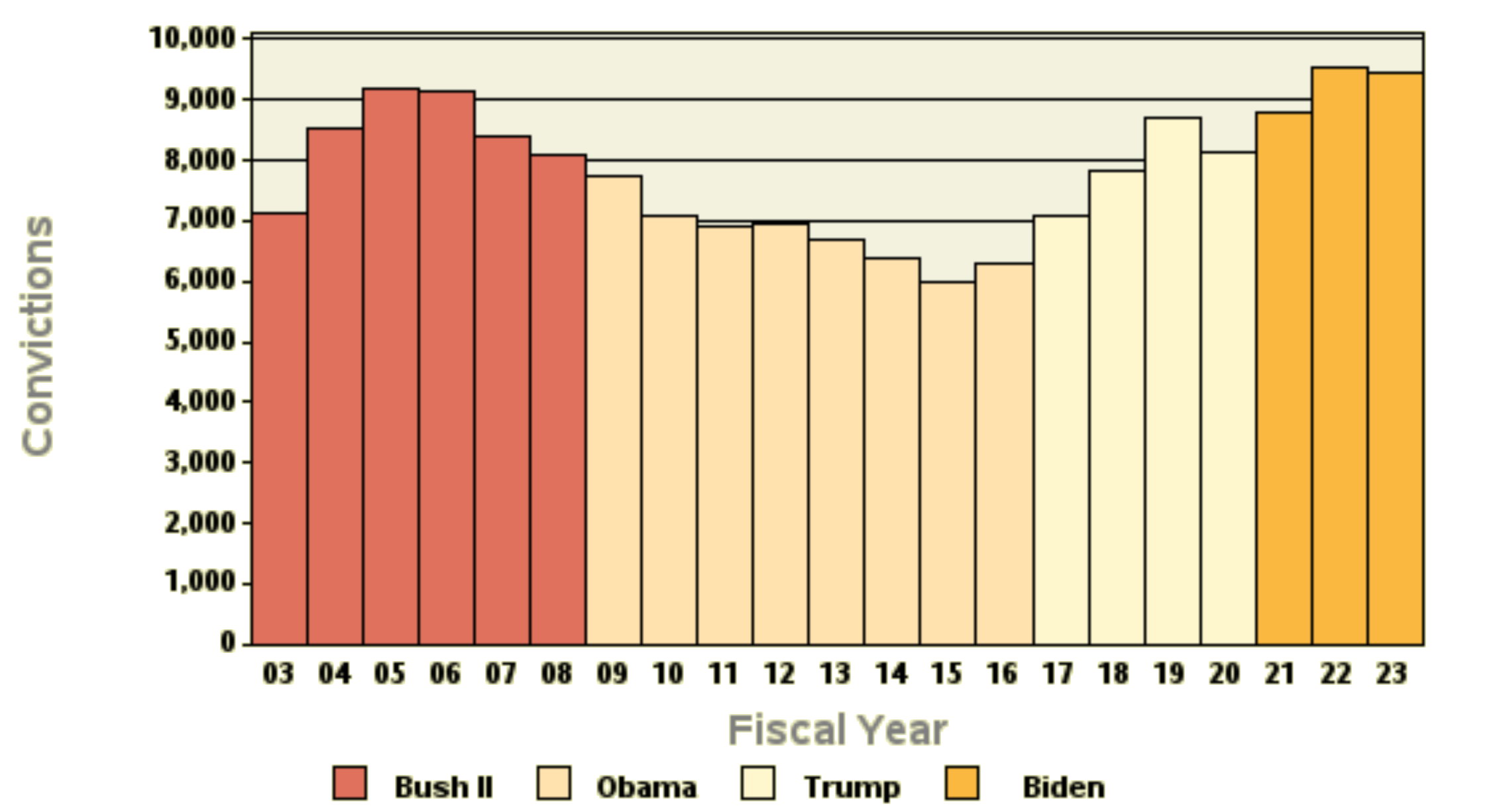
"Rogue rampage" indeed.. almost 10% higher than pre-covid Trump convictions and about the same level as we saw under GWB! Then again, the average person convicted in 2023 had >2 prior convictions and over 7 prior arrests so maybe these are actually just criminals? Wish everyone would decide if we should enforce laws or not.
I'm sorry you buy into all the misleading nonsense from the prepper gun lobby..
They did widen the definition of dealers, but it's still "a person who devotes time, attention, and labor to dealing in firearms as a regular course of trade or business to predominantly earn a profit through the repetitive purchase and resale of firearms."
So casually selling guns to friends and family is fine and doesn't require a license or a background check unless your state requires it.
He had bought over 150 guns in the past 3 years, signed forms for each of them that he was buying them for his own use, and then immediately turned around and sold them, several to undercover Feds. He'd post up at gun shows with a table full of guns and then sell them for cash without paperwork. 6 of the guns he sold were found at crime scenes.. the result of the raid was unfortunate but the dude was exactly who should be targeted by laws like this.
Ok I see the final rule does add definitions of "personal collection," so that would cover me. "Occasionally," is not defined, so that's vague. What if I sell 5 at once? What if I sell 1 a week for 5 weeks, is that still occasional? Up to the ATF to decide.
After reading the affidavit, it was written before the final rule. The affidavit was written 3/6/24 and the final rule didn't take effect until 30 days after 4/10/24. How do you square that?
"9. Your Affiant knows the term "dealer", as defined in Title i8 USC 921(a)(11) of the
GCA, means (A) any person engaged in the business of selling firearms at wholesale or retail; or (B)
any person engaged in the business of repairing firearrns or ofmaking or fitting special ba:rels, stocks,
or trigger mechanisms to firearms; or (C) any person who is a pawnbroker"
Change of the rule:
"Section 12002 of the BSCA broadened the definition of “engaged in the business” under 18 U.S.C. 921(a)(21)(C) to all persons who intend to “predominantly earn a profit” from wholesale or retail dealing in firearms by eliminating the requirement that a person's “principal objective” of purchasing and reselling firearms must include both “livelihood and profit.” The statute now provides that, as applied to a dealer in firearms, the term
“engaged in the business” means “a person who devotes time, attention, and labor to dealing in firearms as a regular course of trade or business to predominantly earn a profit through the repetitive purchase and resale of firearms.” However, the BSCA definition does not include “a person who makes occasional sales, exchanges, or purchases of firearms for the enhancement of a personal collection or for a hobby, or who sells all or part of his personal collection of firearms.” 18 U.S.C. 921(a)(21)(C)."
This matters because his firearm sales weren't his livelihood and could be argued it was a hobby. He made, I believe, $250,000 working for the state of Arkansas as his livelihood.
Sure but many laws leave room for reasonable people to decide whether something rises to the level of crime.. I'm not sure it much matters because he was lying on the Federal background check forms which is a separate crime that the ATF was investigating and he was shipping / receiving them over state lines, another crime that's indifferent to whether his selling 150 guns was a hobby.
Yea I saw that, but in the affidavit, it claimed he broke the rule that wasn't in effect yet. "Well he did other stuff," true or not, is kinda hand wavy. They weren't wearing body cams which is required by law. They could have pulled him over, it was a sloppy raid by a sloppy agency who didn't even follow the law themselves.
Apparently the lie, was that he stated on the forms was he answered yes on the question regarding if the firearms were for himself.
Here's another botched incident, not sure what they were thinking here. This certainly seems extra-legal.
In a similar raid last year, more than a dozen ATF agents wearing tactical gear and armed with AR-15s stormed the rural Oklahoma home of Russell Fincher, a high school history teacher, a Baptist pastor and a parttime gun dealer. Fincher now believes their goal was to scare him into relinquishing his Federal Firearm License.
“It was like the Trump raid. They called me out onto my deck and handcuffed me. My son was there and saw the whole thing. He’s 13 years old,” Fincher told the Second Amendment Foundation last year. “They held me on the porch for about an hour. I was surrounded by agents. One by one, they yelled at me about what I was doing. In my mind, I decided if they were going to beat me up over every little thing, I’m done. As soon as I said, ‘If you want my FFL, you can have it,’ one of the agents pulled out a piece of paper and said, ‘Well then sign here.’ He had made three copies in case I screwed one up. It was exactly what they wanted. I was shocked.”
I have so much disdain for these organizations.. there's a really important debate to be had about the role of firearms and firearm laws and overzealous Federal agents, but the NRA/SAF aren't interested in honest debate, they're just fear-mongering ghouls pumping out bullshit to fundraise off of.
I looked into the Fincher case, and it's another case that SAF is basically just lying about. They can run these insane headlines and then don't follow up...
Fincher had a FFL but no store, so he'd sell primarily at gun shows. He'd buy guns from other dealers or from manufacturers with his FFL, and then sell them in "private" sales at gun shows with no background check. It looks like the Feds caught onto that and then had a CI do a controlled buy where Fincher was told the purchaser was a felon, and Fincher didn't give a shit and illegally sold him ammo anyways.
Call me crazy, but a FFL doing straw purchases for AR lowers so he can sell them under the table at gun shows is exactly the kind of thing that the ATF should be shutting down.
Fincher guilty plea (he got probation with no jail time - and the FFL who was holding all of the guns Fincher had purchased but not yet sold was ordered to sell them and give the proceeds to Fincher):
https://storage.courtlistener.com/recap/gov.uscourts.oked.35...
>It looks like the Feds caught onto that and then had a CI do a controlled buy where Fincher was told the purchaser was a felon, and Fincher didn't give a shit and illegally sold him ammo anyways.
Looks like he sold him ammunition, not firearms. I'll look into it more.
I agree though, the propaganda machines are going full bore.
> 99.99% of gun purchases in the US happen through an FFL with a background check and everything
Alot of states have classified pages where you can buy/sell firearms. Many states don't require background checks for private sales. People aren't paying a gun shop a FFL transfer/background check fee to hand over the gun to the buyer. Source: have seen many of these transactions at rod and gun clubs.
>There are almost no situations where you will not be buying your firearm from an FFL and you will have to fill out a background check form and have a waiting period.
There is what the law says, and what people are physically cable of. I am being realistic, but you are free to challenge that realism with paperwork that can be ignored by folks who would seek out the hardware mentioned. There are laws against murder, how did that go today?
I am making observations of an operating environment, and don't hold strong opinions on gun rights and similar. More, "What am I dealing with as someone who has to live here?"
Your argument started by talking about loose laws for firearm purchases. Not about being “physically capable” of. It then transitioned directly to talking about suppressor availability. I think it’s reasonable to point out that they are different legal regimes if only for other people confused by your abrupt and silent transition away from talking about laws.
Fair points, I simply don't (subjectively, imho, ymmv) believe it is that hard, legally or illegally, to acquire or possess firearms and accessories for them in most US jurisdictions. "The purpose of the system is what it does" sort of thing. Appreciate the discussion! "Don't break the law" PSA.
I spend _a lot_ of my life interacting with firearms, gun culture and accessories. I do so in Illinois where suppressors are illegal and I’ve never seen one here.
Indiana is a bike ride away and has some of the loosest gun laws in America. I shoot suppressed there all the time.
I believe that manufactured suppressors actually are hard to get in the US in a way that is untraceable to the original purchaser, which makes them hard to get in illegal jurisdictions.
Guns are much more broadly sold and less restricted so I agree that they tend to be very available.
You need a metal barrel and bolt to contain the explosion and that's it. FWIW, you can make a single shot shotgun with two metal tubes and a nail. Traceability only matters if you recover the firearm.
It's still slightly impressive. The lobby of that hotel takes up half a city block and has many entrances and exits. There are lots of ways to get in that are not necessarily the front door.
If I were approaching this professionally I'd be waiting near the check-in desk or elevators.
Crazy, if true. Perpetrator knew many people in the area. Had to reduce the chance of raising suspicion. Although “silencers” (suppressors is the better term) are not very silent as depicted in films and tv, but do suppress the muzzle flash and suppress generated sound.
I guess in a crowded NYC, that’s just enough needed to escape the scene.
Suppressors don't just reduce the sound, but they reduce muzzle flash pretty dramatically. So it would help prevent someone from seeing the flash and knowing where the shot came from
In the interest of brevity, they're not called silencers, they're called suppressors since they don't "silence" anything like in a Hollywood movie. Typically a suppressor will reduce the sound signature of a gunshot from something like 140dBA to 110dBA. Still enough to cause hearing damage and be heard a quarter mile away.
The original use case was hearing protection. The modern tactical use case is that it makes it somewhat harder to tell where a shot came from. In almost no scenario does it actually make a gunshot quiet (maybe a subsonic .22).
You can load subsonic rounds in many calibers, but tbf the best and most convenient options are all embargoed from the US because of Russian sanctions.
Off-topic, but the US is, oddly, a bit of an outlier compared to some of our cousins on the other side of the Atlantic, where buying one can be an over the counter transaction. It's weird to be in a situation where the US is more restrictive in anything related to firearms, but I assume the European attitude is that it reduces nuisance when gun ownership is more regulated at the front end.
There is an enormous amount of theater in US lawmaking. “I’m doing something about the <X> problem.” (or even just “I proposed legislation that would have done something about the <Y> problem…”)
Crafting of US legislation has absolutely no basis in efficacy or data, it's entirely driven by the news cycle. Something attention grabbing (like a Mandalay) happens, something extremely specific from the headlines but largely secondary to enabling the actual crime (like bump stocks) are banned, then the whole thing is forgotten about
This is nonsense. Even the companies that make them often call them silencers. And your information is wildly out of date on how quiet suppressed subsonic ammo can be.
Costly permit. Requires authorization by high-ranking NYPD. Only given out to people in certain jobs or with bribes. The only practice range is in Ridgeland. You're required to transport it in your own car, in the trunk, ammo separate from the gun, and only to and from the range.
That puts it well beyond the reach of the vast majority of NYC residents.
Nah - there's a premise permit that's needed if you only have it in your apartment and carry to the range, but the concealed carry is sufficient to have it in your apartment. And the "90%" of Manhattan you can't carry in is basically Times Square, bars and restaurants, festivals, churches, schools and government buildings.
It was actually prohibited to carry on all forms of private property, until a recent court ruling struck it down. So if you can't carry on public transit, you can't carry it in government buildings, you can't carry it near schools and other public property, you can't use it on private property what is the permit for again?
It's no different than how states used "Poll Taxes" and "Tests" to circumvent the 15th Amendment before the Civil Rights Movement. NYC thinks they are above the law and does everything they can to circumvent it.
Yeah I'm not really interested in the debate around NYC carry laws and technically you're allowed to carry on buses but not trains, but it is certainly one of the most restrictive places in the country.
There was even a recent high-profile Supreme Court case that eliminated the historically-common (the majority opinion was simply wrong about the history, just, straight-up factually not correct) practice of sharply limiting carry of firearms in towns and cities, let alone ownership. So no, guns aren't meaningfully illegal in NYC, besides the fact that they're extremely not-illegal outside the city and it's not like they frisk anyone on the way in. Like, right now, guns are kinda the least illegal in the city that they've been in more than a century.
It's not like it would matter. You can buy a gun in a nearby state and carry it across state lines without much trouble. Most of the guns used in Chicago come from Indiana.
In practice it is not easier for an Illinois resident to buy a handgun in Indiana than in Illinois. Even an illegal one.
The way straw purchases work for handguns is mostly that a family member who can legally purchase the firearm does.
But if you are talking cross state border sales, which are not the majority even though it’s an oft quoted trope, a resident of Indiana buys a lot of guns, then sells them illegally in Illinois. Precisely because you can’t easily buy a handgun in a state you don’t reside in.
There's a very good article published by ProPublica about the company in question. The name of the company is "EviCore" - so at least they're being relatively upfront about it.
No, they are a top tier health company that offers different options including premium healthcare. If you have 50 million customers, you will have some negative experiences.
They are monetarily and/or promotionally incentivized to pick a bad, cheaper option for employees. The other employees don't get rewarded for the decision.
I'm sorry to inform you that the money does not go to those things, but rather to reward the person who made a poor choice for everyone, and also to retained earnings.
Unless you were being sarcastic in saying "yeah you're going to die sooner due to our poor healthcare choice, but hey, a free soda*!"
Why do you think perks get better when healthcare benefits get worse? Usually they both get worse at the same time due to the same cost-cutting incentives. We'd need some data showing that savings from choosing terrible healthcare plans get redirected towards improving perks in an equal-or-more-valuable way (including for remote folks) in order to justify the former with the latter.
Besides that, most companies can afford free soda with or without terrible healthcare choices, so it seems totally orthogonal: free soda doesn't require bad healthcare choices and bad healthcare choices don't imply free soda.
Without evidence that the savings were being directed towards a cause preferable to employees, I would conclude that there was insufficient convincing justification for choosing a bad healthcare plan other than that it provided extra incentives to the chooser, like money or favor.
'We could theoretically spend greater than 0% of the savings on something that could be better or worse sometime in the future' isn't good enough on its own, and it's not convincing enough that it will ever happen, and if it does, it doesn't leave me convinced that the money will be spent on something better for me.
> even in the worst case scenario, a very low probability for the median employee is still better than zero probability.
The criteria to use here is, "do employees feel they're better off with the new, terrible healthcare plan, given any free sodas etc they might have received in exchange". If the employees wouldn't have voluntarily made the same choice for themselves, then it was a bad healthcare choice for employees.
No, but this is a case where incorrect AI decisions may legitimately contribute to people's deaths. Let's also not normalize the idea that it's OK for people to die so one of the most profitable companies in the world can make even more money.
I'm not saying that you're wrong, or that I feel that killing is OK, but as others have expressed throughout this thread, it feels weird to say stuff like that in regards to a company that itself has normalized letting people die for the sake of higher profits.
This is not even remotely close to the "big issue" with UHG. There's probably no individual company that's responsible for more dysfunction in the American health system than UHG.
Not that I think it justifies murdering the CEO, but also such is the nature of systematic violation of massive numbers of people's sense of justice.
I doubt anyone on HN would have any interest in normalizing that practice. But almost everyone who will be wronged by these systems are going to be up in arms.
I think we'll see a lot more of this sort of thing in the future. Your car killed my mother and the law said it was fine. Your insurance company denied my grandma's claim and she died in agony after paying premiums for 30 years.
Let's just hope that autonomous drones don't become trivially capable as weapons. At that point, everyone from the President and your local police chief to the chairman of Bank of America and the local ambulance chasing lawyer who sued the wrong guy's mom after she hit someone in a car accident would be in a very bad situation.
We should really try to get this under control before it gets out of hand.
Serious question, why exactly should we work so hard to insulate the ultra-rich from the consequences of their actions? They are already virtually completely insulated, whereas everybody else is held to the standard which should be reserved for those with the education to know better and the resources to do better.
Nobody was killed because an AI product was inaccurate. If this was indeed the reason, this CEO was killed for killing someone's family member by denying them healthcare.
You're not expected to have a faultless AI but you're expected to supervise it, to have an appeal process, and to make things right when AI makes mistakes. In other words, this is a "high risk system" under the EU AI Act, which should have appropriate safeguards in place.
> Human oversight shall aim to prevent or minimise the risks to health, safety or fundamental rights that may emerge when a high-risk AI system is used in accordance with its intended purpose or under conditions of reasonably foreseeable misuse, in particular where such risks persist despite the application of other requirements set out in this
Section.
I don't think the parent poster is doing that, I think they are pointing out that when the ai products are faulty and result in the predictable deaths or suffering of people, someone out there might get angry enough to make bad choices.
Per Reddit: "One is a high powered assassin whose livelihood depends on his ability to rationalize beyond emotion to calculate the cost of a life. The other guy is still alive."
Edit: I would love to make $20/minute every day finding ways to drive people into medical bankruptcy, despair, and death, just like him, because being rich is awesome. :)
He means that if the state, courts and other systems don't get people justice or something you can squint at and call justice when they are wronged some fraction of those wronged will go outside the systems and seek to get even instead.
The (rare, perhaps crazy) people who shoot CEOs or armor bulldozers are what check the power of the state to ignore this part of its job.
An interesting individual I know is fond of reminding people that the Magna Carta has been a useful document for over 800 years, but the actual enforcement of the Magna Carta is that every time a monarch started acting like they were above it, a critical mass of people with the power of violence showed up to remind him that he was, in fact, just as mortal as everyone else.
Not this commenter, but how I've often heard it expressed was we created the justice system as a better, more civilized alternative to putting people in holes just outside of town. At such a time the justice system stops working, as it increasingly seems to have RE: the rich, then we resume holes.
This entire line of thinking just seems to be essentially advocacy for a return to that exact system. "Do what we want or we'll go back to random murder".
I wonder if the original commenter would have put the same comment if the article were "man shoots his wife and her lover on discovery of adultery"
shrug I'm not an accelerationist, I do not want to live in any more historically significant times than I already have. That said, our systems continue to fail us at basically every turn so when I see stuff like this, I'm not surprised either. If you put people in a situation where they feel they have nothing to lose, you shouldn't be surprised when they start acting that way too.
People demand justice, whether they're right to is a secondary concern, as is the methodologies they choose to seek it. Some become activists. Some become politicians. Some pick up guns.
>People demand justice, whether they're right to is a secondary concern, as is the methodologies they choose to seek it. Some become activists. Some become politicians. Some pick up guns.
That is a true, but We should discourage and condemn them picking up guns. There is a feedback loop at play
It's one of the so-called "Four boxes of liberty[1]". When the soap, ballot, and jury boxes are no longer effective, we should not be surprised when people increasingly reach for the ammo box.
There is a big moral and social difference between an overwhelming majority of the people and a dissatisfied group.
The ammo box is not justified and should not be tolerated simply because someone doesn't get what they want. That route is a quick decent to societal collapse.
That is how you end up with your incels, anarchist, communists, and Christian fundamentalists shooting anyone who doesnt agree with them.
I was not defending its use, but its existence means it could be used, and that fact acts as a sort of invisible check on what corporate/government power can realistically get away with. If the ammo box didn't exist as an option, then even in a democracy the "overwhelming majority" could do pretty much whatever it wanted to.
Based on impressions I'm seeing online (and freely admitting that this is hardly statistically-rigorous or -defensible sampling) I'd suggest at the very least that dissatisfaction with working within the system is highly palpable. Revolutions are rarely majoritarian viewpoints.
You're assuming his objective was to change healthcare policy, I doubt it was. I think the objective was good old fashioned revenge.
Like this is pure speculation right? But I have a strong feeling that, should the person be caught, we'll learn that they have or had a family member or even themselves insured with UHC who has suffered some harm, and that person felt UHC was responsible. Whether they were correct or not is immaterial: the CEO paid the price.
And you can feel whatever you feel about that, like I said, I don't want to live in a world where healthcare CEOs get gunned down in the street. But I also am acutely aware of how abusive insurance companies are, both from reading about those abuses in the news of others, and experiencing a handful of my own, and I also don't want to live in the status quo, where unelected, unaccountable private companies get to decide who lives, who dies, and who goes bankrupt via inscrutable bureaucratic practices.
In my ideal world, accountability would be these rich bastards getting hauled into congress and charged for the abuses their companies inflict on American citizens. But since our system seems unwilling to do that, if the alternative is they get to walk around just a bit scared that someone will [ censored for HN ]? Well, probably won't fix anything, but I'd be a liar if I said I'd lose a wink of sleep over it.
>In my ideal world, accountability would be these rich bastards getting hauled into congress and charged for the abuses their companies inflict on American citizens.
My point is that these rich bastards are playing by the rules the American citizens set up. American citizens have the power to change those rules if they want, but cant agree on anything they think is better. People like to imagine a grand corporate conspiracy while ignoring half the population that want the opposite thing.
In my mind, it is the same type of vigilantism that justifies shooting up a school, LGBT club, or killing women who wont date you.
> My point is that these rich bastards are playing by the rules the American citizens set up.
Mmmmmmm.... yes and no? Like it's cliche to blame everything on Reagan but the number of modern social ills that can be directly traced to the Reagan admin and the political movement behind it really does baffle the mind. Ills such as, for example:
- The deregulation of corporate finances, that permits the massive stock buybacks that allow corporations to kick absolutely stressful amounts of money to their shareholders and executives
- The tying of the hands of the FTC regarding anti-trust/monopoly regulation, which has led to the greatest era of corporate consolidation since Standard Oil, and all the problematic things that come with it
- The citizens united decision, which unleashed the ability for corporate America to pump shit fuck tons of money into political parties that would then work for their interests
- The repeal of the fairness doctrine, which let an entire wing of disinformation networks form and spread, masquerading blatant propaganda as news (sorry, "entertainment")
And like, you're right in one way, because the Republicans didn't come out to the American people and say "hey we want to enable corporations to rat fuck you for every dollar you have, along with every dollar you don't have, and to make them effectively the funding that both parties need to accept in order to have a snowballs' chance in hell of winning an election. Sound good?", obviously. But the various "mandates" that they've received from conservative voting blocs over the years are dubious as fuck, and if you scratch them just a little bit, you oftentimes find that their voters are so incredibly bullshitted at this point that they don't even truly know what the fuck they're voting for. Citation: literally in the last presidential race, there was a shit ton of people after the fact who both:
- Didn't realize tariffs would drastically increase the cost of goods in the United States, because exporters do not pay them, importers do (and in fact, if the rumors are to be believed, neither did their candidate)
- Voted for the party promising to repeal "Obamacare" despite receiving benefits from and in fact, needing the Affordable Care Act, not realizing that Obamacare is literally a made-up bullshit name given to the ACA by Republicans.
So like... yes, technically, the Republicans (and Democrats, make no mistake, their fingerprints are all over this shit too, just to a lesser degree) have built exactly the America that Americans want. However, it is impossible to fully divorce that from the just incredible amounts of propaganda Americans injest, both from the political parties who decide what is "feasible" to the corporate media.
That is very close to my point. It is very easy to focus on a shady cabal and ignore the plurality of our countrymen that actively think and want something different.
It is like there is a deep denial that real humans often want something different, and that we are forced to share a democratic society with them, which means losing on issues where we think we are right.
So should we as “real humans” also set up our own lobbying channels in Washington? Or are there some problems that make that somewhat unfeasible for us “real humans”?
Yes, that's the essence of social contract theory. Which, it should be noted, is a historical falsehood, in that we're pretty sure no ancient tribe ever really started with people sitting down and saying "It is mutually beneficial if we curb our violent inclinations for the safety and security of blah blah blah"... but is a useful shorthand for the observed notion "A government lasts only as long as it provides a better alternative to picking up a 2x4 and settling your own scores for most people who support it."
"You rule because they believe," in essence.
(This is why, historically, you'll often see societies keep their pattern of government until, say, famine comes along. Because if you're going to starve to death, the likely outcome calculus on picking up a 2x4 starts to change drastically and quickly).
The distinction would be that you can still seek legal redress in court for your spouse committing adultery. It may not be the redress you want, but it would at least get you something, e.g. grounds for divorce.
Increasingly, though, people in the United States feel that the rich and powerful have become effectively insulated from the legal system, such that the common person is denied any redress. At that point, one no longer feels any reason to continue working within the legal framework, because it seems clear that the framework is not at all "equal" under the law.
Hence, when all other options feel exhausted: murder.
And, frankly, I imagine this will only continue with time, unless this country decides to actually provide some mechanism to hold people in power accountable. Like, I'm frankly surprised no one has attempted to assassinate members of the SCOTUS yet recently, given that they enjoy a lifetime appointment to make wide-impacting, scrutiny-free decisions.
> Increasingly, though, people in the United States feel that the rich and powerful have become effectively insulated from the legal system, such that the common person is denied any redress.
They're not insulated from the legal system, the problem is the public is being misled.
It works like this: The media lies to the public and tells them that a CEO or Public Figure is getting away with X, so they get some washed up lawyer to do an opinion piece on it, a politician or two co-opts it, and possibly throws in some bait about the working class being screwed over, and then the public buys the made-up story- hook, line and sinker.
Since TV Law is not the same thing as real law, the person in question is put through actual due process and the allegation or accusation turns out to be unsubstantiated. The public then feels outrage because "The man on TV said this person was a criminal and he got away!".
There are two outcomes here. Either they are insulated from the legal system (and in many cases, they absolutely are by virtue of having enough money to squash and drag out cases into oblivion), or the legal system is deficient.
Consider the Yotta/Synapse situation. Many people have lost a huge sum of money and the two companies involved are simply shrugging and saying they have no clue where it went. In many countries, either this problem would've never been allowed to occur in the first place or the government would start jailing people from the top down until someone starts to talk.
You're missing the point. The people running corporations are NOT flagrantly violating the law-as-written, with the courts just refusing to enforce it (for the most part). Rather they bend the law, often through tiny repeated violations of the law-as-written, and also through lobbying/bribing to undermine the creation of directly applicable new laws, to produce abjectly terrible outcomes that end up being de facto legal. So when the average person feels ever-more subject to the law themselves while seeing the terrible corpos continually getting pass after pass, they become ever-less invested in the general idea of the rule of law.
There are still the factors of exposure rate and a difference between legal reality and expectations.
Fundamental to this is that people are increasingly siloed and have little idea how closely the legal system reflects the will of the majority. They just think that their opinion is the majority and anything that deviates is the product of a corrupt system and public disenfranchisement.
Sure, that gap exists. But that doesn't mean it explains away the whole topic the way it had been invoked.
Furthermore I'm quite wary of hand waving arguments about the "will of the majority". "The majority" just complained about price inflation, while electing the former president that approved most of the monetary inflation they were complaining about, while he was actively promising even more inflation. And that is on a topic the average person should be able to understand! Never mind more subtle points about the downstream effects of more abstract policies. The way I see it, most everyone is extremely frustrated with the current system (hence spitefully voting for more destruction by President Inflation). But most of the energy gets used up arguing about which direction we should go, while the corporate machine stands ready to latch onto and nullify whatever attempts at reform that may arise.
I wouldn't do it, but I actually do understand and respect the argument, "neither political side is going to materially help me, so why not vote for a wrecking ball that will surely change something?"
I don't respect it because it was not an overt message being campaigned on, but rather the same 4d chess contortionism of people pulling out their own wishful signal from the noise of a double-talking con artist.
Furthermore even taking that argument at face value, it takes for granted how much we still do enjoy - even people on the shit rungs of society. The US military and world alliances making it so that we don't have to worry about military invasions, USD as the reserve currency making it so what we consider high price inflation is actually quite tame, bureaucratic authoritarianism keeping corporate authoritarianism from completely taking over, federal law enforcement keeping armed gangs in check. The economic meat grinder wealth/hope extraction machine is abjectly terrible, but also things can be so much worse.
I don't know about the original commenter, but societies only work when the vast majority weigh the cost and benefit they derive from the status quo against the cost and potential benefit they incur by fighting against it, and decide that they're better off playing along.
Rightly or wrongly, we now have a situation where a lot of people believe that they no longer benefit from society, and are in fact harmed by it, while they also see a few benefit greatly. I believe this is why many people who understand the implication of that choice would still rather vote for Trump, who promises to break things, than for Harris, who would have only made minor changes.
This is not advocacy for anything. I think these people are perhaps not exactly wrong, but they don't correctly estimate the cost of breaking a democratic system, even a poorly working one.
Yes it's not advocacy for anything: It's up to everyone how they respond to their situation if they feel disenfranchised and I'm in no position to judge them one way or another.
The point is just that it's a tale as old as human civilization itself. It would be disappointing if we've not yet learnt enough from our history to avoid more change via trauma.
Indeed, the insurance companies deserve a ton of blame too. They rightly have death panels but use scare tactics to keep people away from gov health insurance that does the same. Still, theyre playing by the rules the gov came up with. Fee for service is a horrible healthcare strategy and insurance is forced into it.
The "Death panel" thing was the primary boogeyman when the ACA was being discussed. But like the comment says, that already exists, just in private form instead of government.
Insurance companies funded the vast majority of advertising using that term to attack the ACA, and their lobbyists meet with politicians often enough that it's entirely plausible they coined the initial term as well (though harder to prove)
The simpler explanation is that political Party A proposed legislation, and political Party B attacks it because a win for Party A is a loss for Party B.
And digging into just slightly further makes the claim make even less sense:
> Palin's spokesperson pointed to Section 1233 of bill HR 3200 which would have paid physicians for providing voluntary counseling to Medicare patients about living wills, advance directives, and end-of-life care options. Palin's claim was reported as false and criticized by the press, fact-checkers, academics, physicians, Democrats, and some Republicans.
Why would managed care organizations (aka health insurance companies) oppose the government paying for more healthcare services?
MCOs earn 2% to 3% of the premiums that flow through them. The higher the healthcare spend, the higher the premiums, the higher the profit for MCOs.
"No evidence" - if you can't avoid misinterpreting every sentence to go off on a rant, this thread is not worth continuing.
Insurance companies spent billions of dollars on advertisements against the ACA. This is public record. They did it because they opposed all of the good things the act required - such as prohibiting discrimination base on pre-existing conditions or demographics (other than age), requiring many basic procedures to be covered, bans on lifetime/annual coverage maximums, bans on dropping policy holders when they get sick, prohibiting copays on various services such as vaccines, requiring that insurers spend at least 80% of their premiums on health costs, a wide array of reforms to constrain costs, and so on.
Someone claimed health insurance companies came up with “death panels”, I provided evidence and logic to the contrary.
No one is ranting, but there does seem to be a lot of “I feel like this could have happened, so I am going to choose to believe this happened because it confirms my priors”.
Why do we need a government program. Continue with the medicare/medicaid and child healthcare programs as always. Outlaw regular health insurance. The problem will solve itself. "Free market".
And insurance companies want us to need more or pay more for health care, not less. Insurance is regulated and the companies can only hold on to a certain percentage of the premiums.
They would rather hold on to 20% of a huge number than 20% of a big number.
Agreed, the incentives are horribly misaligned throughout the entire healthcare market. We desperately need legislative overhaul but again congress is completely broken.
My insurance denied me a MRI and physical therapy because having 2 working arms was a luxury. Had to pay out of pocket to be able to lift my arm above my head. Private insurance can go shove it.
"Americans consume too much healthcare"? I'm afraid to guess the logical conclusion to this, but I will counter with "Americans are offered two little preventative healthcare", because in more advanced countries where that is an option, the costs are lower.
The conclusion is that we need to get rid of fee for service so that doctors stop prescribing things that dont work. Getting rid of fee for service also increases the amount of preventative healthcare people receive as providers realize its cheaper to do preventative than massive surgery down the line.
The primary reason for the cost difference is the massive network of middlemen injected into the system, and rampant profiteering by for-profit healthcare companies.
Average cost of 1 vial of insulin in France: $9.08
Average cost of 1 vial of insulin in the US: $98.70
HDThoreaun: huffing some libertarian shit "The people are using too much insulin."
It’s not middlemen. The middlemen (managed care organizations, aka health insurance companies) earn low single digit profit margins.
In the US healthcare chain, the ranking of profit margins goes (and this is public info from public financials):
Pharmaceutical companies
Healthcare software companies (based on other software company margins)
Healthcare providers (doctor groups)
Hospitals (HCA, tenet, etc)
Managed care organizations and retail pharmacies at the very bottom.
The big one I don’t know is legal, which I assume slots between hospitals and healthcare providers, but could be higher. Those millions and tens of millions of dollar judgments don’t come from thin air.
Go ahead and get rid of MCOs, and at best you will reduce costs by 5%. That’s an objective fact. They are just allocating the very limited resources among more and more demand.
> Go ahead and get rid of MCOs, and at best you will reduce costs by 5%. That’s an objective fact.
That doesn't make any sense. Profit margin is meaningless if you are spending billions on a bunch of useless administrative staff pushing paperwork for no reason.
Obviously some of that is necessary, but certainly not nearly all of it. I don't care about a company making 5% on top of a $150k/yr admin salary. I care about the $150k/yr salary which is the true cost added to the system.
Having watched from afar my friends in healthcare who actually provide bedside care vs. the administrative bloat - it's going much like education. Tons of admin staff added that don't ever touch patients that seemingly just get in the way of the folks doing the actual work.
Margin is a meaningless number if you can just pump your expenses to increase the total dollar amount.
> Margin is a meaningless number if you can just pump your expenses to increase the total dollar amount.
That doesn’t make any sense. If one MCO were to pump their expenses, there are 4 to 6 others waiting to take their customers with lower premiums.
Currently, medical loss ratios are around 85% to 90%, which means MCO administrative costs are 8% or maybe 10%, at most.
However, getting rid of the MCO doesn’t mean those costs go away. Government employees will have to do the prior authorizations rather than MCO employees. So I split the difference, and you end up with a net savings of 5%. Make it 10% if you want to be super optimistic and think the government will streamline paperwork for healthcare providers.
The other 90% of healthcare costs are still there.
>there are 4 to 6 others waiting to take their customers with lower premiums
Why do people believe this?
Healthcare isn't widgets and factories in an ECON-101 class.
The chances of anything short of an extremely large and well-funded consortium of investment bankers and private equity firms starting a new MCO is exactly and precisely 0.0%.
And those groups have the same incentives to maximize the payouts to all parties involved that the incumbents do.
Of course, they would never do that because increased competition would threaten their already-extensive investments in the sector.
The problem isn't regulation, or regulatory capture, or any other buzzword a podcast full of morons bandies about.
The problem is that you need at least $10 billion just to open the doors.
UNH/Elevance/CVS/Cigna/Humana/Centene/Molina are just the biggest publicly listed ones. They might not all offer plans in all states on the exchange, but there’s a decent amount of competition for employer subsidized plans.
The low single digit profit margin proves the competition exists such that the sellers don’t have pricing power to earn a higher profit margin.
I think you left out several layers. At least one of which in the news lately is the PBM, which sit between hospitals/providers and pharmaceutical companies, and are able to exert monopoly power on that market. They have agreements with hospitals that hospitals are only allowed to purchase through them, and then their suppliers are permitted to purchase exclusive access. This results in things like the saline shortage last year, and pushing small local pharmacies out of business. The PBMs also have incredible profit margins, upwards of 80%.
> the massive network of middlemen injected into the system
Does anyone have a good reference for this? It's something that I inherently assume exists but would love to see a flowchart of how rampant it is and where different layers are siphoning their penny.
It doesn't have to be 17%, it can be an arbitrary number because the ones who decide on the nominal pricing are the ones who make money on them being extremely high. These same procedures can in some cases cost even 2-3 orders of magnitude less - and not in another country but in the same hospital but with a patient willing to pay in cash.
list prices are high to scare Americans into buying [more expensive] insurance plan.
they want Americans be scared of going bankrupt from medical bills.
on the backend, between insurance and hospital, these giant list prices are automatically lowered by factor of 10 to the actual cost of procedure
the business model is:
1. insurance scares people with huge prices
2. healthy americans buy a lot of expensive insurance
3. money is injected into healthcare system from healthy patients
4. money is split among insurance/pbm/providers/pharma
>The main reason for that is because Americans consume too much health care.
No, come on man, this is easily googleable. Americans go to the doctor less than other countries, they stay in the hospital less than other countries, they have lower life expectancy, infant and mother mortality than other countries. If you want to know why we spend so damned much, it's because we're billed 2-3x as much for the same care as other countries.
A more apt statement might be that we spend more, even if our quality of care is not better. And the reason we spend more is because of profit-maximizing companies in the middle.
TV pundits are compensated based on their ability to keep audiences engaged. The people who decide that anger-based engagement is acceptable are, like Brian Thompson, executives.
I don't think any of them deserve to be murdered, but the pundits are an odd place to place blame.
Guns are inanimate objects and cannot be ascribed blame. Gunmen and lawmakers can.
This CEO, in particular, has almost certainly taken actions that resulted in preventable suffering and death.
To some degree, that's the nature of running health insurance companies, but if he put profits ahead of patient outcomes, I think we could have a very reasonable discussion on the morality of letting people die at scale vs murder.
It's supposed to be a pretty blank check for critical bills, and this company does a bad job of fulfilling that.
> You can always decline the health insurance and pay out of pocket if you think it is a bad deal.
Ha. You could make this same argument about literal scam insurance that denies almost everything once your claims go above your payments. That's not a reasonable defense.
What planet do you live on? Are YOU getting your information and worldview from "TV pundits"?
Corporate greed is a race to the bottom and CEOs are the avatars of that greed. Nobody needs a pundit to tell them that, they're experiencing it first hand for themselves, and you're playing a losing game defending them. You will never convince a man who struggles to pay rent and buy food that a CEO deserves millions of dollars. You will never convince a woman that she deserves to be in thousands of dollars of healthcare debt so that the CEO can buy extra houses and cars.
Human nature will never accept this, no matter how much you wish your libertarian philosophizing about the world was representative of reality. Corporations and billionaires continue to gain power and working class people are getting exploited more and more. There's a breaking point and we're racing towards it fast.
The wealth gap is higher now than it was during the French Revolution, if anyone was interested in "history repeating itself" insights into the future.
Won't spin off reform, and in all likelihood, is just going to result in Fortune 500 companies doing unethical shit to begin budgeting for armed protection for their top brass.
There is nothing wrong with "eating the rich", because if something were to happen to the rich, they brought it upon themselves, since they control the governance via lobbying, special interest groups, media, corporations, NGOs, etc
We should absolutely normalize "eating the rich" discourse, to remind the elites that they are not better than the common folk, so that the system can self-correct without resorting to the violence that can break apart society completely
> The tone has shifted in a way that people who would have never be considered violent, are out buying weapons.
I think that's what happens when people feel a peaceful discussion is going nowhere. The frustration only increases while available non-violent solutions appear to shrink. The Black Panthers, Palestinian terrorism... There's nothing good about it, but I find it entirely unsurprising.
Not only people feel that the non viability of peaceful dialogue doesn't exist, it is a reality that such dialogue is not going anywhere. As reiterated by the Genocidal regime's prime minister, peace in Palestine is not an option for Zionists.
The solutions are not appearing to shrink, rather the solutions are made to shrik, deliberately.
If we are to be intellectually honest, then my position is:
1. Zionism is a colonial settler project created by British Empire, lord Balfour created it to create a buffer zone between Suez Canal and Ottoman Empire to protect British trade route to India.
2. After ww2 when British lost all their colonies, US picked it up as its own colonial entity and uses it as a military base to exert pressure in the region on oil rich countries
3. Zionists have no claim to the land of Palestine because “biblical claim from 2000 years ago” is a ridiculous pretext for British-US empire to keep a colony in the middle east.
4. People of Israel are being used to project power and fight imperial wars to control the middle east, at the great expense of the jewish people and especially global diaspora and long-term prospects and reputation of Judaism
5. Because it is colonial settler project, it is accompanied by all sorts of crimes against humanity, like: ethnic cleansing, displacement, genocide, war at the great expense of the native population that lived in peace in the holy land, before Zionists from Europe showed up in late 19-early 20th century
6. Because we live in 21st century, I dont agree with colonial settlement projects and crimes against humanity, recognized by UN and other international organizations and the best course of action is to implement UN agreed decision to resolve a conflict
Since Palestine is considered occupied territory and is a member of UN, then in this situation Protocol I of Geneva Convention applies, that justifies military means to resist occupation and self-defense
Palestinians are resisting occupation and apartheid state - is my position and is a position of an overwhelming majority of UN members (who dont have strong Jewish lobby)
Why do I obsess about terminology? Because “palestinian terrorism” and “islamic terrorism” ingeneral is being used as dog whistle to spread Islamophobia and justify foreign invasion into Muslim countries by the imperial forces to steal resources like gold and oil (Iraq war, oil in exchange for food and etc)
I don't think anti-capitalist is a useful label in this context. There doesn't have to be a contradiction in being pro-capitalist and also being pro-eat-the-rich. A situation of extreme inequality that is likely to precipitate an eat-the-rich sentiment is probably not an effective example of capitalism at work.
Miltia groups, and any such group as you are describing would be or are completely infiltrated. Al Qaeda was less of an organization and more of a brand name that was taken up by different groups who had no affiliation with eachother but did so to increase the amount of donations and resources they received from the community.
There are around 200 armed militias in the United States. Some of them have a national presence, working command structure, and tens of thousands of members.
I can certainly agree that the healthcare system in the US is broken, but I don't think applauding the slaughter of healthcare executives is a reasonable reaction.
>Also that would be a great plot for a movie, akin to the Breaking Bad TV series.
If you took this idea and worked it into a script with characters and drama you'd get something close to John Q starring Denzel Washington. Not his best work, but a pretty good watch.
Indeed, or in a Tarantino movie, but in that case the killing would need to happen in a different way.
Maybe like, his own employee has her husband's treatment denied, then fueled by rage, does the justice with her own hands with a lot of red in the screen and some feet shots, of course.
This is unjust. I don’t want to know what sick conspiracy mindset led to this - I wouldn’t be surprised if the murderer’s only motive was terror and a ill-defined, horrifying blanket desire to target “the establishment”.
In a just world, sadly, this man would have been slapped with a class action case with a 1000 times the ferocity the ex-CEO of Steward Health is getting, and both he and UnitedHealthcare would be painstakingly charged for the tens of thousands of manslaughter cases he would be liable for, that families of victims would happily testify to, whether due to denied care, or the stress or unsustainable and unjustified medical debt.
That would be justice, and that would the be the only way the insurance industry would have been seriously pushed to reform.