I think you'd be surprised at how quickly that sentiment has moved from the far-right to close to the center. People are (rightly, in my opinion) pretty upset at their governments for letting mass migration happen with pretty much only downsides for their actual citizens. People are all about the idea of helping the downtrodden when it's just an ideal, but when they realize it's having negative consequences for them that can easily change.
Radiolab (the podcast) did a good series on border policy that was pretty informative.
IIRC, the US-Mexico border was never open, but it was quite porous. People would come to the US, work for a season to make some money, then go home.
Then once border security started to be tightened, leaving was too risky so people would stay leading to a huge increase in the number of undocumented people living in the US.
To expand on this. California has the majority of illegal migrants. A significant portion of them are "seasonal" fruit pickers where there exist some migrant farmer visas for them, but not nearly enough. Now should we have American citizens/PR holders doing these jobs? Maybe, but it's pretty hard to get Americans to do this back breaking work in the hot sun for a few weeks, travelling from farm to farm until all the fruit is picked. American fruit is really only as affordable (and available) as it is thanks to all this migrant seasonal labour.
I think there's probably some leftist argument against this system on account of how we're taking advantage of poor countries and something something workers rights, but I think removing the ability to leave, to go home is the worst of both worlds.
Strict borders have only existed for ~100 years, and many were drawn without much regard for the people living there, often constructed with intention of religious segregation, and to maintain europe's global superiority
They run counter to the notion of sovereignty and local agency which we value greatly in the US
The irrationality of strict country borders and heavy migration controls will emerge as a heavy global challenge due to economic and climate migration and aging populations
I don't think we have a good answer for what replaces them, but I don't believe there's enough evidence to state that hasty decisions made after WWI and WWII should forever govern global human freedoms - and we need a better approach than war to renegotiate some of this
Part of the reason this thread and this topic is so fraught is there are many people, like you, who are willingly and confidently lying about history. Strict borders have existed since ancient times. There are physical markers of them all over Europe that are more than 1000 years old. You can see other borders from space. This idea that only in the 20th century did this idea emerge is so wrong that it’s got the history completely and totally inverted. Why make stuff up like this?
Specifically, assuming a succesfully policed border, how did one prove their nationality, if they had such a thing, or their legitimacy otherwise for crossing it?
I will take your word for it either way! Just genuinely curious. How was it all handled before passports and birth certificates and such?
For identity away from people that knew you or your relatives you had to rely on physical letters of introduction from trusted, well know people.
But usually you were proving that you were entering (or leaving) for a legitimate purpose rather than identity exactly. There is a long history of travel documents for this, see https://en.wikipedia.org/wiki/Passport#Antecedents
Worth noting that once urban centers formed travel became the exception rather than the rule. There were traders who traveled trade routes and knew that requirements on those routes but for more exceptional travel you had to rely on these introductory letters in many areas of the world.
Mass migration events were different of course - and were always problematic.
The concept of a passport didn’t emerge out of the ether. If you were traveling on official business, for the state or the military or as a merchant, you’d be carrying papers that said as much. Much of it relied on trust and reputation, and assuming we’re talking about say medieval Europe possibly the signature or word of a Lord. As for enforcement, violence was common.
One of the biggest drivers of strict borders was tax collection: they defined who could collect tax from which subjects. This was a common source of conflict and so anywhere feudalism was practiced strong border definitions were strongly enforced.
It's possible the grandparent is talking more about the idea of limiting travel across those borders. That is a more defensible position but even then it was more about the the costs of enforcement.
Trade routes had very strong border enforcement because the borders were places taxes were collected for example, and there were limits on who could travel various routes.
For example Venice, Genoa and the Ottoman Empire jealously protected European end of trade routes linking to the spice road.
A lot of but certainly not all Dems (for example, Jayapal) support essentially unlimited asylum claims admitted to the US while claims are processed (i.e., not "Remain in Mexico"). This is a de facto open border policy; the vast majority of claims are bogus, but the claim gets you into the country and then most who are denied will overstay illegally as well.
The obvious solution to the problem of abuse of the asylum system (which is in fact a real problem) is to hire more immigration judges so that claims are processed in a timely manner. Apart from getting rid of the asylum process entirely, that's the only long term solution. It's something Joe Biden made progress on (though he did overstate his progress), and Donald Trump reversed.
It doesn't show up in the short term numbers because it is a long-term solution. But Americans aren't interested in long-term solutions.
Tell me, how do you, as an immigration judge, actually judge someone that says their life is at risk due to x,y, or z but you have no way of actually verifying that? Especially when they crossed quite a few countries to get here? I don't see how that's an actual solution to the problem.
One could easily argue that Trump made for more progress as far as the immigration courts being backed up by simply not having an almost completely open border like we did with Biden.
(Also, FWIW, those immigration surges were good things (for the US), and likely helped the US stick the "soft landing" instead of slipping into a post-covid recession)
Not better, just different? GP's chart includes two prior administrations for context; yours includes Trump 2, which also provides additional context (but excludes Bush and Obama).
Biden: "Here's an app where you can make an appointment to illegally cross the border. Our system will be so backed up that you won't need to go to actual immigration court for years, and even then if we tell you to leave and you don't we probably won't go after you. You'll have plenty of time to make an anchor baby. Oh, I can't close the border without a bipartisan bill that essentially enshrines a certain level of illegal immigration. Can't be done."
Trump: "Border is closed. We're deporting people, starting with mostly those that have committed serious crimes."
The mandatory trigger at 5,000 encounters/day (or 8,500 single-day) implied acceptance of very high volumes—potentially ~1.8+ million encounters/year—before full expulsion authority kicked in. That expulsion authority only lasted for 3 years. It also codified/expanded release authority for asylum seekers under certain "operational" conditions.
The main point is that Biden acted like his hands were tied and Trump showed that they clearly weren't, and that we already had the tools to effectively shut down illegal immigration (through the border, at least).
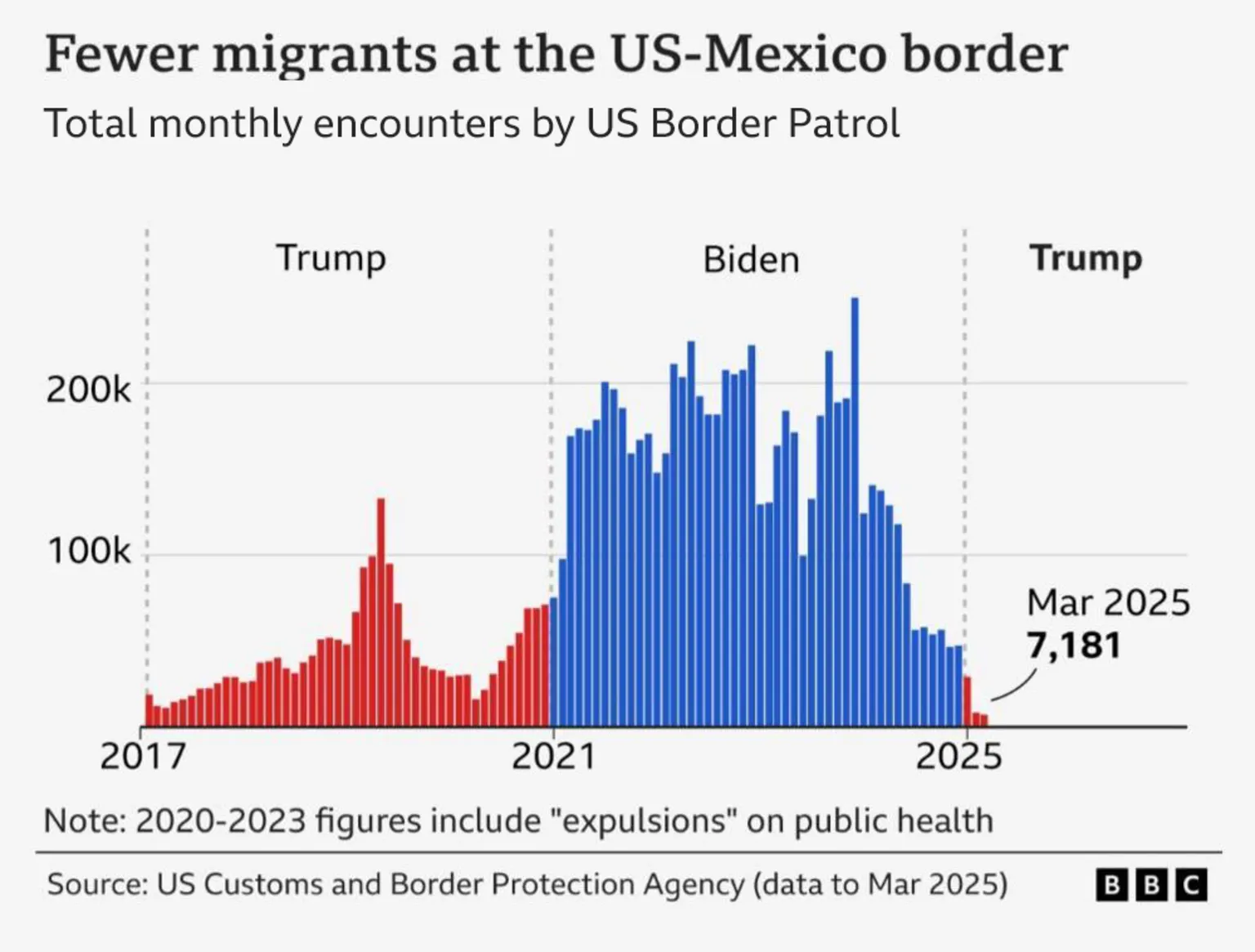
the graph actually makes it look like the jump was due to Trump's policies, since the spike started in his term. if anything the graph shows that Biden policies arrested it shortly after. I recall reading deportations were actually very high during Biden's term.
Biden, his party, and some Republicans worked for years on the toughest border legislation ever endorsed by a Democratic president. Trump demanded it be shot down so he'd still have an issue to campaign on.
Biden's executive actions resulted in the loosest de facto border in recent memory. That he later worked on some legislation that was ultimately ineffective isn't a great defense. He could have just directed the executive branch to be less lax the whole time!
> That he later worked on some legislation that was ultimately ineffective isn't a great defense.
The in-effectivity was due entirely and directly to Trump interfering in the matter. How can a president sign legislation that doesn't reach his desk because the party in control of the legislative body is in the pocket of a man who cares more about his career than the nation's well-being?
The current Mayor of New York City and three candidates that just won congressional primaries in the city belong to a political party called Democratic Socialists of America (DSA). They will be joining two more DSA members in congress. This is the DSA's platform on immigration:
> Allow workers to freely migrate between countries to seek employment without restrictive immigration controls. Demilitarize the border, end all immigrant detention and deportations, immediate amnesty for all immigrants regardless of current immigration status, and provide access to jobs, labor rights, and social services to all immigrants.
In other words, give labor the same mobility as capital. Nothing inherently unreasonable about that.
Note they say “to seek employment” and “without restrictive border controls”, not “for any purpose” and “without border controls”. This does not mean they’re advocating to let in convicted murderers or people who just want to migrate for welfare benefits. Calling it “open borders” is an exaggeration in absolute terms, though it is for sure accurate as a relative comparison to what we have now.
Also, their political party, as such, is the Democrats. DSA is not a political party. But yeah they are members of DSA as well as being Democrats.
Well, some people are far more affected by it than most people. I'm in an area with a huge influx of Somalis in proportion to our population and I've heard many vague hushed conversations about it but our newspapers are filled with stories about how great our diversity is.
What are the specific factors that make you, in measurable terms, a person affected by this issue?
And from your perspective, what makes this issue so significant compared to others?
Structurally speaking, being left and pro-open borders is incoherent. The left is about collective power controlling labor supply and using it to tamp down corporate overreach. Open borders and H1B that allow corporations to side-step local worker bargaining power are squarely antithetical to being Left.
I think 'liberal progressives' that are mainly concerned with identity representation, not working class power, are rhetorically bundled as 'far-left'. To people who buy that, Bernie Sanders (a Leftist) and Kamala Harris (a Third Way liberal progressive) are both far-left. It's incoherent but rhetorically potent.
I'm not sure I've heard anyone claim that Harris is "far left" (other than people arguing against her during an active campaign, which doesn't really say much)
Indeed, but the posturing/behavior of the USA's two, not-particularly-diverse political parties should probably not define the meaning of the words "left" and "right" (in a political context). There is more to politics than Democrats and Republicans.
Biden wasn't "far left". The "far left" in US politics is basically Bernie Sanders and AOC's "squad", neither of which have ever come close to running the country.
The Biden admin was not far-left. Biden was basically a mainline Liberal Democrat and much closer to the center than far-left. The far-left basically hates mainline Liberal Democrats like Biden.
nobody wakes up in syria and thinks "drowning in the mediterranean sounds like a fun way to fulfill the far-left's desire." people leave because the alternative is worse, and the alternative being worse is often something the west had a hand in. quick tour of the "desire" pipeline: iraq 2003, invaded over weapons that didn't exist, army disbanded, vacuum becomes ISIS. syria, proxy-funded civil war, 6+ million refugees, the actual engine of the 2015 europe wave. libya 2011, NATO topples gaddafi with no plan for after, failed state and migration corridor. afghanistan, twenty year occupation then an abrupt exit. the migration is downstream of the bombing. you don't get to set the kitchen on fire and then file a complaint about people leaving the building
and that's before the boring stuff that drives migration everywhere and always, wage gaps, no economy, dead farmland, family already abroad, the same reasons europeans showed up in the americas by the tens of millions without anyone filing it under "desire." you can have a real argument about capacity and integration, how many people a system absorbs and how fast, thats legitimate. but "it's the far-left's desire" mistakes the symptom for the cause, the people making that trip have their own reasons that have nothing to do with anyone's domestic politics
Ooo ooo don’t forget the US’s hand in the South American drug trade, or toppling numerous South American governments because we didn’t like who was in charge, even if it had been done democratically!
To think “the west” could make so many messes and not worry about cleaning up after ourselves - the absolute hubris!
> Markus Allard initiated heavy debate in 2025 by claiming that Sweden is "the land for/belongs to the Swedes"
> In a debate hosted by Studio3 with Liberal member of parliament Martin Melin, Allard asked: "why won't the Liberals push for deporting 100 000 social welfare-Somalis?" and in the same debate said that "Sweden belongs to the Swedes.
I don't think it's particularly hard to figure out what these are dog whistles for, and equating my vehement disagreement with it as being in favor of "open borders" is absurd.
It doesn't sound much of a dog whistle? More pretty plain spoken. I think Sweden had one of the lowest crime and high trust societies and then admitted a lot of Somali refugees and now has gang warfare and much rape from the guests. Not sure it's that ridiculous to suggest they go home?
I am confused. Are you using multiple HN accounts or something? I was not reply to the saghm account and your saghm account isn't even present up the thread.
No, this is my only HN account. I'm equally confused why you think that claiming that being in favor of "open borders" being a common perspective wouldn't generate reactions from the type of people holding the views that you mischaracterize as that.
> I'm equally confused why you think that claiming that being in favor of "open borders" being a common perspective wouldn't generate reactions from the type of people holding the views that you mischaracterize as that.
I'm having trouble grokking your statement, but "open borders" is not a pejorative. It's a belief that people, more or less, should be able to freely flow across borders and live where they like.
Again, I am speaking from a US perspective. It may carry different connotations in other countries. It's too prescriptive to apply the same immigration policies at a global level. There's too much nuance and geographical differences.
I think, all pretty recently (atleast in the 'States), there's been much news and noise about the abuse and fraud of these systems designed to help the downtrodden.
Now whether that's all true, has always been true, is propaganda...whatever, but it's easy for me to understand why sentiment has been changing as the spotlight is focused more and more on the abuse of the systems as opposed to the benefits.
I also think there's some 'hierarchy of needs' going on here, where as the economy shifts and more and more Americans are struggling to afford housing, groceries, and other necessities, it's easy to feel like you should be putting yourself first over strangers. Combine that with the prior point, and you have a great recipe to build resentment. Selfish, maybe, but I can understand how you get there.
This is NOT to say 'There is no xenophobia' or anything...racism in general is alive and well in the USA... but I have pretty sound-minded people around me starting to echo this mindset, and this is my best understanding of what's been brewing.
For what it's worth, the most effective propaganda is that which reinforces latent biases.
Humans en masse are selfish, self-serving, and tribal, so it's incredibly easy to believe that there is massive abuse of social services like SNAP/EBT, those delivering services are incompetent, and that we should investment more in fraud reduction.
However, the reality is that the US spends $3.75 for each $1 of fraud discovered. And, "fraud" includes clerical errors made by the government, so the actual ROI of enforcement is even lower.
So much of the propaganda -- "immigrants steal benefits paid for by hardworking US taxpayers, so we should ramp up enforcement spending to make more room for [white] citizens" is designed to simply reinforce our biases because it's just so darned believable to a cynical and tribal people.
In reality, spending more on benefits enforcement just loses taxpayers more money while cutting more US citizens off from benefits they both need and are eligible for. It results in the opposite of its stated goal and this is well known to any policymaker.
So if saving taxpayer money, and punishing those guilty of fraud, isn't the actual objective of all this toxic propaganda, you have to ask yourself what is.
every $$ spent on this "abuse" is a $$ not spent on tax evasion while giving an impression of "finally someone is doing something" and the $$ that could be made in plugging corporate tax evasion by gar outrun the $$ saved on the no income side.
Comparing the US and Sweden, it's also useful to know that the proportion of refugees accepted by these two countries is wildly different. Sweden has historically taken in many refugees (including draft dodgers from the US). In 2015 (an outlier) they accepted rouhgly 1 refugee (163k) for every 60 people (~9.4m) in the country. At its peak in 2024, the US admitted 100k refugees, significantly fewer than the Swedish peak. The impact of refugees is much more visible (also in budgetary allocations) in Sweden than the US because of this difference.
Why are you just comparing refugee numbers? That's incredibly disingenuous. A very large portion of the US's population is here illegally, and it would be significantly larger if we didn't have birthright citizenship.
Migration in my part of Europe (Holland) has largely been workers for jobs the Dutch won't do. These people are abused as a sort of semi-serf labour mainly in the farming sector.
Some groups are a big net benefit to our (looking at the income the group benefits / social support costs) and others slight net negative. But once you take the economy into account it's positive.
It has been shown repeatedly in multiple studies (you might have heard a very prominent one from Denmark) that Non-European/Non-Western migrants are a net loss for the economy during their lifetime and also their children are a drag on the economy. Meaning the money spent by the government to support them is never made back (from the working) during their whole lifetime.
So no, most migrant groups are not a big benefit. Especially considering that this is only taking the economy into account. When you take into account the societal disruption and anti-values that they bring with them, then its clear how negative they have been for Europe.
No they weren't, 50 years ago is when they were working very hard to get people in from Turkey/North Africa to do those jobs because they wanted to pay peanuts and the natives had options.
These are all hyper exploitative industries based on capital exploiting the poor. Which is something we both agree on.
You'd have to stop importing the things you're not paying people enough to produce, otherwise your own products will be more expensive than the next nation over that has no qualms about poor pay for agriculture or whatever.
It all sounds great until the last 40+ years goes away, with the apples year round and bananas, etc.
Going back to just what you can produce in your country is gunna be a rude awakening for billions.
At least from a US perspective, the problem is that the downsides are the deliberate policy goals of the political class. Immigration was but one tool used to achieve them, and now the immigrants themselves serve as a convenient visceral scapegoat for releasing the grassroots political pressure. We finally built enough political capital to do something about the economic vise most Americans find themselves in, only for it to be squandered on performative vice signalling.
How can you be sure the opinion moved to the center and not that the center moved to the right?
Migration is all a distraction anyway. Brown people existing doesn't hurt you. Whenever you think they drive up rents or whatever, that has nothing to do with the brown people, that has everything to do with the system that sets rents.
Yes, existing doesn't hurt. But when you import mass amounts of people who don't talk your countries language, have no intention of learning, and have no intention of getting a job, and on top of it are intensely religious supporting a religion which is antithetical to your values, then it DOES hurt.
Western Europe has simply allowed too many Muslim immigrants in than they could ever successfully have integrated. Now Europe is full of ghettos of Muslim immigrants who don't get jobs, don't learn the languages, and sap resources which the countries cannot afford.
Note: this isn't about being racist or not, it's just common sense. There is a limit of how many immigrants a country can take, financially and culturally.
So is the religion the biggest problem or just a symptom?
I'd agree immigration must have limits and don't recall any prominent voices calling for unlimited migration or even limitless compassion.
Being a union, one can hope the load of migrants fleeing wars and violence would be spread among all the states, in proportion to their ability. Economic migration is a more complex matter since everyone benefits from it up to some threshold. Where it crosses into an undeniable problem is subjective. If it negatively affects me personally then it's bad, especially if I can overlook all the benefits I accrued (like lower prices of commodities and services).
This may shock you, but not all numbers greater than zero are equal. Something might cause a price to go up by some amount, but something else might make it go up by an even larger amount, so stopping that first thing might not stop it from still going up higher than people want.
So for housing it depends on the local laws (1), but for labor this has actually been heavily studied, and the general consensus (2) is actually higher demand for native-born labor. All of those immigrants need goods and services, after all, so they increase demand. Focusing on immigrants providing labor without mentioning that they buy things as well is assuming your conclusion.
And the demand is not just for doctors and other highly credentialed labor. The most nativist work on the Mariel Boatlift (3) (by Borjas) only found a decrease in wages for native-born high-school dropouts, and the general consensus of other economists seems to be that his work was faulty. The general consensus on Mariel (cite fn2 again) is that it was good, economically, for the native-born people in the Miami labor force when an additional 7% of the labor force suddenly arrived as immigrants over the course of a few months.
1: How much housing can be built legally is the key factor here. Immigrants can drive up the prices if no more housing can be built but that's just another way of saying that "no more housing can be built" is a really terrible policy that is enormously destructive. If building housing is relatively easy, then it doesn't drive up prices. In fact, immigrant labor is often used to build this new housing. Don't let your area become like the Bay Area and you'll be fine.
2: Wearing my physics hat, I am not comfortable saying that anything in economics is actually proven.
When people are added to the economy, demand increases, including demand for more labor.
The downward pressure on wages that one might intuitively expect from immigrant labor is basically erased by those increases in demand. It's self-reinforcing.
Some economists theorize that a long time Mayor of Boston (James Curley) used economic populism (taxing wealthy people of English descent and redistributing to poorer, usually of Irish descent) and anti-British rhetoric to reshape the electorate in ways that benefited him, even if it didn't benefit the city as a whole. The theory goes, he had a plan to drive out the wealthy people of English descent so the poor people of Irish descent would make up a larger share of the electorate and he could win more elections.
My understanding is that even most economists think that this isn't actually real. It's largely a couple of economists building a mathematical model, and then looking at cherry-picked examples, e.g., minority mayors during the 1970's and assuming that it was the result of a dastardly plan by the minority mayors rather than the result of larger social forces driving White Flight from cities.
In general, I think that mayors might make dumb decisions, but they largely do it because they think it will be good for the city and are wrong, not because they are twirling their mustache and cackling away.
Why did you feel the need to say "Brown people" instead of migrants? Are you trying to play the racist card? Poles are white and when they migrated en mass to Britain they were also making locals very unhappy.
> How can you be sure the opinion moved to the center and not that the center moved to the right?
I'm pretty sure he meant that what used to be a far-right view is now considered mainstream. Which is true, since even the EU Parliament has now begun passing laws vs migrants, and governments all across Western Europe are now taking steps against migrants.
> Brown people existing doesn't hurt you.
Correct, and I'm one of them. Unfortunately some abhorrent elements of our culture, traditions and values hurt erstwhile peaceful societies.
I think it's pretty clear. You think that rapidly increasing demand for housing without an equivalent (impossible) increase in supply isn't the cause of price increases.
I'm sure you'll justify it by saying we should have price controls or something that would further limit supply increases and be an absolute disaster, or some pie in the sky "just build more houses" as if that's a switch that can just be flipped and we can crank them out of a replicator. The rest of us live in the real world where economics matter.
Can you please not post in the flamewar style? You crossed into that here and it's the opposite of what we're trying for on this site. You're welcome to make your substantive points thoughtfully.
In Sweden, brown people are heavily overrepresented in violent crime, so many people are getting hurt.
Obligatory disclaimer: the problem is not caused by skin color, but by a complex mess of poverty, lack of opportunity, societal attitudes within and against immigrant groups, etc. But voters hearing about a steady drum beat of robberies, rapes, drive by shootings (yes, in Sweden!) don't really care.
Culture's a thing too. If you admit a bunch of Somali warlords they may keep behaving like Somali warlords irrespective of the other factors you mention.
What solution do you have in mind? And is it guaranteed to work? Because deporting the people who are massively over represented in crime is guaranteed to work.
Indeed, but scapegoating people who are Different(tm) has a long history of being a successful political tactic, at least if you measure success solely in terms of getting elected.
Considering the history of labor unions and their support for the banning of Asian citizenship in the US, I think the right frame is that migration support / opposition has something to do with other things but not entirely. There are only a few ways to come to the US and the employment-based approach is probably the most widely used by unconnected foreigners seeking to live in the US and that pathway is intended to be abolished by Senator Bernie Sanders with no replacement planned. I think it's hard to describe that senator as particularly right-wing.
Likewise, it was a labour union in Georgia that lobbied to get Koreans deported from the US. It should be unsurprising that those who hold to the Lump of Labor economic school should oppose immigration and that's quite popular among the left-wing.
There is one person/bot here with well over 30 comments in this comment section making all about race and racism even though the topic is migration. Don't you have any guidelines about that?
I don't assume you are omniscience, but I do expect you have at least minimal tools/stats where you can see things getting of charts. You did have to find the comment to which you replied and reminded the author of not starting religious wars somehow too.
Well, if you expect us to see everything you see which deserves moderator attention, it amounts to the same thing - since "you" here means every user (obviously you're not just asking for yourself personally). That's what I mean by moderator omniscience. It's far beyond our ability.
When this comes up, it's usually because someone (yourself in this case) saw X getting moderated and Y not getting moderated, and derived signal from that, when in fact it is nearly always noise.
By deriving signal, I mean bogus conclusions such as "the mods treat X side harder than Y side", or "the mods must secretly be aligned with Y". This is all non sequitur. Overwhelmingly, what you're seeing is randomness (https://en.wikipedia.org/wiki/Clustering_illusion) - but especially easy to overinterpret because of the strong feelings generated by the underlying topic.
Thank you for the link I will use that next time. Regarding everything else, you assume way too much from a single comment. I don't care what side you are on or what side are you reprimanding. On a tech site I do expect you having a certain amount of tools helping you find questionable content and I know you do rate limiting at least for some people.
I do like a good political debate, but it was a bad call unflagging a politically charged topic which has no chance to develop into a productive discussion if minimum moderating standards can't be met.
Sentiment hasn't moved from far-right to the center. If it feels like that to you, it sounds like your perspective changed because you moved from the center to the far-right.
It does appear that the Overton Window has shifted far to the right on immigration, such that far-right views are mainstream enough to be highly visible, and found in representatives of formerly or otherwise centrist parties. I consider this shift deplorable, but it's clear that it has happened.
I think it's phrasing and the phrase "damn parasites" that makes it far-right.
The idea of changing immigration policies is not unique to any political party. However the quote isn't that, it's trying to stir up an angry us/them reaction at a large group based on national/racial lines. Also "damn parasites" is somewhat dehumanizing (whether you apply it to billionaires or immigrants).
A "free speech" HN is just HN. It would end up with the same cryptic way of describing replacement theory, because it's not for the purpose of evading censors. It's for the purpose of cosplaying having "dangerous opinions". The idea of left-wing censorship on Paul Graham's website is a joke.
No. That sentiment didn't "move toward the center".
What happened is that the far-right -- and, lets not use euphemisms like "the far right" here, we're talking about fascists and literal Nazis (ethno-fascism is Nazism) -- have successfully taken control of much of our mass media. They've also more or less captured the government of one of the world's super powers. Those two things put together have allowed them to make their views appear mainstream.
This is exactly what happened during the 1920s and 1930s prior to World War II. And similarly, you were finding Nazi views expressed openly and proudly and being given a veneer of respectability. (See https://en.wikipedia.org/wiki/1939_Nazi_rally_at_Madison_Squ...)
But they are no less extreme now than they were then. They are still fascist and Nazi views. And they still ought to be abhorrent to anyone who considers themselves a decent human being.
It's beyond incredible that anyone thinks that the far right has taken control of the mass media. It's clearly the left that has control of most of the media, which makes sense. People in cities tend to be on the left. Journalism majors tend to be on the left.
The days of a scrappy newspaper or local market newscast are over. Reframe your statement from "People in cities tend to be on the left. Journalism majors tend to be on the left" to "People who own media firms tend to be on the right. People who set journalistic standards for their outlet tend to be on the right."
NPR. NBC. ABC. CBS has decided to try being moderate, so we'll see how that goes. MS NOW or whatever they call themselves now. The New York Times. The Washington Post. Politico. USA Today. Vox. Slate. The New Yorker. Huffpost. The Atlantic. Much of the gaming media, weirdly. Reddit. Twitter was. Bluesky is. Wikipedia, if that counts as media.
Allsides even lists the AP as left leaning, though I don't ingest enough direct AP stuff to verify. I'd disagree with them listing the BBC as neutral on quite a few topics, nowadays, and put them towards left - but that's just me.
Sure, there are right-leaning places like The National Review, but apart from the opinion section of the WSJ and Fox News as a whole they're pretty small.
Washington Post is owned by Bezos, so at best center-right. CBS (and its associated properties like Paramount) are owned by a family of far-right oligarchs, who will also soon own Warner Bros Discovery. Said oligarchs appointed a far-right political commentator as a political officer to control editorial content at CBS.
A lot of the rest you list are not left leaning, but centrist (derogatory).
You could make an argument that some of them are "classical liberal" or "neoliberal", but that was the center in the US and everywhere else it is center-right.
Definitions are helpful here.
"Classical liberal" is what the US was founded as. It was a liberal Republic. Classical liberals value political freedoms, civil rights, and free markets. They are anti-monarchy and anti-authoritarian. Most of the revolutions of the 1700s and 1800s were driven by Classical Liberals seeking political freedom
In the origination of "left" and "right", Classical Liberals were "center left". "Center right" were the moderate constitutional monarchists. In the US where we have zero interest in constitutional monarchy, Classical Liberalism was always the center.
Since World War II, that center became a settled question in much of the western world. The answers are "Yes, constitutions", "Yes, political freedoms", and "Yes, civil rights". Though in many places, civil rights were incompletely extended and so much of the argument has been about extending them fully.
The other side of the argument is "the social question" which got rebranded as "economics". It boils down to how much do we allow power and wealth to concentrate. This became more and more of an element of the revolutions starting in the 1850s -- the revolutions of 1848 were the first to really feature a true left as it is understood today: socialist, communist, and anarchist. (At the time, it was just socialist. Communism as a theory didn't exist yet and anarchism was nascent.). And just to be clear, the "left" refers to Classical Liberals as "Bourgeoisie liberals" -- capitalists and capitalist defenders -- and does not consider them to be part of the left.
The center in the US since the 70s has been a neoliberal consensus which argues for allowing the Capitalist markets to do their thing with minimal intervention. And most of the debate has been about how much that minimal invention should be -- with the two sides mostly arguing between "almost none" and "minimal".
Neoliberalism is more or less a form of libertarianism (US Libertarianism edges into Anarcho-capitalism).
For all of the 80s, 90s, and early 2000s, Neoliberalism was the center and was the entirety of both the Democratic and Republican parties. The "left" vs "right" argument was focused on things like foreign policy and whether we complete the extension of civil rights to everyone.
For most of those decades, all of those sources you just named arranged themselves squarely around that center. They were all Neoliberal. They all took rotating positions on foreign policy, aligning with each party based on the political winds of the moment. Many of them did include arguments in favor of the continued extension of civil rights, but many of them also included arguments against it. Few of them whole-heartedly endorsed that extension until after the fact.
We've never had much of a truly left mass media to speak of.
In the last decade and a half, authoritarianism, fascism, and neo-Nazism have seen a resurgence world wide. And in the US an explicitly fascist movement with Nazi elements captured the Republican party and then the government. Anyone with a political science background taking an honest, empirical look at the MAGA movement will identify it thus. That movement directly pulled from the Nazi playbook in their rise to power. Trump has often cribbed directly from Hitler's speeches, barely even paraphrasing them.
During that movements rise to power, we have seen large elements of the wealthy elite that controls much of the media align with that movement.
At this point, most social media sites are controlled by actors who either have explicitly aligned with the US fascist movement or have effectively acquiesced to it.
Meta has added fascist aligned members to its board and put fascist aligned people in executive positions through the company. They've also voluntarily acquiesced to the regime's requests to silence anti-regime activists.
Twitter is explicitly fascist. Elon Musk is a core member of that movement.
TikTok has been captured by that movement through an orchestrated buyout.
Most of our media is social media, and right there you now have the biggest source of news and information for the vast majority of people fully captured by the fascist movement.
As for traditional media, CBS has been captured. Bari Weiss is a part of the fascist movement and her elevation was part of their pressure campaign.
The Washington Post is owned by Bezos who has aligned with that movement and is explicitly exerting editorial control.
News Corp (Fox News and the WSJ) is aligned with the fascist movement and is arguably one of its originators. Sinclair group, which owns most local TV stations, is also aligned with that movement.
And to be clear, I watched this happen. I've long made a habit of subscribing to sources from across the spectrum and made a hobby study of political science and trying to identify source's biases by political taxonomy vs the frustratingly simplistic left / right spectrum. I used to subscribe to The National Review, Reason, The American Conservative, the Weekly Standard, and others. I've largely tried to avoid those that are blatant, ingenuine propaganda (which Fox News has always been) in favor of those making earnest well founded arguments. And one by one, I've watched them fall to the fascist movement over the last decade. Reason is the last hold out, truly committed to civil liberties and libertarianism -- though it hasn't yet recognized the fascist movement for what it is (or hadn't last I checked in on them -- I haven't had the time to read as much lately).
It's pretty clear that you're in the fascist propaganda bubble, based on your posts and where you put things, and that is badly skewing your perception of where the center is.
I would strongly encourage you to get out of that bubble.
I'm not the one in the bubble. You are so far left that think that MS NOW, Huff Post, Vox, etc. aren't on the left in a No True Scotsman type manner, and in your comment you used the word 'fascist/fascism' over 10 times in reference to people that are simply right leaning or even very centrist.
I personally have individual beliefs that align with both of our two major political parties, which is something very few people can actually say, for what it's worth.
No, I'm basing my analysis in history and political science and you are basing yours on your own gut biases. I'm referring to people who are part of an explicitly fascist movement (as identified by political scientists, historians, and experts in fascism) as fascist.
Another point of the Rwandan genocide that's important to remember, is the party who eventually committed the genocide spent months talking about how the other side was about to use extreme violence and they were really the victim. This allowed them to preemptively use violence "in self defense."