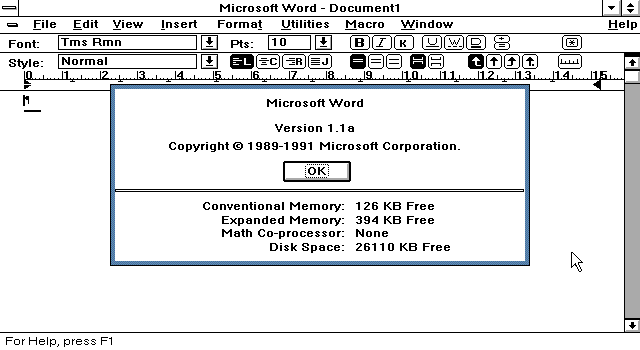
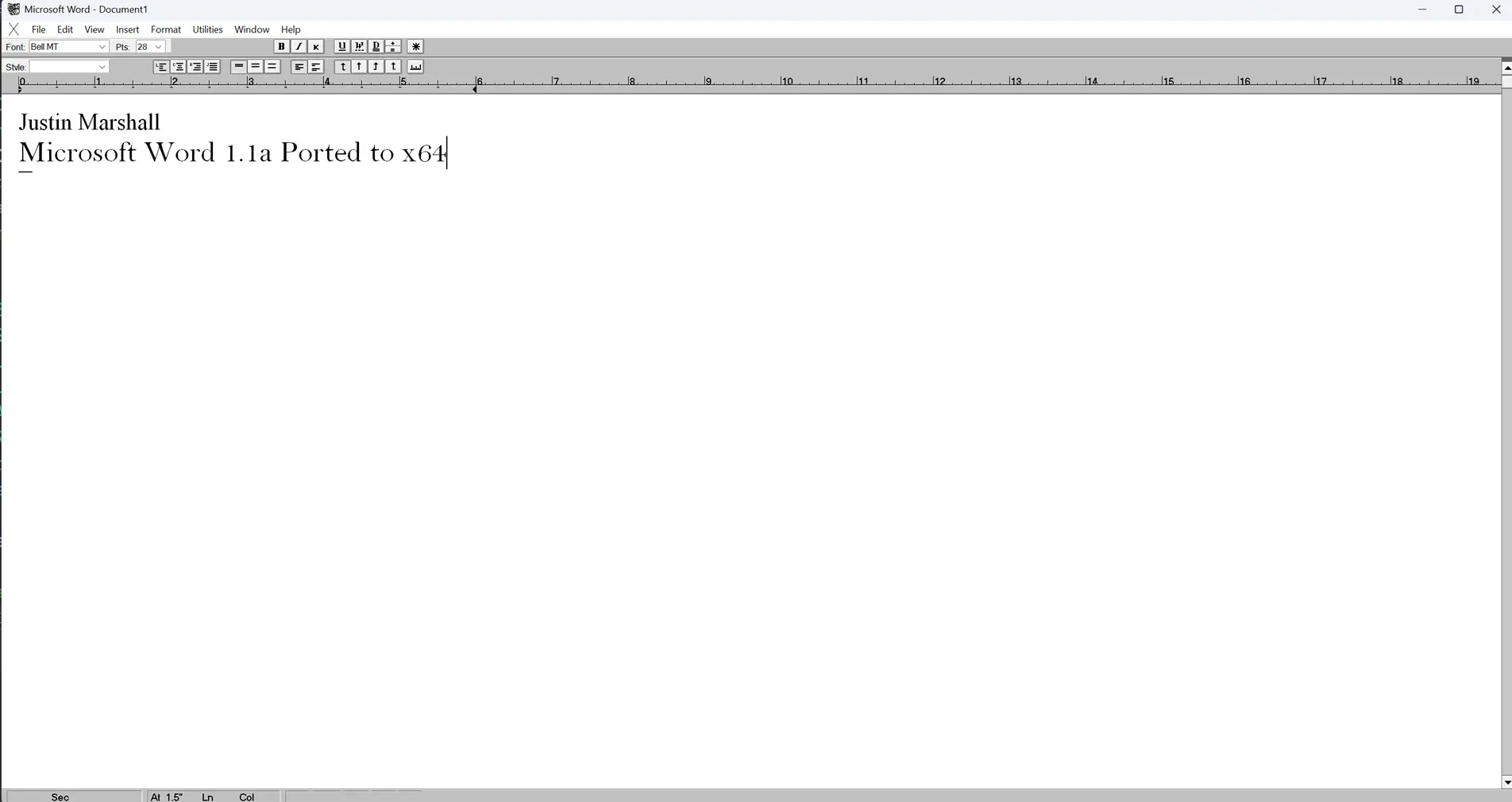
Wow, it really looks like Win 10/11. Microsoft is back to the roots now.
But Word 1.0 even has 3d GUI elements. They must have had impressive computers back then.
I'm pretty sure it was an opt-in thing for individual programs, if an app didn't intentionally use it they kept the old look.
I've always thought that it's a bit of an undocumented and slightly forgotten bit of Windows 3.1, most things on the internet only show the flat style. I guess people doing retro things often only mess around a bit with the base OS, and don't really install things like Office 4.x on top of it.
I think it's just that 16x16 icons didn't become a thing in Windows until Windows 95, and so older apps don't supply one. Windows will then scale down the 32x32 icon instead, and it's never really done it that attractively, and I suspect the black and white nature of this icon really suffers.
The original source for WfW 1.1a was open sourced (I realize that doesn't mean there isn't copyright, but it's unlikely to be the reason that there are no pics):
You may use, copy, compile, and create Derivative Works of the software, and run the software and Derivative Works on simulators or hardware solely for non-commercial research, experimentation, and educational purposes. Examples of non-commercial uses are teaching, academic research, public demonstrations, and personal experimentation. “Derivative Works” means modifications to the software, in source code or object code form, made by you pursuant to this agreement.
You may copy and refer to any documentation provided as part of the software.
You may not distribute or publish the software or Derivative Works.
You may not use or test the software to provide a commercial service unless Microsoft permits you to do so under another agreement.
You may publish and present papers or articles on the results of your research, and while distribution of all or substantial portions of the software is not permitted, you may include in any such publication or presentation an excerpt of up to fifty (50) lines of code for illustration purposes.
The point of open source is to address and concerns around copyright. And this source is not open source by the definition most people use when they refer to “open source”. It’s still proprietary but source available.
However I will say, this source is unlikely to be useful to anyone beyond academic curiosity. So for the purposes of this project, the source license is “good enough”.
More concretely, Microsoft's license [0] gives you at most one of the four essential freedoms:
0. Freedom to run for any purpose? No.
1. Freedom to modify the program? Maybe; Microsoft can revoke it without cause at any time.
2. Freedom to distribute unmodified? No.
3. Freedom to distribute modified? No.
I'm using the free software definition [1] because it's simpler and clearer than the open source definition [2], which is usually considered mostly equivalent in practice, but as far as I can tell Microsoft's license satisfies zero of the latter's ten criteria, apart from perhaps non-discrimination and technology-neutrality. Most of the criteria of the open source definition have to do with distribution, which is not allowed by Microsoft's license.
Only if you have a lawyer department as large as theirs.
But to be fair/realistic, as an individual, I've never worried about their licenses (for myself, my friends, and family). The only time I did was when installing their software in professional/commercial contexts, that's where they do most of their enforcement as far as I know... and only when the scale is egregious.