Is it just me or does anyone else feel there's more than a hint of satire in this essay? Did Benjamin Franklin propose DST as a joke to save resources? I'm a bit confused here.
I don't think he considered the actual idea a joke. The "tongue in cheek" tone comes from the absurdity of suggesting something so simple as using actual free daylight to do your work, whilst the rest of Paris seems to be stuck solving optimal candle efficiency.
    The "tongue in cheek" tone comes from the absurdity of
    suggesting something so simple as using actual free
    daylight to do your work, whilst the rest of Paris seems
    to be stuck solving optimal candle efficiency.
Didn't he make the same mistake himself? I'm not sure if that was satirical but
    Fourth. Every morning, as soon as the sun rises, let all
    the bells in every church be set ringing; and if that is
    not sufficient?, let cannon be fired in every street, to
    wake the sluggards effectually, and make them open their
    eyes to see their true interest.
was a much complex solution than the simple one adopted decades later - altering the clocks of the city towers. That said, I'm not quite sure if such clocks existed back then. I guess it would bode well for Benjamin Franklin if they didn't!
I've seen this before, but it's always seemed curious to me. Does anyone know the circumstances of this letter?
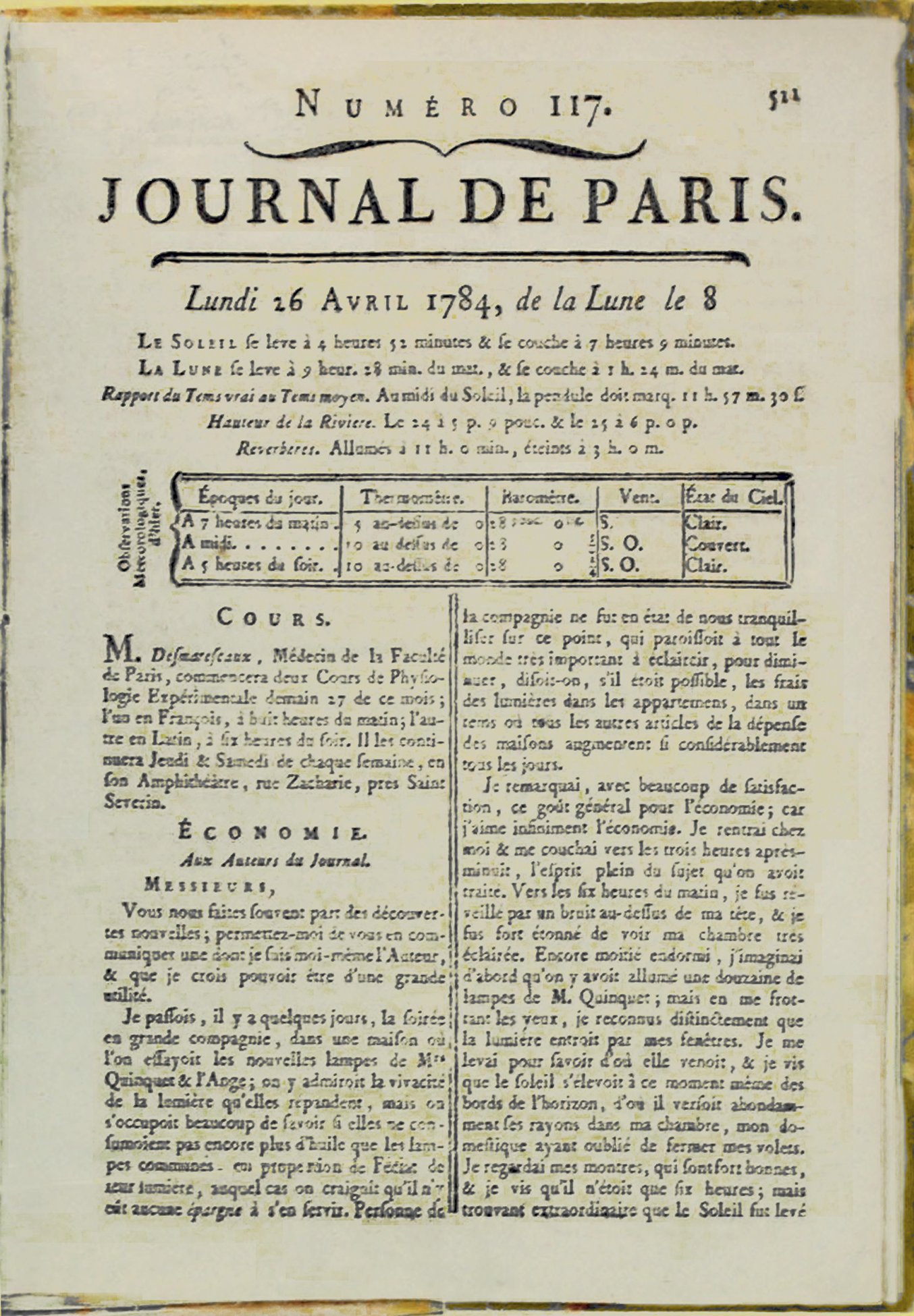
Was there really a journal of Paris? Was it some kind of English language paper for ex-pats, which would explain why Franklin was writing an letter in English to it? Or was he writing a letter in English to a "Journal de Paris", assuming that anybody educated enough to read was educated enough to read English? Or is the whole "journal" thing just a joke, and it's just a pamphlet for general publication making fun of the Parisians (which would also explain the English language)?
On a broader note, Franklin and Jefferson spent an awful lot of time in Paris, but I never run across any letters or writings of theirs in French. Do these things exist but just don't show up often, was there some kind of social faux pas that explains this, or was their French just kind of sucky?
I think this was from Le Journal de Paris. "Journal" in this case actually means "newspaper" -- it was a daily that ran from the 1770's to the 1840's. I have a copy, but sadly it has no Benjamin Franklin essays in it.
If it was actually published in Journal de Paris, why the weird "Journal of Paris" thing? And did the actual Journal de Paris really publish letters in English sometimes? I've always heard Franklin was a big celebrity in Paris(that definitely might be propaganda in American schoolbooks), but English wasn't all that popular of a language at the time.
I can believe that Franklin was making a joking reference to Le Journal de Paris, but it seems hard to believe this actually got published there.
The article starts in the "E C O N O M I E" section.
(note: the shape of the printed lowercase s looks like an f)
Don't be surprised that the he was able to write in French, as educated people of that time knew French, much as educated people today know English. Moreover he was ambassador to France during 1776–1785.
Thank you very much!! I stand corrected. And with this to search with, I found the complete original on Google Books (along with what seems to be a complete set of Journal de Paris from the 18th century; I'm going to waste the whole day reading bits of these.)
I'm not surprised at all that Jefferson and Franklin spoke French -- I always assumed they did -- what surprises me is that we (at least in the US) see so little evidence of it and that translations are presented as originals so often.
This letter is a good example. Is the English translation even Franklin's? And yet it's everywhere, while this French original doesn't even show up on the Library of Congress Franklin site. That's what I find bizarre.
I'd be interested to know a little more about the historical context surrounding this piece - was Franklin responding to some well known problem of the time like a rise in the price of candle wax or lamp oil? The essay seems like an attempt to encourage people to conserve resources using the vehicles of sarcasm and humor. I wonder how common it was at the time to wake up around noon though?
> I wonder how common it was at the time to wake up around noon though?
Despite all his quotes about "early to rise", Franklin was known, during his time in Paris, as a party animal. This provides a lot of context to those jokes about waking up around noon.
Interesting how Ben Franklin's solution was a prohibitive tax on window shades and post-sunset transit, a quota on candles, and a citywide alarm clock. After all those regulations that would be near impossible to enforce, maybe simply changing the clocks was a far more elegant solution.
Daylight savings has to only exist today for political reasons right?
Because it makes little scientific reason.
So what is the political logic then? I'm a little mystified.
Will people rise up and say "omg stop changing things, we're had DST for 200 years, let it be?"
Because they keep messing with the start date and end date, so it's not like it's sacrilege.
I've always found it humorous that it always ended just before Halloween, just in time for little kids to be put in danger in the early dark, they recently moved it to early November though, so someone wised up.
I agree that DST works well in the summer, but let's not bother switching back in the winter. We would get all of the advantages of DST, without the expense of time changes. It really would be better to have the last glimpse of sun at the end of the day work day during winter.
Saskatchewan is on to something here!