When I was a kid I was obsessed with inventing a 3D TV. I went to the library and tried to understand how holograms worked and everything. I was so intrigued by stereopsis that I would constantly try to get any two similar objects in my field of view to "combine" by crossing my eyes until they locked. I'd hold my index fingers in front of my face, and then either cross my eyes or stare past them to bring them together, and see how far I could move them apart before I lost the lock.
I obtained the power of exceptional vergence. I was actually surprised to find that only two or three people I've met can make non-auto-stereograms (two photos side by side) work at all. And to this day, autostereograms resolve automatically for me.
My only weaknesses are cheap faux wood flooring and other short period tilings.
You just have to un-focus your eyes, and wait. Sometimes it can take a few minutes. I'd suggest trying for a bit with this example, it's amazing once you get the hang of it.
I could never get it either, then I figured it out.
You know how when you cross your eyes you get like two different perspectives of whatever you're looking at? Well if you focus in the right way, there's a "middle" perspective between those two. That is where I can see these stereograms or whatnot.
There are two ways to view 3D images: parallel and cross-eyed. This page has some nice images[1].
What you're describing is the cross-eyed way. The parallel way has the disadvantage that the separation between the two images can't be too big (no more than about 5 cm at arms length is my guess), while cross-eyed images can have very large separation (e.g. two side-by-side images[2]).
In return, once you learn how to put your eyes into parallel mode, it's incredibly easy and quick to do so compared to cross-eyed viewing, and much much less taxing on your eyes (since they are pointing in only slightly unnatural angles), and with more easily discernable details.
(also, if you try to view an image with the opposite viewing method it was designed for, it'll come out with the depth inversed, e.g. the raptor image linked by another poster[3] should stand out, rather than look "punched-in")
This is exactly what I do. You'll notice that there is a pattern repeated horizontally across the page. Now cross your eyes until 2 of the repetitions are on top of each other. Once they're on top of each other the image will pop out(you may need to move your head backwards or forwards to make the image pop out). To increase the clarity just focus on one of the edges of the 3d image and your brain will tune it up.
Try it on this picture of a dinosaur[1], notice the 7 white bird-like shapes repeated across the page. Cross 2 of those over and you should see the image of the dinosaur appear.
The key is to relax your eyes, let them get lazy like you stayed up all night and cross them just a bit. Focus on just one spot and it should come into focus - eventually :)
I have difficulty too I find if I put my nose right up to a stereogram stare as if at an object off far away then move back very very slowly I may be able to see it.
Ha! A blast from the past. Who remembers buying those Magic Eye books? I had some friends as a kid who could not see them. And remember struggling for a week to see them myself. After finally getting it I felt like I was in an exclusive club somehow.
I never was able to see them with my naked eye. Of course, the hacker in me want to figure it out, so I spent day figuring out how to reveal the picture. The solution is to XOR the image with an itself at a variable phase shift. There is one phase shift that reveals the general shape, then increasing it shows the 3-dimensional details (you'll want to bitmask with the general shape here).
The way I assume it works is that our brains naturally filter out patterns so we can see the interesting stuff. In a stereogram, the underlying image is XOR'ed with a random pattern that is repeated, and therefore filtered out by our brain. Interestingly, the repeated pattern is not constant, so if you XOR the image against the first instance of the pattern it will look increasingly noisy as you get further into the picture.
For those having hard time to see, I believe expecting something to see beforehand would help you see it. I weren't able to 'see' those images, but after I saw once the rest were easy.
So I'll describe what you should expect to see. The image consist of 3 equal sized columns. Left and right columns are not part of the tetris field and have the same depth with the page itself (Z=0). Middle column is the tetris field with 5 playable columns which is the deepest layer on the page (Z=-2). And the tetris pieces are on an intermediate layer between those two layers (Z=-1). You now should be able to imagine what the game will be like. Hope that helps.
I actually find that eyes burning and watering is more of a problem with prolonged exposure to stereograms, although I get that with 3D movies using glasses too.
A while back, I watched Captain America in side by side mode on my computer. Only problem was that in SBS they put the left eye on the left and the right on the right. To view that as a stereogram would require "wall-eyed" vergence, which is basically impossible to do beyond a certain angular distance - I'd have had to watch it all tiny. So as an experiment in perceptual adaptation, I watched the whole movie cross-eyed, so that I perceived the depth as inverted.
It wasn't really enough time for full perceptual adaptation, although by the end of it, I basically found that my brain had stopped paying attention to dept whatsoever unless I consciously thought about it.
Anyway the point is that at the end, I let my eyes slide back into their normal state, and they burned for a while after like they were dry, but they didn't ache at all.
That said, I have spent a ludicrous amount of time in my life setting my vergence to values outside of the manufacturer's recommended range. So my results may not be typical.
Great experiment, but it always takes me a while to focus on the image (I expected that's why the pause option is there but no, a modal javascript alert pops-up).
If you are having trouble with this, wikipedia has some good instructions which helped me. First try autostereograms [1] (these are more simpler to see), and then simple random dot stereograms (RDS) [2], and finally magic eye static and moving stereograms.
BTW, the book which introduced RDS: "Foundations of Cyclopean Perception" by Bela Julesz is considered one of the most influential books in cognitive science. With just a computer, using no invasive microelectrodes and animal sacrifices, he proved a fantastic result...stereopsis (fusion of the individual images from each eye) occurs before object recognition!
It's definitely cool, and I hope you didn't get a migrate developing it. Downside is that having the score and other messages not part of the stereogram means you have to unfocus to see them. It would be even more awesome if the whole thing were 3D.
I can easily see stereographic images where you have to focus on a plane in front of the picture, but with this implementation you should focus behind the picture. That's hard for me to do, and this implementation doesn't allow this to be toggled.
You can focus in front if you wish, the depth is just reversed but that doesn't matter, may be easier if you zoom in the page. I got 4860 focusing behind


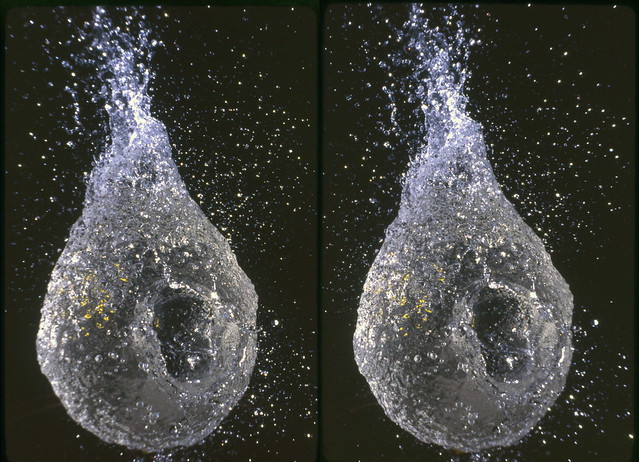


When I was a kid I was obsessed with inventing a 3D TV. I went to the library and tried to understand how holograms worked and everything. I was so intrigued by stereopsis that I would constantly try to get any two similar objects in my field of view to "combine" by crossing my eyes until they locked. I'd hold my index fingers in front of my face, and then either cross my eyes or stare past them to bring them together, and see how far I could move them apart before I lost the lock.
I obtained the power of exceptional vergence. I was actually surprised to find that only two or three people I've met can make non-auto-stereograms (two photos side by side) work at all. And to this day, autostereograms resolve automatically for me.
My only weaknesses are cheap faux wood flooring and other short period tilings.
And Tetris. Man I suck at Tetris.