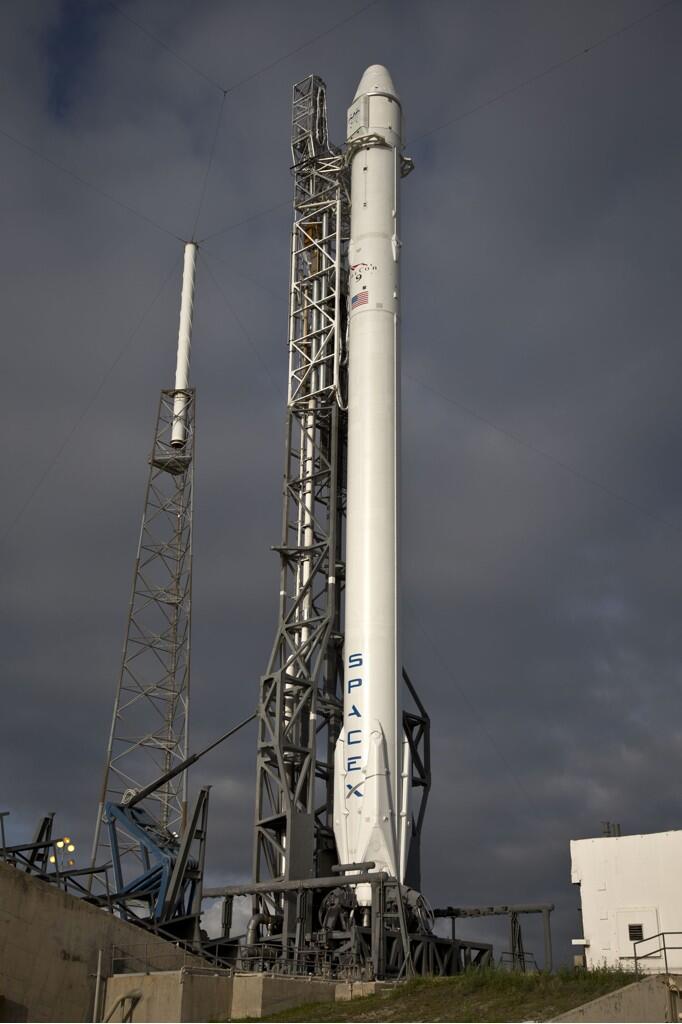
No, this is a fully operational regular launch which will deliver cargo to the ISS. But it will have sufficient extra payload capacity to allow for this test (which will test some but not all of a reusable flight profile of the first stage including a controlled deceleration and hover burn but only over the ocean).
Precisely so. SpaceX has been enormously aggressive in developing reusability. The Falcon 9 v1.1, which has flown to orbit 3 times already, is fundamentally capable of reusability, it just requires addition of landing legs and then flying a reusable flight profile.
In software terms it's as though they have deployed reusability but kept it behind a "feature flag" which keeps it turned off for most uses, for now. Once they gain more confidence in actually flying reusable flight profiles using stages that include landing legs then they will eventually work their way to returning to land at the launch site.
Sorry for being ambiguous, this flight has legs, most don't. The only major requirement for reusability is the legs. Every "expendible" flight makes use of reusable equipment that gets thrown away.
Considering where they launch I don’t think landing anywhere but in the ocean is an option.
They launch from the coast to the east (taking advantage of the Earth’s rotation), meaning when the first stage shuts off it will be somewhere over the Atlantic, on a ballistic trajectory further eastward. Since the goal is to be re-useable without losing too much payload capability I really don’t think they can have much fuel to spare at that point. To decelerate and come to a hover, sure, that’s the goal, but to actually decelerate, accelerate in the opposite direction, decelerate again and come to a hover? That would be ridiculous.
SpaceX will need to launch from somewhere else to end up over land when the first stage shuts off.
They claim that a big part of reducing costs is eliminating recovery operations that made the nominally "reusable" solid-rocket boosters on the shuttle so uneconomical.
I believe that the idea ultimately is indeed to thrust back to to land after taking off from the east coast. Earth's rotation helps them again, as the rotation is such that the land will be be rotating toward the rocket, reducing the distance that it must cover.
This self-post on /r/spacex describes how it could/would work. Basically the guy modded KSP to hell for realism (realistic fuels, more realistic aerodynamics, realistic earth and launch site inclination, etc) and managed to fly the first stage up and then back to the launch site: http://www.reddit.com/r/spacex/comments/1z6vyt/boostback_dem...
@mikeash (posting is throttled for me at the moment):
The rotating earth isn't providing any sort of mechanical advantage for the returning first stage (unlike during liftoff). However it does move the launch site closer to the rocket.
Very rough numbers: earth rotates at about 1000mph at the equator, so if we fudge florida down to the equator and assume stage separation is at t+3:00, then in the elapsed time between launch and stage separation, the launch center has moved 50 miles to the east. In the subsequent minutes up until first stage touchdown, it will move even further to the east.
Consider that just launching from the equator straight up to 35,786km would not put you into into a geostationary orbit; you would fall back down to the west of your launch site. If you went straight up, while initially moving at the same horizontal velocity as the ground from which you launched, you would not maintain the same surface-relative velocity; you need to speed up going east to do that. The outside of a record moves faster than the inside of a record.
I believe your comment about the Earth's rotation is fallacious in the same way as saying that walking to the tail of a moving train is easier than walking to the head.
Reaching orbit while launching to the east is easier because orbital speed counts in a non-rotating frame, but it doesn't matter at all (except for minor centripetal effects) for the case of landing back at your launch site.
Edit: sorry, but your pseudo-reply continues to commit that fallacy.
You're right that the rotation of the Earth moves the launch center 50 miles to the east in the time between launch and stage separation, assuming that happens at 3 minutes. However, it also moves the rocket 50 miles to the east. Net result is zero.
Imagine doing this in a gigantic train car. You launch a rocket to the end of the car and then have it come back. Does it matter which way the car is moving? Of course not. The roundness of the Earth complicates it a bit, but not much at these speeds and altitudes.
You do, in fact, maintain the same surface-relative speed as you go up. Well, until you move sideways enough that the Earth's gravity exerts a significant sideways force, but that's not going to be significant for a while. In any case it is gravity, not the rotation itself, that causes that. You need to speed up to maintain the same angular velocity as you rise, but not your linear speed relative to the surface.
The rotation of the earth would move the rocket 50 miles iff it was still on the ground.
The rocket, not on the surface, still has that 1000mph extra kick that the earths rotation gave it, but it is above the earths surface and therefore must move faster than 1000mph to keep up with the earth. (Of course it is moving _much_ faster than 1000mph, but the point is that while the rotation of the earth gave it 1000mph, that 1000mph does not keep the rocket above the same position once it is up there).
To understand why you don't maintain the same surface-relative speed as you go up, consider geostationary orbit again (where the numbers are extreme enough to work out intuitively):
Sitting on the launch pad, the geostationary rocket has a "bonus speed" of 1000mph, which is enough to put it stationary over the ground. The surface relative speed, with this 1000mph, is 0, which is your objective for geostationary orbit (~35k kilometers directly above the launch pad).
So all it needs to do is go straight up, right? Wrong. While 1000mph is enough speed to keep up with the earths rotation at sea level, it is nowhere near fast enough to keep up with the earth at ~35k kilometers. It needs to go up ~35k kilometers and it needs to move ~5867 mph faster to the east in order to keep up with the same position on the earth. If you were up at 35k kilometers and moving east at 1000mph, the same speed as the ground is moving at sea level, then the ground would be whipping by you as it rotates underneath you. Plotted on a map, you would appear to be moving very quickly to the west.
The ultimate point is that the numbers are so unextreme that they make no real difference. MECO happens at 80km. That's roughly 1.3% of the Earth's radius. If you were launching at the equator, you'd need an extra 13MPH to keep up with the launch site. Higher latitudes mean less. From Florida it's about 11MPH. It's going to be hard to notice at all (the rocket is traveling at 6,300MPH at MECO), and certainly doesn't come anywhere close to 50 miles in 3 minutes.
I'm saying that the conclusion is wrong due to improper reasoning about relative motion. Furthermore, that this is a common way to reason incorrectly. The word is often used to describe common incorrect reasoning.
They absolutely plan on returning to the launch site. Why would they put landing legs on a rocket destined to land in the ocean?
The eventual plan is to accomplish the maneuver with a total of three burns. Shortly after separation, the first stage will reignite three of its nine engines to decelerate enough that hitting the atmosphere won't break it apart. This is a fairly short burn, and they have done it on at least one flight so far.
The second burn, which they haven't tested yet, will use the same three engines to boost the stage back to the site where it launched from.
Finally, they will ignite just the center engine shortly before it hits the ground in order to land softly. It can't hover. Even with the engine throttled as low as it will go, the TWR is still >1, so no hovering...
SpaceX has published all sorts of information about their Return to Launch plans, and a simple googling should reveal that. They're even put out some shiny promo videos demonstrating the process.
Well, they obviously plan to land on land. Why do you think I ever thought otherwise?
It just seems weird to me that this fluke of geography would force them turn around and land. It seems like they could launch in Texas or somewhere and then land in Florida or something.
It would take a lot more fuel to reach Florida from Texas than it would take to boost back to the launch site. The first stage is only a couple hundred kilometers downrange at stage separation. Florida is >1,000 kilometers away from Texas.
The other advantage to boosting back to the launch site is that any failures result in the first stage crashing into the ocean. If you put it on a ballistic trajectory towards Miami... the worst case scenarios get a lot worse...
Please note: This is pulled out of my a.. ahem KSP knowledge, but: The first stage of an orbital rocket doesn't yet have a very high horizontal velocity - because of wind resistance it's best to go more or less straight up until a certain height has been reached. Therefore most of the first stage velocity can be killed just using gravity and letting it decelerate to terminal velocity before firing the engines again. The 2nd stage is where recovery becomes much more costly per ton. Thus, recovery capabilities might lead to new designs, such as more lightweight second stages or even two stage orbiters.
In The Rocket Company book they use a "pop up" 1st stage, so there is no downrange to contend with for the 1st stage. The 2nd stage then is basically a "cheating SSTO" that gets to start in vacuum. So their setup was TSTO. It was also massive, but only put 5000 lbs in orbit.
The Rocket Company has other similarities with SpaceX. Kerosene open cycle engines. Aluminum construction with friction stir welding. Company started by dot-com tycoons.
My understanding (from watching Scott Manley's KSP videos) is that Kerbin's atmosphere is amazingly thick near sea level and that a real-world rocket should start its gravity turn much lower.
The Grasshopper test flights didn't really expand the envelope to anything nearly like the conditions the first stage experiences at entry (max altitude and speed <1% of the real thing) so I'm sure there's no shortage of things to test.