I was at a holiday party and some guy was telling me all about the exciting life extension breakthroughs he was reading about in mass media. I tried to explain that, while exciting, what works in mice models is highly unlikely to directly scale into humans and that making progress against aging is very probably a "wicked" problem.
I pointed out how many headlines we saw in the 80s about a "cure" for cancer being just around the corner. Yet, cancer turned out to be a "wicked" problem. We've made exciting progress and reduced cancer mortality for nearly 30% in the last 25 years but there's been no "cure".
There's some really exciting research going on around ageing (and cancer as they are quite related) recently. I'm someone very far outside the field, but as far as I can tell we're starting to understand cancer (and ageing) on a much deeper molecular machinery kind of level.
Combined with epigenetics it really does look quite doable to extend lifespans of humans as well. I mean there have been techniques known for millennia - fasting, exercise, saunas etc.
What's changing now is that we're starting to understand _how_ those things are actually working under the hood, not just spraying chemicals and hoping something changes.
Great read. The combination of metformin, revaratrol and NMN is quite something. Add fasting and an intense workouts and it’s amazing how much you can impact your wellness.
I recently unretired from the over 40 hockey league i’ve played in the past 8 years and rejoined the top A league playing against 20 year olds... anecdotal sure... but then again so are those sets of 30-40 pull-ups I do in my workout multiple times a week... incidentally in my 30s I could only do 15 pull-ups... been steadily increasing the last few years much to the surprise of my 20 year old teammates I workout with. I’m currently 52 and look mid 30s and have taken supplements for nearly 10 years to affect aging.
> I’m currently 52 and look mid 30s and have taken supplements for nearly 10 years to affect aging.
Might want some anonymous feedback on how old you really look before you use this tagline in the wild. ;)
It's always a bit awkward when someone tells you how many 15+ years younger they [think they] look and you're stuck between "should I tell them?" and "smile and nod." I always presume they keep getting older but forget to update the story. Soon they're 60 years old and still refer to themselves as baby-faced, their intramural flag-football nickname back in university.
1 gram of NMN, metformin and resveratrol. Beyond that I take other things including carbon 60. Those are the most exotic items; the rest are your usual items such as fish-oil, krill oil, multi-vitiman most of which I tuned from my Inside-Tracker.com blood results.
I also have the right genetics; aka longevity gene(s), Ashkenazi Jew markers, etc and my farther is in his upper 80's; his mother lived to 98.
I don't want to claim that it's any one thing. I'm sure it's everything. The Tabata style sprinting 2-3 days a week, the hour+ workouts minimum of 5 days a week, the 16/8 fasting, the hockey/cryotherapy-like effects of being cold and working out/aerobic exhaustion of being on the ice or skating outside etc. And of course diet... I eat much much less than most people I know (big fan of Paleo menu by Green-Chef).
The way I see it is there are studies around NMN, metformin and resveratrol right now; let's say in 10 years they all prove they slow aging/extend life... to me it's worth the cost to take these now and bet on a positive outcome. If some of these studies don't pan out, so it goes, but so far it seems like it's working out pretty well if my increasingly annoyed friends are any indication.
I do all of those things, but I am finding the NMN to be quite costly. I take almost the same amount as Dr. Sinclair, which means going through a bottle of pills every three to five days. I really hope someone makes a less expensive version soon. I do feel the difference and can probably attribute it to higher ATP production. I have no idea if it's helping my cardio vascular system.
You'll notice if you stop; that's what happened to me when my NMN went on back-order and stopped for 8 days.
Like metformin NMN doesn't produce any significant immediate noticeable effect like Alpha-GPC for example; it's more like working out - overtime the long-term effects are significant. At least that's the hope.
I buy my NMN in a month supply at a time (150 a month).
I second that. I have to spend a lot to get 800mg/day. That's why I would love to see more companies make it and the price come down. I fully understand the molecule is a little more complex than its precursor, but maybe if more people made it, then the price would come down? /shrug
Does your father looks a lot younger too? My father is in his mid 50s and he looks 40. I am in my mid 30s and I look younger too. This is genetics obviously. I am also doing fasting 16/8 and eat less than most people.
It's possible that those supplements have 0 effects and it's all just genetics.
> Not really but he smoked for 40 years before quitting around age 55.
My father smoked for around 30 years, I've smoked for around 16 years.
> Or it’s possible the preliminary results are correct.
Sure, it's a possibility too, I would like to see more long term studies tough, with enough participants to statistically exclude all environmental noise.
For now we can be sure of one thing, genetics is the main factor in how we age.
I've seen some articles suggesting that berberine (plus sylamarin) may be superior to metformin with fewer side effects (plus it's cheaper and doesn't require a prescription).
When you see an article on HN about how someone took some code, profiled it, and increased its speed by 10 times, I think it's tempting to credit virtue to the person who sped the code up. But I think you also have to remember that the only reason you could speed up the code by 10 times in the first place is that the original code left that much on the table. It isn't just that there is a person who was skilled enough to speed the code up, it is that somebody else left the opportunity behind in the first place.
For similar reasons, I find it quite likely to be engineering-meaningless [1] when someone takes a life form that lives for a 2-3 weeks and extends that by a factor of 5. We humans have the "live for fifteen weeks" problem solved. Optimization being what it is, it is very likely that whatever that improvement is already effectively exists in us. (Possibly not directly, possibly through some other mechanism that doesn't completely match, but it's probably done.) It is, unfortunately, much less impressive to "optimize" an organism that has left that much on the table.
Improve an elephant's lifespan by 50% with an intervention when they're already fully-grown and I'll really take notice. Unfortunately, there's all kinds of reasons why that's hard....
[1]: Contrast with meaningful to science. There's nothing wrong with studying this sort of thing as steps to both eventually treating aging, and just plain scientific understanding of the world, in the mean time. But something can be scientifically useful, and even perhaps someday eventually be useful to engineering through its contribution to a dozen other discoveries, while being "engineering-useless" today. Remember the context we're speaking in is in being excited about all the longevity news in the media and to hope that maybe it'll be ready by the time we personally need it.
> Optimization being what it is, it is very likely that whatever that improvement is already effectively exists in us.
This only really works if there's evolutionary pressure on humans to live forever, though. And there probably isn't. We live longer than most mammals (even without good nutrition and modern medicine) but that's arguably because we're somewhat social animals; we provide a useful function after we stop reproducing. But there are limits. While having grandparents still around might be an advantage (and likely to make a prehistoric human more likely to pass on genes for long life), there are diminishing returns; having great-great-grandparents around is much less interesting.
Not to say massive human life extension is practical or even possible, but we shouldn't necessarily assume that our lifespans have already been fully optimised.
"By the same token, there are animals who have the „live for 400 years“ problem solved so there must be sth left on the table yes?"
Note my claim wasn't that optimization isn't possible, just that the impressiveness of the optimization is inversely proportional to the amount of performance left on the table.
In terms of that being a promising avenue, I'd observe all the animals with long lifespans I'm aware of seem to achieve that with a quality of life that would in humans be considered very elderly behavior, due to low energy consumption. People generally want eternal youth, rather than eternal elderliness. I don't know of any 200-year-old animal leaping about from tree to tree or anything like that.
Body part regeneration seems a lot more like a solvable problem to me than generalized "fix aging". While we know we're lacking spontaneous body part regeneration, we also know the "programs" for growing parts are in there, since we used them once.
(As I've observed before on HN, "solving aging" would be a lot easier if we just had to produce organs with the same DNA or something. It's a bit body-horror-esque, but if we could just grow clone bodies and transplant things in we'd probably be pretty close. But there's that whole problem where we'd be happy with a new heart, we'd be happy with a new liver, we'd be happy with a new left arm, but we stubbornly want our old brain....)
This is a very important point. Human lifespan is already an outlier compared to our primate cousins and other creatures of similar (or even larger size). I'm sure there's plenty of room for "optimization", but it's not as easy as it is with nematodes or mice, which also get a lot of attention in the general science media.
As someone who is 62, I am glad I am still alive! I feel good, think clearly, and enjoy life. Some people are old at 60, but I think that is less and less common as work and health habits improve.
I see many peoples health go south after 80, but I have a 102 year old friend, and he was great thru his late 90s. 100s have been a bit rougher...
I'm shocked when I see some 90yo people. Some of them are not worse mentally than a 40yo. Good genes I suppose (genes that also made the guy want to swim regularly all his life).
Yeah, aging involves breakage of multiple things in people's bodies. There is no single switch to fix them all. Instead they have to be fixed one by one.
To the joint problems you are mentioning: we are already replacing various joints and bone parts in the body. The solutions aren't perfect though, there are risks of infection, death by septic shock, people often have pains, etc.
I think replacing parts is a good idea, but comes up against some harder limits... Surgery becomes harder to recover from as you get older. Cell division limits are a thing, build-up of scarring tissue, etc.
So if we can address cellular aging mechanisms, I think we'll have the latitude to address some of the more macroscopic aging problems (like joints, etc) through surgery.
Agreed. I try to explain it to my family by pointing out the most likely proximate causes of death in old age: A) cancer, Alzheimer's, B) heart disease, C) organ failure, etc. Solving "aging" means we don't just have to solve A, B or C but rather 'All of the above'. Much harder.
They've proven much larger lifespan increases even in primates. Issue is it looks like many of these interventions might alter your mental health as well, and no animal model will faithfully replicate that.
While stated in what I interpret is a joking way, it is a very real concern. As the average life expectancy increases we either have to plan for a longer period of non-productivity (in the private sector) or work longer. A blend of the two seems to be what is occurring, but over my life time I have seen my expected retirement age continue to push slightly further away.
I expect it to be non-existent for a huge chunk of the economy. Well paid programmer types can FIRE, but honestly they can keep working until they can't sit upright or think clearly. Folks like welders have their eyes and knees go in their 40s.
Statistical modeling of biomedical corpora: mining the Caenorhabditis Genetic Center Bibliography for genes related to life span - Blei DM, Franks K, Jordan MI, Mian IS. - http://www.ncbi.nlm.nih.gov/pmc/articles/PMC1533868
"The roughly 2,271 genera are placed in 256 families. The many parasitic forms include pathogens in most plants and animals. A third of the genera occur as parasites of vertebrates; about 35 nematode species occur in humans."
There is a lot of cooperation in biology. People from diverse backgrounds – physics, chemistry, engineering, computer science, mathematics, medicine – work in the same research group. They are scientists who research biology, but they are not biologists as in they don't have a degree in biology.
Why does it seem no one worries about what we might break in humanity by disrupting the evolved pattern of death. It's a network characteristic selected for in living system, and very few creatures have survived into our epoch without developing the capacity to die.
It's literally an evolved feature of our lifecycle and our existence within this web, and it terrifies me (esp everything going wrong already in our world) that we're not being more critical and cautionary toward life-extension....
Every time I read about life extension, I have almost zero positive thoughts about its effect on our common good, and it's just "oh shit, this is going to have bad outcomes for us all" :/ It's pursuit feels like peak selfishness in our individualistic society, one that really need collectivist thinking.
So you wrote your opinion on some blog... doesn't make it any more relevant than any other opinion, here, there, anywhere. This is a public forum.
Death is an interesting topic, plenty of people are scared shitless of it, regardless of their beliefs. Many wish that they would be that special spark that will live almost forever, ideally young, but god forbids that everybody else with them gets the same chance (simple math indicates that would be a bit of catastrophe for whole ecosystem and ultimately mankind too these days).
Research should be definitely done, results might help in places like space travel and probably some diseases, but I don't see it as something super important currently. Maybe because I am at peace with my inevitable death, so other things are considered as higher priority (say pollution, global climate change, inequality, f@cking wars).
I would also be concerned about people living longer but with the mental sharpness of an (average) 80 year old.
Pre emptive; yes I know there are sharp old people but it’s fair to say that on average old people have significant mental decline hence targeting for scams and what not.
Thanks. Sorry, realizing I avoid clicking into these most times, so just finally did now and saw nothing but boosting (and I unfairly generalized).
If i understand, you feel that death is a curable condition, and not an evolved adaptation of a population within living networks?
I guess i just find it difficult to conclude that death, an evolved trait for 99.999% of lifeforms, esp ones like us (with its uncountable trillions of iterations of validation) is something we should allow our members to cavalierly just brush aside. My "survival of species" lens says we should just "cap" lifespan -- so that no set of individuals can bend the structure of biology and society to create such an existential asymmetry in the our shared systems. But that has obvious clashes with the belief systems we've established.
There's a rad allegory in city planning. A student wants to remove a fence across a narrow laneway. She says to her wise mentor "hey this fence is here and it's not doing anything. can i remove it and improve the flow". The mentor replies, "sure, but before you remove the fence, you should first uncover why it was there."
I feel like our wise mentor is the process of evolution. She's been around the block. She wasn't born yesterday. I truly don't feel we're wise on this topic. And conveniently, there are essentially no death-defeating maverick species to teach us their learned wisdom. It feels like hubris to presume that we know better than this mentor...
If you have a way to brush aside death, do share with us.
So far as I can tell, nothing about the attempts have been cavalier. Fortunes have been squandered, tears wept over the fresh graves of the beloved, lives were focused in an all-consuming passion, and so forth. The subject has already been rendered not cavalier by the agonies of our past.
We haven't a "skip death" button to press.
Chesterson's fence, which you referenced, is only applicable to the conscious acts of thinking beings. Evolution is not wise, evolution is not careful, evolution did not plan or reason for that fence. Evolution also gave us susceptibility to diseases, revolting parasites, defects of birth, and an often tragic fragility. Shall we preserve those as well? After all, they must be there for a reason.
Under that aegis, nothing which applies to death does not equally and as thoroughly apply to quite literally every other medical intervention humanity has invented starting with the humble bandage.
Evolution gave us allergies which cause people to asphixiate and clotting disorders which have children bleeding out from a casual scrape. Blindness, gangrene, arthritis: this is the wisdom of evolution.
> Evolution gave us allergies which cause people to asphixiate and clotting disorders which have children bleeding out from a casual scrape. Blindness, gangrene, arthritis: this is the wisdom of evolution.
It is indeed a wisdom, albeit a primitive one which simply works good enough long term - survival of the fittest, best adapted, strongest, with better immunity etc. Collateral damage for the unfortunate is not important when we talk about billions of organisms over countless generations, and survival of the species as a whole. We also evolved over weaker species, because we were better and luckier. And we will evolve more either naturally or by our hands, if we keep on surviving.
> Evolution is not wise, evolution is not careful, evolution did not plan or reason for that fence. Evolution also gave us susceptibility to diseases, revolting parasites, defects of birth, and an often tragic fragility. Shall we preserve those as well? After all, they must be there for a reason.
I think you do yourself a disservice thinking this way about the process that gave rise to you.
Edit: and I didn't even read your whole comment.
> Evolution gave us allergies which cause people to asphixiate and clotting disorders which have children bleeding out from a casual scrape. Blindness, gangrene, arthritis: this is the wisdom of evolution.
It also, apparently, gave us breathtaking ignorance. No wait, that was human society.
fwiw I find myself very torn to be rationalizing death when my mom just went into paliative care last week. I'm literally typing this as I should be walking out the door to the hospital. I suppose I'd like to push the button that let me mom live 200 years, but i also fear for that button ever existing. I don't think I could NOT push it.
I promise I'm not callous. I'm maybe suspicious of the west's cult of the individual. I feel like sometimes we as individuals can't have what we want for ourselves, if we want the bigger ongoing project to succeed. Things are already so complicated, not least due to accumulation of generational wealth and inaction of the older generation. I worry the "curing" death will doom us all, and collapse this whole beautiful mess in on itself :/ Curing death sounds great when young startup folks are pushing it, but we all age out, we all get stuck inside the minds that grew up in old worlds.
I'm sorry that you're suffering. No one should discount your experience. Yet even through our cloudy lens we behold a miracle beyond our possession, even beyond our comprehension. We are all transitional forms, even the best of us. We'll all die. It's nature's equalizer, grinding everything to dust and recycling it. We're all made of garbage. Junkyard parts, you and me both, buddy. Isn't it incredible? We're all Wreck Gar https://tfwiki.net/wiki/Wreck-Gar_(G1). I think the awe of that realization is worth the meager existence allowed to me for the moment.
Miracles do not necessarily have to be positive. Imagine Dante's inferno, where in some sections fire might rain down forever upon the limited sinners. That would also be a miracle. Possession, comprehension of miracles, all irrelevant if it is something to which you are subjected. If you are ill, if you are very ill and occasionally must ingest large quantities of painkillers, marveling at the exquisite engine of torment (how finely tuned! how painstaking its affordances!) is quite beyond one at times.
Evolution is a shuddering conglomeration of what has worked to make a few more copies, over millions of oft-unlucky organisms, than a few thousand years ago. What persists exists, even if it is tortured. Evolution does not respect its individuals, all collateral damage, nor is it tender even to its most faithful adherents, as the male octopus, under a chemical spell, will tear off its own arm to proffer to a mate, and then to starve, function fulfilled.
I'm not going to negate you here, because you have a lifetime of lived experience and I don't doubt your pain is and has been real. Yet people suffer in many ways and there are some deeply twisted realities that many people have lived. In our darkest moments we all feel we are the tortured one, but that is not the whole truth either. It is tempting to believe that we are at war with an implacable, all-powerful enemy. But truthfully, we are only at war with our own minds.
The mind is ultimately a digging machine. It matters a lot where you point it, more even the lens through which you interpret all that you see. Some very disadvantaged people have put forth some incredible feats of overcoming. They refused to be defined by their disabilities, their pain, their hardship--and refused to rue their existence. This engine grinds us all, but this world is no hell. And that damn octopus, maybe he reaches the height of ecstasy in that moment, an orgasm beyond belief. Wicked is a judgment.
“Finally, let’s not delude ourselves into thinking that death is going to be an easy disease to cure. Maybe we’ll get a few breakthroughs over the next couple of decades and we’ll figure out how to add a few extra healthy years to the average person. We definitely need to move beyond long term studies and peer deeper into our bodies. By the way, the latest study says we need to take 15,000 steps a day to live a longer life.”
I truly love the optimism, but even our experiences in democracy don't seem to support this. [1]
Plus, does what you're saying even feel true in your own life now? Does knowing something in your youth make you a louder or better or more powerful advocate in a far future. Slow catastrophies are a human blind spot, and I lack your confidence that extending our individual window from 80 to 120 years would make us better able to grapple. Especially considering that those additional 60 years are going to have a much more stubborn and formed and fully-convicted mind piloting the body around.
I'm not sure our brains are capable of continuously learning for 1000 years without becoming useless. Also, there is a dystopian version of immortality - a tiny fraction of elites becoming immortal super-tyrants.
Appendixes have recently started to be regarded as something functional, a sort of incubator for healthy gut bacteria, but I'm sure there are other examples in nature that could support your point, too.
And you'll be surprised how many people _are_ indeed thinking about all of the outcomes. Have in mind though that as with any technology it is not good or bad, and if it is possible someone will do it sooner or later.
It makes no sense to not do it as your adversaries will, and then they'll dictate how it is used, probably not to your liking. If you develop it first you can talk and deliberate at your leisure and find solutions that look much better to you and yours.
> it terrifies me (esp everything going wrong already in our world) that we're not being more critical and cautionary toward life-extension....
Don't worry bro, you'll die and all your fears will go away :). From a personal point of view biological immortality would be great, but I think you're right that there are risks - I can imagine a world where a tiny fraction of wealthy/powerful people make themselves into immortal super-tyrants.
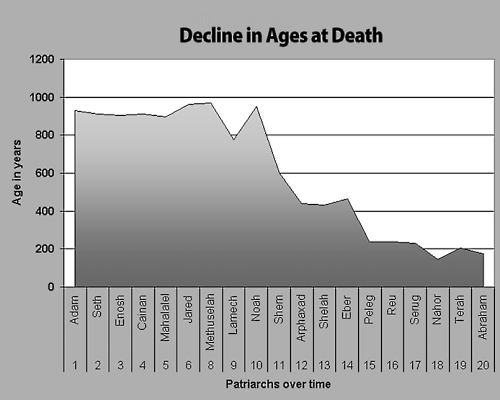
Whats interesting is that according to the Bible humans lived from several hundred years to ~1000 years.
Now this article is saying "The increase in lifespan would be the equivalent of a human living for 400 or 500 years, according to one of the scientists."
Its just an observation, fiction or not. i remember this fact from the bible and its funny how in this article they talk about 400-500years human lifespan.
Could you explain the exact connection, though? I don't understand what's funny about it. It'd be like a book written 100 years ago saying "humans can fly", and then in 2200 someone invents a cheap portable jetpack. If you lived in 2200, would you say "it's funny" that that old book mentioned flying and look, here we are, flying?
Plenty of other old texts depict long-lived humans as well. It's probably been a fantasy among humans for many thousands of years.
why was my comment not intelligent? if anything - peoples reaction so far to a simple comment is not tolerant and pure garbage. i simply quoted bible (im not religious) and folks here lost their marbles. says something about these people if you ask me!