Climate change is terrifying, but I also have a hard time taking self titled Doomers totally seriously. It makes sense to consider all of the worst case scenarios for any event, and to prepare for them. But Doomers seem to have an obsession with it, and a need to convince others that the worst will happen.
I noticed this a lot in 2020. COVID was (and is) awful, but there was so much shit that Doomers claimed would happen that year that just didn't. They seem to have a bias towards always considering the worst case scenario the most likely.
My take on it is that "well presented doomers"[0], if you will, serve to balance the "well presented optimists"[1] in that they are needed in society so we can have some take on how things could actually go wrong and sound warnings for potentially catastrophic failures. Its important though, that I think it needs moderating, like not everything "Doomers" say needs to be taken at face value, its important that others can come up and really either shore up their case or make a case for different more likely outcomes, for instance. I feel the same way about overly optimistic takes as well.
They serve an important function in society to keep us aware of just how fragile things can be and that we need to be vigilant about understanding the second order affects of our actions as a society.
[0]: Ones that generally rely on nonpartisan facts / science / evidence for making their claims, without resorting to debunked information to further their claims and/or not relying on conspiracy theories, for instance.
[1]: I'd put alot of technologists in this group, for an example. People who constantly hype real breakthroughs and advancements as proof that we will always be trending upward as a species
"Everything will go wrong whether we do anything or not!!"
No, it won't. Because we will act.
"Everything will turn out fine, we don't need to worry about anything!!"
No, it won't. We need to act.
Honestly, both extreme reactions paralyze humans and nations into inactivity. We fixed the hole in the Ozone. We fixed Acid Rain. We stopped the whales from going extinct. We did this through concerted human and governmental actions together with pressure and regulations on corporations.
We can do it again. Not without some consequences. Significant human populations will become climate refugees. Significant species will go extinct. But we can offset the worst effects, but not if doomerism or "climate change is inevitable, humans have survived worse" optimism cause us to stop trying.
I truthfully don’t get climate doomerism at all. Does the whole climate picture seem decidedly not great? It does. Seem not great.
But hectoring and chiding and unhealthy amounts of stress aren’t going to muster sufficient resources and capabilities to put a handle on this problem.
You know what will? Good old fashioned human ingenuity and optimism. This isn’t to lessen the inevitable losses. Humans will die. Species will be lost forever. Island nations will sink beneath the waves (and not just the UK this time).
Things are gonna get worse before they get better, but like the apocryphal Americans, you can always trust humanity to do the right thing after they’ve exhausted every other option.
We’ve got this. Shaming someone for throwing out a USB mini cable ain’t gonna get us there.
There is some dissonance in your comment. On the one hand you acknowledge that things will get bad, but you don't want people to dread how abd it will get, because some will survive?
Reminds me of this quote: "Some of you may die, but it's a sacrifice I am willing to make"
You speak with certainty that is not possible. Those were all tiny hobby projects in comparison. You don't have to overhaul all of modern civilization to save whales or the ozone layer.
And... will act? The time to act already has come and passed, probably during the Bush years. We did not act. This is no longer about making it to the runway, this is about deciding which patch of rocks will kill the fewest passengers.
In the Bush years climate scientists told people that change is coming, and nobody paid attention.
In the Biden years climate scientists are telling people that change is here, and it IS here.
And more people are at least talking about the change, and asking what are we going to do about it.
And the worst thing to tell someone who is motivated and curious (and an entire Generation Z is) is to say "It's too late. You had your chance and you blew it. There's nothing to do now"
Your first sentence betrays a horrific misunderstanding: "I don't care if it's possible or not". It should not change my certainty in my ability to try. Even if it's not possible, it's still worth trying. What else are we supposed to do?
One downside though is that people generally love an excuse to avoid change or avoid additional effort. “It’s not real, so we don’t have to do anything” is functionally equivalent to “it’s already too late, so why bother doing anything”
I disagree, learned helpless is an easy attack on realists who tell it as it is.
We consistently fall in the worst case scenario of most climate models so much so that "faster than expected" is now a meme.
It is indeed too late to avoid famine and water wars but it is not too late to keep large parts of the world still livable. I would very much like my children and my children's children to have a fighting chance.
This is true even with positive things. I wish I had a good answer for human nature and resistance to change, as that would be game changing generally speaking
There will always be people fixated on The End, some because they think we all deserve it, others because they can't seperate their own existential crisis from potential global crises
And still others because they've started looking at the pieces of how our global society functions as a system and realized that it's very possible we have pushed our environment beyond it's ability to support us. Leading ultimately to overshoot which leads to collapse.
Maybe, but they never seem to weigh any of the challenges against humanity's staggering ability to adapt and overcome. Doomerism has planet-sized infomercial hands.
There is a long and embarassing trail of false apocalypses predicted from extrapolations + assumptions of helplessness, often made by otherwise intelligent and scientifically inclined people. We were all going to starve, but then Haber figured out how to chemically fix Nitrogen. Nuclear war was going to end the world, but then MAD actually worked. The ozone hole was going to cook the plant life, but then we cleaned up our refrigerants. We were going to run out of oil by 2010, but then we found more.
Betting against humanity isn't a historically wise move. You don't have a choice in the matter, and it's easy to fixate on this and imagine yourself trapped, but you are "trapped" with one hell of a fighting chance so the truth is you just don't know.
Hm, I do get why people trying to be optimistic always bring up examples from the past to extrapolate that "humanity will always find solutions".
What I don't get is that the same people simply overlook that we're not talking about single symptoms with a simple cause but about a root cause (emitting co2) which is deeply integrated into all our actions and economies and humanity is struggling dealing with that for at least a couple of decades.
We're talking about bringing half a dozen to multiple dozens of networks out of balance that we only halfway understand.
Consuming food wasn't deeply integrated into all our actions and economies? Oil?
> extrapolate that "humanity will always find solutions"
Good thing I didn't do that! Doomers, however, do extrapolate failure. They walk far out on a branch and forget they are carrying the burden of proof. That's my entire point.
Well climate scientists have collected more proof than ever in the last 2 decades to back the models and predictions. What we see is _measured_, not just opinion.
And if you happen to read a bit about how biological systems, the weather systems, our economical systems, food supply et al. work together while keeping in mind that IPCC reports are _conservative_ about their predictions (meaning they rather underestimate than overestimate), you should really deeply be worried about the near-future outcome of the ongoings.
Just because we successfully hacked our nutrition system a 100ys ago does not mean that we'll be able to cope with how consumerism and agricultural intensification afterwards affects us with dozens of new problems. At some point it just gets too expensive and/or too complex for humans to solve.
> they never seem to weigh any of the challenges against humanity's staggering ability to adapt and overcome.
I'm not sure who the "they" you're referring to is, but the fast majority of authors/researchers I've read on these topics are quite well aware.
The problem is the vast majority of this "adapt and overcome" has been based on two major things:
- Historically: a geologically remarkable period of climate stability
- More recent: abundant fossil fuels
Malthus was wrong because he failed to predict the Haber process. But currently the Haber process relies heavily on fossil fuels. We didn't produce astoundingly more food per acre then ever before in history because we are incredibly smart, but because we had ready access to hydrocarbons. The same logic follows for nearly all great inventions of recent eras
> Betting against humanity isn't a historically wise move.
I see this comment all the time but it's a very odd one. As far as species go humans are very, very young and survived very little, just about 300,000 years. Additionally, like I said, we've only existed as a species during one of the most stable climates in the history of the planet.
One final point on the "people always think the world is ending!" rhetoric. We've only really started seeing strong apocalyptic thinking in the last several hundred years. Let's say, for argument, that humans were wiped out in the next 100 years. Alien scientists visiting would see people thinking about the end times in the last 1/300,000 of the species' existence to be fairly prescient, even if they were off by several of their own species lifetimes.
On top of that the writing on this topic is not without merit historically. Revelations was written during the Siege of Jerusalem, when things were collapsing for the world of the author. Most medieval apocalyptic literature was written or based on the black death which wiped out between 30-50 percent of Europe. Hardly irrational beliefs that the world is ending based solely on existential anxiety.
There's also an obvious logical fallacy in all this thinking. Most of the time when people look up webMD they think they have cancer, and they don't most of the time. But it doesn't logically follow that they can't have cancer no matter how strong the evidence.
We've only really started seeing strong apocalyptic thinking in the last several hundred years.
Humans have been contemplating the end of the world and the promise of a subsequent paradise or judgement for thousands of years, evidenced by ancient religious and cultural texts. The Book of Daniel in the Old Testament, Zoroastrian eschatology, etc.
I may be misremembering my ancient history here but didn’t Homo Sapiens arguably almost go extinct during the last ice age?
As a related digression I think what people just keep forgetting about here isn’t like, we’ll survive. It’s we have all this nice stuff like avocados, grapes, heart surgery, and MacBook Pros, elephants, winter sports, houses, etc. and it sure would be nice to not lose that stuff for no good reason only to say “we’ll see we didn’t go extinct it wasn’t that bad”.
The apparently abrupt changes the unnecessary lives lost, and what could be damaged or lost forever are what’s of concern. Less so just survivability.
I agree 100% that we should do everything in our power to save as many people and as much technology as we can as we go through climate change.
My point was just that claims that the entire species is going to go extinct are unlikely and, worse, counter-productive. The last thing we need is fatalism and people giving up hope.
Not an expert, but my understanding is that the end of the last ice age led to an overall global average temperature change of +10°C.
For the current climate change, we've been calling +2°C catastrophic.
It is catastrophic: millions will die, species will go extinct, trillions will be spent updating infrastructure and rebuilding. But I believe that it's survivable.
> Not an expert, but my understanding is that the end of the last ice age led to an overall global average temperature change of +10°C.
Over what time period? 10°C in 10 million years is fine. In 10 years it would kill almost all life. The amount of change is inconsequential as long as the rate of change is small enough.
So let's go with 5°C over 2000 years, or 1°C over 400 years. Do you see the difference between that, and our current change of 1°C over 100 years (and accelerating)?
Yes, I do. But I also see significant differences in our level of technological sophistication and adaptability compared to Homo sapiens during the last ice age.
So our technology and so on will magically ensure our ecosystem doesn't die? We will find ways not only to adapt ourselves, but also to keep plants from dying due to sudden changes in climate, to keep animals from dying whose food sources have died out? We'll find magical solutions for all of these problems, whose complexity we still aren't close to fully understanding?
> it doesn't logically follow that they can't have cancer
Good job, you really pwned that straw man.
Also, I want to preserve this one for posterity, because I'm pretty sure it's hilariously wrong but I have better things to do than dig through the literature right now:
> We've only really started seeing strong apocalyptic thinking in the last several hundred years.
You can't reason how the end of humanity is going to happen based on priors, because it's never happened. Whenever it happens, (and it will definitely happen,) it will be unprecedented. It also won't matter how many times the (doomer) boy has cried wolf and been wrong.
I guess the problem I run into is that "the worst" as proposed by Doomers is usually so bad that there's no way for me to prepare for it except by becoming a full time prepper. And that just becomes exhausting to even consider, so it's easier to fall into the trap of either depression or complete inaction instead.
"Eliot Jacobson, Ph.D.
Retired professor of mathematics and computer science, retired casino consultant, now a full time volunteer, husband and grandfather. Know-it-all doomer. Born in the year 316 ppm CO2."
>> Is this his schtick? Does he just say the world is ending all the time, or is what he's saying true?
I didn't get any "alarmist" signals from this post of his until near the end. If all the data is as it suggests there really does seem to be something going on this year in particular in addition to a trend. But then he said "Infrastructure will break beyond repair." which jumped out as alarmist to me. Like we can't fix or build more infrastructure? I wish people wouldn't do that, as it makes me react with "dude calm down" when they otherwise seem to have a point.
I think the point here is the metaphore. When you say "infrastructure" you think of bridges, roads etc. And for those you have a notion of possibility and difficulty of repairing them.
When he says "infrastructure" he means the nature that we draw on (to build our infrastructure) i.e. the weather, the trophic chains etc.
I would doubt that everything from one type of infra can be translated to the other.
E.g. when it comes to nature some things are simply almost irreversible, whereas there is no such thing for man-made infra.
I guess it depends on what you mean by “beyond repair”, I.e. how many pieces of a bridge can you replace before you’re replacing the bridge rather than repairing it?
I am definitely not an expert on infrastructure or civil engineering in general, but I’ve heard lots of stories about heat being bad for our infra, e.g. warped rail lines in the UK. “Beyond repair” seems within the bound of reason
EDIT: also, obligatory dont-look-up-ication:
"I didn't sense any 'alarmist' undertones from this post of his until almost the end. If all the data is as it suggests, there genuinely seems to be an extraordinary astronomical event headed our way this year on top of other celestial trends. But then he said, 'Civilization will crumble beyond repair,' which struck me as alarmist. Like we can't rebuild or adapt our society? I wish people wouldn't resort to such extreme statements, as it prompts me to respond with 'dude, calm down,' even when they otherwise seem to have a valid concern."
As I understand it there is a scientific consensus about both the causes and the potential effects of global climate change. Scientists say that we are headed for 2C degrees of warming in the next years. Scientists say that 2C degrees of warming would be disastrous for millions of people. Any random dude can put two and two together.
Perhaps. I never know what to believe. I've heard smart, knowledgeable people like Bill Gates state that he thinks we won't experience a scorched Earth ending, but that we will solve this crisis. I'd like to believe him, but then I see an article like this and I don't know who to believe, the graphs are pretty damning if only to say "that line is way above the other lines, and that is bad."
For what it’s worth, the average interpretation I’ve seen from climate scientists is:
- No, we won’t hit scorched earth Venus-like runaway warming.
- If we don’t reduce emissions drastically, greenhouse gas warming plus various feedbacks will cause extreme weather, render some parts of the world unlivable due to wet bulb temperature, and overwhelm unprepared infrastructure, costing huge amounts of money and creating millions of migrants.
So, not the end times, but definitely dark times.
If you sprinkle a bit of pessimism about current politics it’s not a stretch to assume we probably won’t handle those impacts gracefully, or achieve the drastic emissions cuts required to avoid them.
What's your citation for suspecting that more than 1 in 8 living people will be a migrant? That seems pretty alarmist, and well over any number I've seen suggested elsewhere.
- 19 countries with the highest number of ecological threats are among the world’s 40 least peaceful countries including Afghanistan, Syria, Iraq, Chad, India and Pakistan.
- Over one billion people live in 31 countries where the country’s resilience is unlikely to sufficiently withstand the impact of ecological events by 2050, contributing to mass population displacement.
- Sub-Saharan Africa, South Asia, the Middle East and North Africa are the regions facing the largest number of ecological threats.
- 3.5 billion people could suffer from food insecurity by 2050; which is an increase of 1.5 billion people from today.
- The lack of resilience in countries covered in the ETR will lead to worsening food insecurity and competition over resources, increasing civil unrest and mass displacement, exposing developed countries to increased influxes of refugees.
Well if current temperatures and predictions are anything to go by, big chunks of Iraq, Iran, Afghanistan, Pakistan, India and Bangladesh will become uninhabitable, wet bulb temperatures wise. Just from that area you can easily get to 1 billion; there's also Africa and the Americas that could experience droughts, destruction of wildlife habitats relied upon for sustenance (mostly fishing), unviable temperatures, floodings, etc.
Just look at the population figures for the areas of the globe that are projected to become uninhabitable. That's your baseline number and it by itself is over a billion people. Any additional extrapolation for political and social upheavals related to resource conflicts (regardless of how conservative your analysis might be) only add to that baseline.
Well, this is when the military budget of many countries will be put to a test, for real this time. After all, the reason to keep investing into military force is to be able to defend sovereignty. It is a harsh thought, no question, but we have to admit that we always prepared for this case. Sure, the left is trying to make it a humanitarian thing, but in the end, available space and resources will determine how much the people of a country are willing to accept foreigners. Right now, this "game" is very much leaning in favour of the left, however, one day, it will pivot, and then there will be only tears. The real question is, will you be able to migrate before the borders are closed with military force?
> greenhouse gas warming plus various feedbacks will cause extreme weather, render some parts of the world unlivable due to wet bulb temperature, and overwhelm unprepared infrastructure, costing huge amounts of money and creating millions of migrants
This is what I've been trying to tell people for years. Climate change is everyone's concern, if only because entire nations becoming uninhabitable, wars over natural resources (not just oil - now we'll be seeing fighting over arable land and water sources), etc. will cause massive influxes of refugees. Even if many nations did not have a significant split in opinions on migrants, most are still ill-equipped to handle the many millions of climate refugees that will come.
Remember the Syrian migrant crisis? Where people were shouting about "the great replacement" (read: "white genocide") over people fleeing ISIS? That's going to seem like chump change compared to what's coming (and I'd bet good money that new extremist groups will start popping up as conditions deteriorate, governments collapse, etc. - a good chunk of the blame for climate change can be laid at the feet of developed nations, after all, so I would be shocked if no extremist groups decided to take matters into their own hands).
I could write at length about this, but I'll leave it at this: the US is not going to come out of this unscathed. Obviously, sea level rise will lead to coastal flooding, yada yada, but unless American agriculture is forced to be more conservative with its water usage, the aquifers we rely so desperately on for our farmlands will run dry due to over-pumping within this century (and with megadroughts getting worse, our aquifers are recharging far slower than before...this will only get worse as climate change worsens).
Bill Gates has been buying up water reserves, has investments in polluting industries, and he's got an interest in keeping the public thinking it's "not so bad". It is. Bill Gates is also behind the "our world in data" series on youtube, that consistently misrepresents climate science to make it seem like we can solve it with enough "green industry", when the only real solution is degrowth, we can't afford to keep siphoning the carbon out of the earth. GDP growth is correlated with --- and the main driver of --- the warming.
This message doesn't serve the interests of billionaires, and Gates is no exception.
Economists tell us that the COVID-19 pandemic triggered the sharpest downturn in the world economy since the Great Depression. Result? Well, looking at the Mauna Loa atmospheric CO2 for the last five years, it's difficult to detect any shift in its monotonic increase.
This is an emotional response and not a scientific one. The Haber–Bosch process was the biological equivalent of a deferred-interest loan. It gave us enough food to scale from 2 billion to 8, but now the planet is coming to collect its dues. We never had the natural resources to support humanity's current numbers, and by inflating our Nitrogen supply and stripping the Earth of everything else we need, we've utterly fucked it all up. Degrowth would be the worst tragedy in human history, but it would at least give future generations a chance. Geo-engineering is like paying off one credit card with another. It's a recipe for further disaster and doesn't solve the underlying issue. Humanity has to default.
Yes, but more specifically, all technological progress since the industrialized revolution. Prior to that, we at least had a reasonable credit limit in the form of a fixed Nitrogen cycle. Advancements in pre-industrial technology primarily made life easier, not more abundant.
That's an interesting question, and one I've looked at answering in part by looking at technology in terms of its mechanisms.
As I see it, it's possible to frame all technologies as being fundamentally based on one of the following mechanisms, interactions, or focus points:
- Materials: stuff, its properties, abundance, and sourcing and disposal issues. Wood, stone, ceramics, metals, fluids, chemicals, nuclear materials.
- Fuels: energy potential stored in material arrangements. Biomass, fossil fuels, nuclear fuels. This excludes energy flows such as solar, wind, tidal, and geothermal. Subject to limits in stores and creation rates. Result in waste products and phenomena.
- Power transmission and transformation: from simple machines to complex mechanisms and grid distribution. Levers, screws, pulleys, electromagnetism, beamed energy. This would include energy flows described above.
- Process knowledge: "technology" writ large. As J.S. Mill put it, the study of means, how to achieve some goal through some process or technique.
- Causal knowledge: "science" writ large. As J.S. Mill put it, the study of causes, or why the world is and acts as it does, based on empirical study.
- Networks: nodes and links. These may be physical or logical. Transportation, distribution, social, economic, commercial, political, and conceptual collections of loci and the connections and interactions between them. Famously give rise to network effects, also subject to hygiene factors (below).
- Systems: management of process with feedback and models. From basic polity to vast technological, economic, and ecological systems. "The Art of ship handling involves the effective use of forces under control to overcome the effect of forces not under control" -- Charles H. Cotter.
- Information: input, processing, storage, and output. From basic anatomical senses (sight, sound, smell, taste, touch) to language, maths, logic, abstract representation, manipulation, detection, transmission, reception, and retention. Capable of immense scaling itself, but often with profound limits on direct application.
- Hygiene: management of unintended and/or unanticipated consequences. All technologies achieve both desired and undesired effects, those may be manifest or latent, and may occur immediately or lagged. We tend to best cope with immediate and manifest effects, it is the lagged and latent ones that tend to cause the greatest trouble.
The technologies which seem to best fit your "credit card" model are those involving fossil fuels especially, materials resources formed very slowly or at singular points in time in Earth's history, and of hygiene impacts whose immediate and long-term consequences diverge strongly. Steve Keen (amongst others) shows that economic productivity scales near-linearly with energy consumption, yet we are using fossil fuels at rates millions of times greater than they accumulated. Virtually any mining activity represents extraction at rates greater than accumulation (the reverse is "farming", though even that can be problematic). Current industry has a strong reliance on a large number of elements and minerals, many of which are scarce or sparse. An example of the latter being "rare earths", which are not actually rare so much as they do not form ore bodies, and must be separated with high energy and waste-material costs from exceedingly low concentrations in the Earth's crust. Similarly, various emissions are often presumed or advertised as being low-consequence ... until they are not. Heavy metals, inert compounds (most notably hydrofluourocarbons), synthetic materials (e.g., plastics with bioactive and endocrinologic effects), and carbon dioxide resulting from combustion are all now major environmental concerns, initially dismissed, overlooked, or actively obscured by those with a short-term benefit from their use.
It seems that there are possibilities within process and causal knowledge, power transmission and transformation, networks, systems, and hygiene mechanisms for technologies which are far less prone to risk or debt-shifting. Though critics such as Tainter would suggest that complexity is its own inherent risk, with substantial justificiation.
Not disagreeing with your post here but curious about this point:
> Steve Keen (amongst others) shows that economic productivity scales near-linearly with energy consumption, yet we are using fossil fuels at rates millions of times greater than they accumulated.
The only way I can see (without spending more than just a few minutes thinking about this comment) this being true is with 100% efficiency and I wonder if that's the underlying assumption here. I'd hazard a guess that we're using fossil fuels at low single digit percentage efficiency if that and perhaps even putting more in than we're getting out. To your point though, since we're using fossil fuels way faster than they accumulated there's just no way to escape "running out" [1]. Just a matter of when.
[1] I don't think we'll ever run out of course, it'll just be more and more expensive. When I think about running out I think about not having society able to adapt to the cost because of how we've built and designed our infrastructure. The US is particularly screwed here since we rely on them so much.
Steve Keen, Robert U. Ayres, Russell Standish, "A Note on the Role of Energy in Production" (March 2019):
Energy plays no role in the standard Cobb-Douglas Production Function (CDPF), and a trivial role in a three-factor CDPF where it is treated as a third input, independent of labour and capital. Starting from an epistemological perspective, we treat energy as an input to both labour and capital, without which production is impossible. We then derive an energy-based CPDF (EBCDPF) in which energy plays a critical role. We argue for the redefinition and measurement of real GDP in terms of exergy. We conclude that the “Solow Residual” measures the contribution of exergy to growth, and that the exponents in the EBCDPF should be based on cross-country comparative data as suggested by Mankiw (1995) rather than the “cost-share theorem”.
For an excellent discussion of efficiency of energy use over time, see Vaclav Smil's Energy and Civilization (2017), which shows the actual attained efficiencies of various fuels usage.
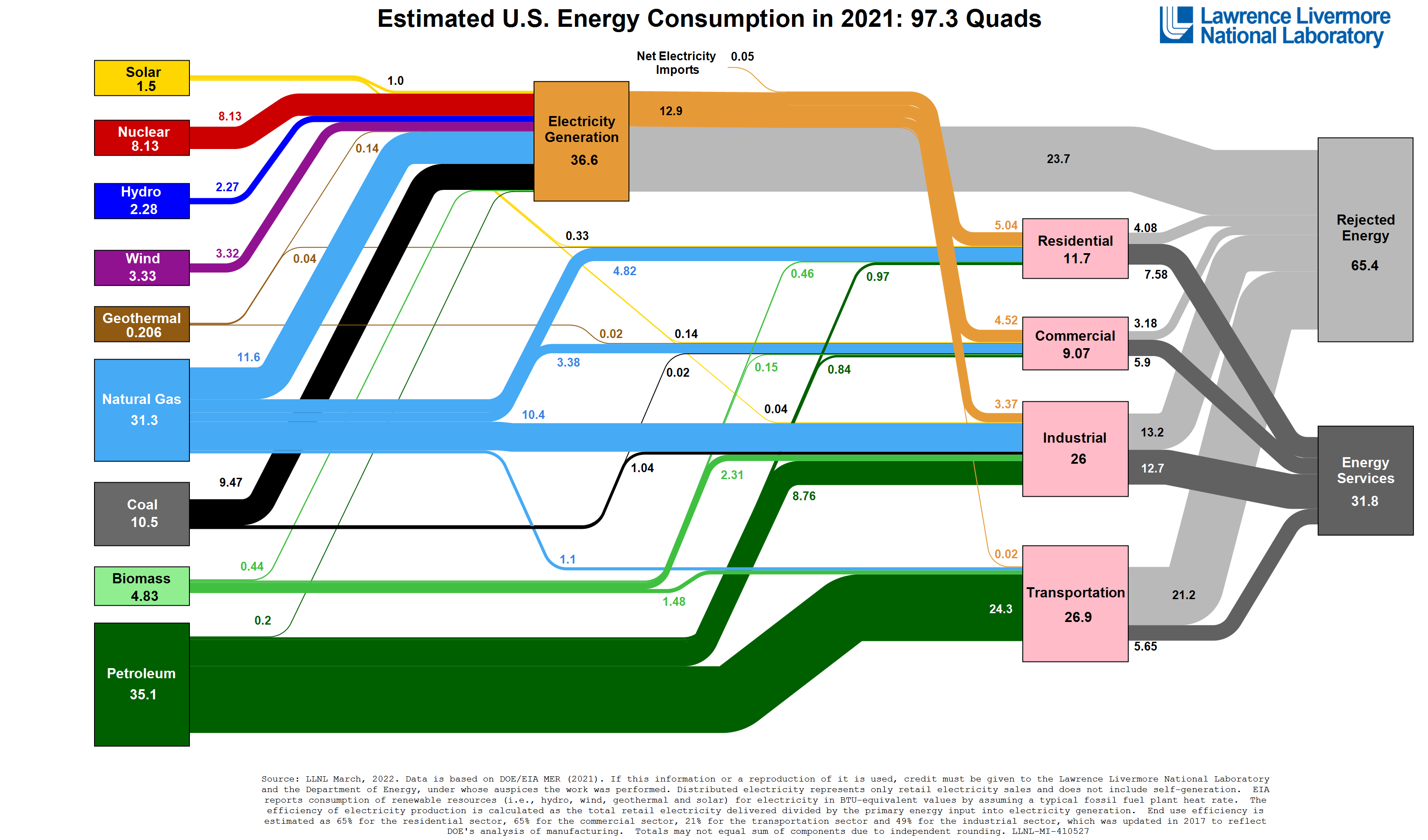
Note that due to conversion efficiency limits, most generally those of Carnot engines, achieved efficiency in converting thermal to mechanical energy trends around 30%. That can go higher in some applications (e.g., dual-cycle steam turbines combined with usage of residual thermal heat in cogeneration plants). But for the most part large-scale modeling relies on the 30% figure. See for example the Lawrence Livermore Labs energy-flow Sankey charts, in which ~30% efficiency simply assumed for the model, rather than explicitly measured, based on modeling:
End-use efficiency is estimated at 65% for the residential sector, 65% for the commercial sector, 21% for the transportation sector, and 49% for the industrial sector, which was updated in 2017 to reflect DOE's analysis of manufacturing.
It is the only practical solution. The only way to get humanity's energy equation to balance is to dramatically reduce the population or dramatically reduce energy use per capita or invent and deploy a mythical free energy source within the next 30 years. And this just covers replacing black energy with green energy -- even more energy will be needed to address the climate problem.
You underestimate the threat of eco-fascism. By that I don't mean green party politicians, no, I mean literal facists who blame climate change on overpopulation and who believe that the population has to be cut drastically. In the most basic form this would mean closing our borders and making sure nobody can cross illegally by using lethal force, if necessary.
Climate change is a result of overpopulation and overconsumption, though. It's right there in the name. The climate is changing as a result of anthropogenic activity. I fail to see how eco-fascism affects the outcome here, if we do not cut our population and consumption the planet will do it for us.
I'm not certain I do. I feel like we may be arguing the same side here? What I'm hinting at is that unless concrete results don't begin to materialize and that right soon the resulting climate driven geopolitical upheaval, and knock-on effects to global logistics, is quite likely to result in a significant downsizing of both global GDP and the world population. Perversely both of these obviously bad outcomes will very likely improve global carbon emissions. Here's a really shitty joke for you: How do you reduce your carbon footprint by 100% overnight? Shoot yourself in the head. How do you reduce your carbon footprint by 900% overnight? Go shoot your neighbors in the head. :/
pedantic "secrete" means to emit fluids or odor.. if you say so! ; "clandestine" means secret or secretive "especially if illegal" .. not illegal per se..
"so what" is up to you.. maybe it means nothing to you, "so what"
a public figure like Bill Gates who is trying to provide solutions (or whatever he is doing, I see some other posts pointing to other less noble agendas he might have) can't exactly come out and say "well, this will probably all not work, most of the observations point to collapse of most farming and mass die-offs due to heat / starvation within ten years", that would work against his goal of getting people motivated and interested in working / voting towards a solution.
From what I can tell, they'll all be riding it out in New Zealand, to minimize the climate effects they personally experience and keep themselves nice and far away from any political instability (or consequences...) It's the goldilocks-zone country for avoiding climate chaos, if you also need to minimize chances that the government will seize all your stuff (as less-liberal states might).
Why do you think these things are in tension? If the world has been on a decades-long trajectory careening towards disaster with little indication that we can coordinate to respond appropriately, someone _should_ be saying it all the time _because_ it's true.
- Influenced by human activity, both positively and negatively.
- Difficult to study, because we only have decades of hard data for what is a phenomenon spanning eons.
- A narrative pushed by Western economies to discourage economic development of the Global South and maintain hegemony. If the former were actually serious about mitigating it, it would harshly regulate planned obsolescence which causes astronomical amounts of waste and pollution. Instead, they browbeat poor countries for building durable infrastructure.
- Classic fear-mongering as a means of maintaining control ("follow me or everyone will die").
- An expression of aging "hippy" eschatology; we have one of the most individualistic generations in human history reaching old age and projecting its death onto the world as a coping mechanism.
- A polarizing topic that lures engagement.
I think blogs like this are a manifestation of the latter two or three.
As opposed to the narrative pushed by Western economies to encourage limited forms of economic development in the Global South, by facilitating the creation of captive markets and dependent client states? You know, the normal day-to-day economic orthodoxy the world's been running under for two hundred years?
Which one do you think is winning?
(Also, when you say the Global South, do you mean the Global South that tends to be exempt from, or subjected to less stringent carbon limitations than the developed world? Or do you mean the Global South that everyone starts complaining about as soon as I mention that maybe we should reduce our emissions...)
The sea surface temperature data is from NOAA and the sea ice extent data is from JAXA. His claims are not difficult to verify, if you follow the citations.
We should do both. Gates has outsized personal influence and resources, he's not some quirky hermit that publishes startling pamphlets but is otherwise separate from the world. It's rational to consider whether and where his personal interests coincide with his policy proposals.


Is this his schtick? Does he just say the world is ending all the time, or is what he's saying true?